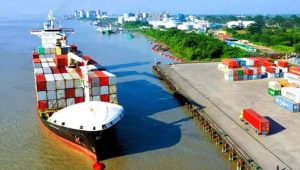
Chattogram Port is set to record a slower 6.4 per cent growth in export container handling in 2025, as slower ready-made garment (RMG) shipments weighed heavily on overall export performance.
Data from 21 private Inland Container Depots (ICDs) show that export container handling rose by 48,390 twenty-foot equivalent units (TEUs) in 2025 compared with the previous year.
According to the Bangladesh Inland Container Depot Association (BICDA), ICDs handled 750,559 TEUs of export goods in 2024, which is estimated to have increased to about 0.80 million TEUs in 2025, reflecting a 6.4 per cent rise.
The association estimated the monthly figure for the year’s last month by doubling export volumes recorded between December 1 and 15.
In terms of cargo volume, Chattogram Port handled about 7.96 million metric tons of export goods from January to November 2025, with November alone accounting for around 0.75 million metric tons. If the anticipated 0.7 million metric tons are shipped in December, total export volume for the year will reach approximately 8.66 million metric tons, marking growth of about 9 per cent by volume.
BGMEA Vice President Mohammad Rafique Chowdhury told TIMES of Bangladesh that the RMG sector normally grows by 15 per cent to over 20 per cent annually.

“If exports grow by just 6.4 per cent this year, the sector has effectively lost its regular 15 per cent growth,” he said.
Chattogram Port handles around 92 per cent of Bangladesh’s import-export trade and 98 per cent of container transportation. Of total exports, about 84 per cent are ready-made garments, with knitwear, woven apparel and home textiles together contributing more than 80 per cent of export earnings.
Other exported products include jute and jute-based goods, processed agricultural products such as vegetables, frozen food including shrimp and fish, handicrafts, footwear and plastic products.
Stakeholders said political developments following August 5, 2024, disrupted garment production and exports. Several factory owners left the country, resulting in permanent shutdowns of their facilities.




In 2025, at least 216 garment factories across Bangladesh closed due to political instability, labour unrest and other operational challenges.
Rafique Chowdhury also cited the 20 per cent tariff imposed by the Trump administration in August as a major factor affecting garment exports, adding that several high-value orders arriving toward the end of the year helped prevent a sharper decline.
Looking ahead, Chowdhury expressed concern about the early months of 2026 due to the upcoming national elections.
“Exports and export orders are likely to slow from January to March 2026. However, once a new government stabilises the country, we expect the ready-made garment sector to return to normal,” he added.
Before reaching Chattogram Port, export goods are transported from across the country to the 21 private ICDs, where containers are stuffed according to shipping schedules.
BICDA Secretary General Ruhul Amin Sikder said export growth is expected to edge up slightly by the end of the year.
“Even with a few days left in December, our daily average calculations show export handling rose by 6.4 per cent compared with 2024,” he said.
Despite slower export growth, overall trade flow through Chattogram Port, including imports and exports, is projected to grow by 9 per cent in 2025. Import container handling at ICDs rose by 14 per cent, while total container handling at the port is expected to increase by around 4 per cent.
In 2024, Chattogram Port handled about 3.28 million TEUs of containers and roughly 124 million metric tons of cargo, including imports, exports and empty containers. By the end of 2025, total cargo volume is projected to reach around 138 million metric tons, marking growth of roughly 9 per cent.
Major imports include cotton, diesel, stone, scrap ships, furnace oil, palm oil, cement clinker, wheat, crude oil, fertilisers, soybeans, hot-rolled steel and pulses.
Chattogram Port Authority Secretary Md Omar Faruk said automation has improved efficiency across operations.
“Automation of payments, collections and gate passes has increased work speed,” he said, adding that ship waiting time and vessel turnaround time have also improved.
Of the imported goods arriving at Chattogram Port, 65 categories are now delivered directly from ICDs. Import handling at ICDs rose by 14 per cent, with deliveries increasing from 0.27 million TEUs in 2024 to 0.31 million TEUs in 2025.
Depot owners said the expansion of depot-eligible import items by the National Board of Revenue eased congestion at the port. Currently, 20 to 25 per cent of imported goods are delivered through ICDs before reaching the port.
From January 1 to December 25, 2025, Chattogram Port handled about 3.35 million TEUs. An additional 0.05 million TEUs are expected by December 31, taking total annual handling to around 3.4 million TEUs, representing about 4 per cent growth.