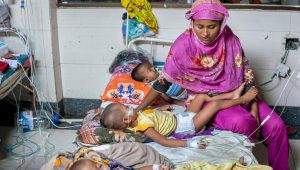
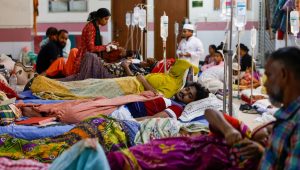
Mohammad Yusuf, a resident of Chhota Bighai Union in Patuakhali, is spending his days navigating a blur of hospital corridors, emergency departments, and crushing uncertainty over the past week.
His infant daughter, Humaira, initially fell ill with a fever that rapidly took a turn for the worse. Even after she was admitted to a local hospital, doctors struggled to pinpoint the issue.
“She had a fever first,” Yusuf told TIMES of Bangladesh. “Later, the fever seemed concentrated in her head. We got her admitted to Patuakhali Hospital, but they couldn’t determine whether it was measles or pneumonia.”
Yusuf’s ordeal reflects a grim, nationwide pattern. The stories of families bringing sick children to Dhaka from different parts of Bangladesh are strikingly similar. Local healthcare facilities are vastly unequipped, leaving provincial doctors with little choice but to refer critical paediatric cases to the capital.
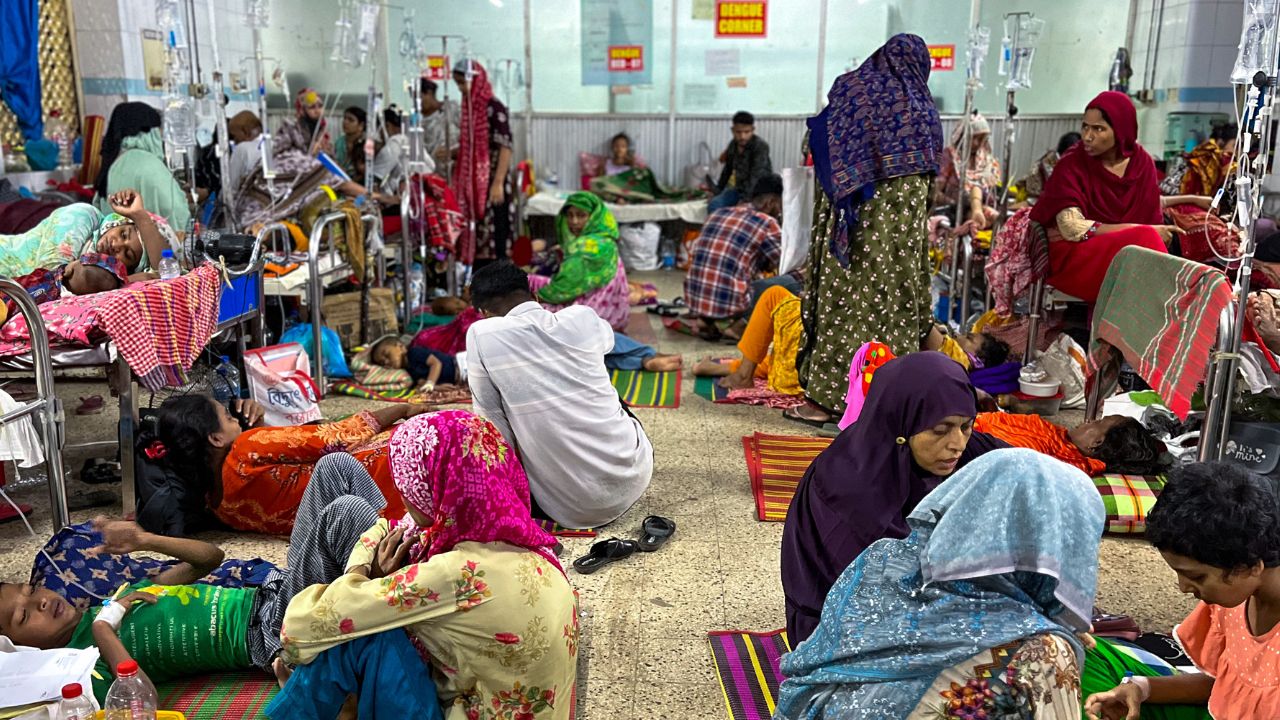
Finding a hospital bed in Dhaka is another battle, forcing desperate parents to race from one overcrowded facility to another.
The outbreak is hitting low-income families the hardest. Many have been forced to leave their jobs and plunge into deep debt just to cover the costs of staying with their children in the capital.
The scale of the rural-to-urban influx is stark. Out of 34 patients at Dhaka’s Infectious Diseases Hospital and the DNCC Hospital on Sunday, only two were Dhaka residents.
According to patients and their relatives, many upazila and district-level facilities completely lack dedicated treatment units for measles.
Where units do exist, they are easily overwhelmed by the patient load.
Consequently, the disease is often detected too late, and patients are only sent to Dhaka once their conditions have severely deteriorated.

Medical professionals note that this bottleneck is worsened by a general tendency among families to seek hospital care only after symptoms become severe.
Public health expert Dr Md Mushtuq Husain told TIMES, “The weak infrastructure of our primary healthcare system is driving this massive influx of patients to Dhaka. This pressure will only intensify, if we do not urgently secure adequate manpower, beds, oxygen support, and paediatric emergency services at the upazila and district levels.”
In response to the crisis, the Directorate General of Health Services (DGHS) held a meeting last week with the directors and paediatric heads of government medical college hospitals to discuss patient referrals and training. While critical instructions were reportedly issued, visible progress on the ground remains scarce.
Moinul Ahsan, Director (Hospital and Clinic) at the DGHS, was contacted for comment but he did not respond.
Bounced among hospitals, Yusuf’s exhaustion deepens
After an agonising four-day stay at Patuakhali Hospital, Yusuf set off for Dhaka with his infant daughter in his arms. But the gruelling journey brought no relief.
When he arrived at the Dhaka Shishu Hospital, he was told there were no vacant beds. That sparked a relentless, exhausting cycle of being turned away from one facility after another. From the Shishu Hospital, he was redirected to Shaheed Suhrawardy Medical College Hospital.
“I went to Suhrawardy, but they said they had no oxygen,” Yusuf recalled. “They told us flat out that if something happened to her without oxygen, they wouldn’t take responsibility.”



In total, the desperate father had to visit at least five different hospitals across the capital.
Shunted from reception counters to upper floors, he and his wife spent the entire night running through city streets with their sick child.
“One counter told me to go to another floor. Another told me to go somewhere else. By then, it was already midnight,” he said.
As the hours ticked away, their anxiety spiked. The ailing infant could no longer even nurse properly.
“By 2:00am, my little girl couldn’t even take breast milk,” Yusuf said, his voice heavy. “You can understand how much that breaks a parent’s heart.”
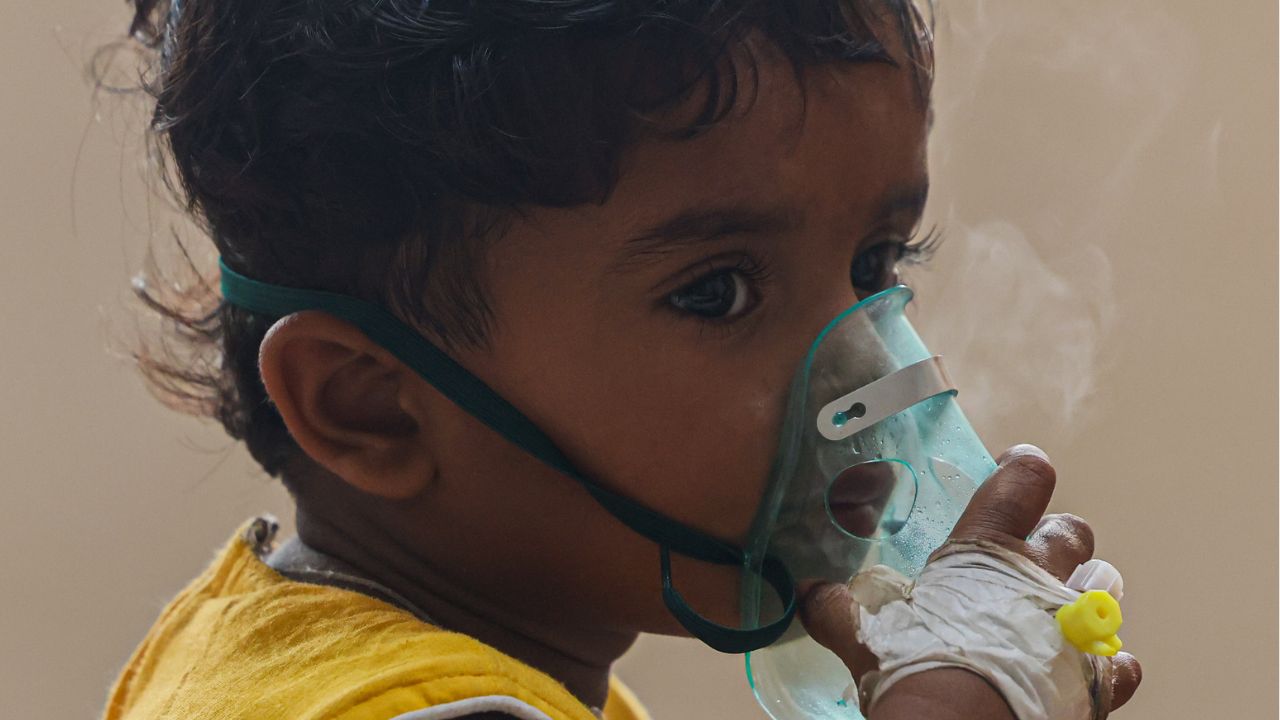
Humaira is now finally admitted to the capital’s Infectious Diseases Hospital, where she has been undergoing treatment for the past eight days, following her four-day stint in Patuakhali. Yet, as Yusuf sits beside his daughter’s hospital bed, the toll of the ordeal is etched deeply into his face.
Because Humaira is less than a year old, she has not yet reached the eligible age to receive the measles vaccine. Meanwhile, her illness has already cost the family between Tk10,000 and Tk12,000.
For Yusuf, who earns a living as a ride-sharing motorcyclist, scraping that sum together was a monumental challenge.
“I didn’t have that kind of money,” he said. “I had to swallow my pride and ask relatives for help. Thankfully, people step up when you’re in trouble.”
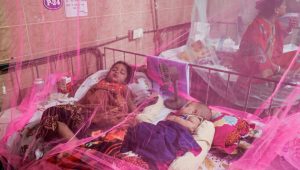
Yusuf iterated that he was only forced to head for Dhaka because Patuakhali lacks basic medical facilities for children. Describing the bleak conditions of his local hospital, he noted that wards are so overcrowded that two to three children are crammed onto a single bed.
“There isn’t even enough room to sit and feed your child,” Yusuf said. “If there was proper healthcare in Patuakhali, we would never have had to come to Dhaka, and we wouldn’t be drowning in these expenses.”
Struggling to fund treatment amid mounting debt
Mizanur Rahman, a father from Bhola, shares a similarly harrowing experience.
He is currently staying at the Dhaka North City Corporation (DNCC) Hospital with his six-month-old daughter, Amina.
According to Mizanur, the illness began when small spots erupted across the infant’s body, followed by a spiking fever. Recognising the rash, the family realised it was measles. When they rushed her to a local clinic in Bhola, doctors urgently advised them to head to the capital because the child had developed both measles and pneumonia.
“The doctor told us, ‘There is a severe complication, take her to Dhaka immediately. If the fever spikes further, it will be too late,’ so we didn’t delay any longer,” Mizanur recalled.
Since arriving in Dhaka, Mizanur’s income has completely dried up. He has already spent around Tk 23,000 on medical expenses – a fortune he could only raise by begging for financial help from his colleagues and workplace contractors.
“It is incredibly difficult for me,” Mizanur said. “That is a massive amount of money. For people like us, just coming to Dhaka brings immense tension. We are constantly gripped by the fear of where we will get the money and what we will do next.”
Because Amina is only six months old, she is still too young to have received her routine measles vaccination.
A few beds away, Abdullah Al Fazal Razi from Jashore is fighting the exact same battle. His daughter was also diagnosed with a simultaneous case of measles and pneumonia. When he first rushed her to the Jashore Children’s Hospital, her oxygen levels were dangerously plummeting, yet local doctors could do little more than refer her to Dhaka.
Arriving in the capital, Fazal found himself in a state of sheer panic and confusion. “There wasn’t a single vacant bed to admit her at Dhaka Medical College Hospital,” he said.
Eventually, he managed to secure a spot at the Infectious Diseases Hospital. Though his daughter is finally receiving care, the 10 to 11 days of hospitalisation have already cost him between Tk27,000 and Tk28,000.
Like Mizanur, Fazal’s income has entirely stopped, forcing him to rely heavily on borrowed money just to keep his daughter alive.
Razi firmly believes that if better paediatric facilities existed at the district level, his family would have been spared the trauma and financial ruin of migrating to Dhaka.
Death toll mounts as outbreak intensifies
As families scramble to secure medical care, the nationwide death toll from the measles outbreak continues to climb.
According to the DGHS, six more children died from measles and measles-related symptoms in the 24-hour period between 8:00am Saturday and 8:00am Sunday.
These latest fatalities bring the total number of deaths since mid-March to 459.
Of those casualties, 200 occurred in Dhaka. While the local transmission rate within the capital itself remains relatively controlled, the disproportionately high death toll in Dhaka is driven by a massive influx of critical, undocumented cases referred from rural districts across the country.
The strain on the medical system remains severe. Within the same 24-hour window, 1,064 new patients were admitted to hospitals nationwide, driving the total number of hospitalisations since 15 March up to 42,092.