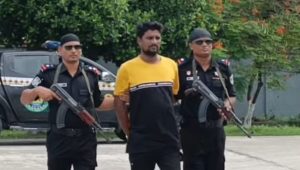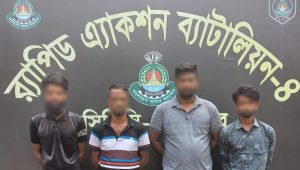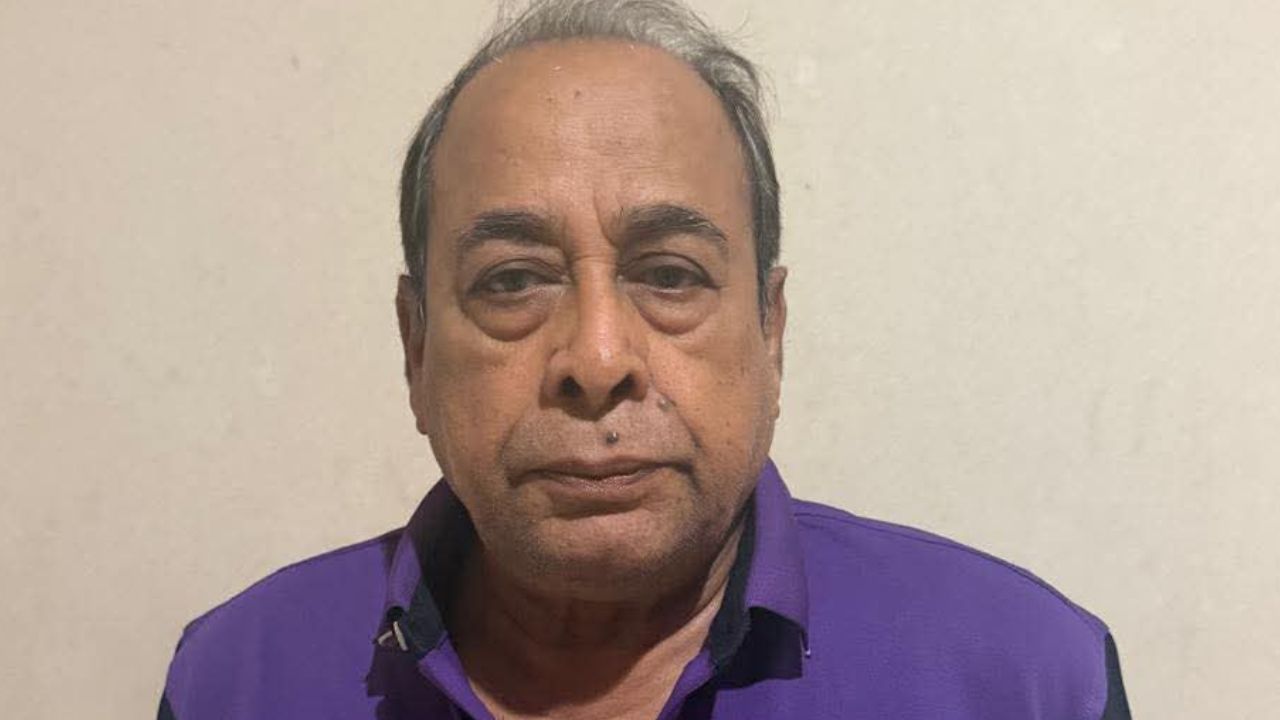

In a dramatic twist to a 45-year-old cold case, a former army major has been detained in Dhaka, with security forces later confirming that he was arrested in connection with the 1981 assassination of former president and BNP founder Ziaur Rahman.
Acted on a crucial tip-off from an intelligence agency, officers from the Detective Branch (DB) of the Dhaka Metropolitan Police launched a midnight raid on Wednesday, arresting Mozzaffar Hossain at a house in the upscale Banani DOHS.
The Inter-Services Public Relations (ISPR) has confirmed that the long-lost fugitive will now face trial under military law.
Mozzaffar was serving as a major in the Bangladesh Army when military-ruler-turned president, Ziaur Rahman, was assassinated during a bloody military coup in Chattogram in May 1981.
How he managed to evade justice for nearly half a century remains shrouded in mystery, as official details about his decades on the run have not yet been released.
However, a senior investigator revealed that intelligence suggests Mozzaffar hid out in India between 1997 and 1998, before allegedly slipping across various international borders using a string of aliases.
It also remains unclear whether the former major had only recently slipped back into Bangladesh or if he had been hiding in plain sight in the capital for some time.

Dhaka Metropolitan Police Detective Branch chief Shafiqul Islam confirmed that legal procedures are underway to hand Mozzaffar over to the army.
Reinforcing the gravity of the arrest, ISPR Director Lieutenant Colonel Sami-Ud-Dowla Chowdhury said that because the suspect had been absconding for such a significant period, he would be dealt with strictly under the military justice system.
What happened after Zia’s assassination
In the early hours of 30 May 1981, President Ziaur Rahman was assassinated during a military coup at the Chattogram Circuit House. He had originally taken the reins as Chief Martial Law Administrator on 29 November 1976 before assuming the presidency on 21 April 1977. Later seeking a democratic mandate, Zia organised a presidential election and was officially elected to office on 3 June 1978.
Yet, despite the initial bloodshed, the rebellion was doomed to fail.
Based on newspaper reports from the time, BBC Bangla has published a detailed account of the events following Zia’s assassination.



By the following morning, radio broadcasts carried the voice of Major General Muhammad Abul Manzur, then General Officer Commanding of the 24th Infantry Division at Chattogram Cantonment, announcing that a mysterious “Revolutionary Council” had taken charge.
In Dhaka, the response was swift and uncompromising.
Vice-President Justice Abdus Sattar immediately stepped forward as acting president, declared a state of emergency, and ordered decisive action against the mutineers.
Meanwhile, a tense curfew gripped Chattogram as rebel forces seized control of the streets. With road and air links abruptly severed, the port city was plunged into complete isolation, and the rebels secretly buried Zia’s body without informing his family, according to newspaper reports published at that time.
Backed by acting President Sattar, Army Chief Lieutenant General HM Ershad issued a stern ultimatum: surrender by noon on 31 May or face the consequences, offering a general amnesty for those who laid down their arms.
Though a defiant Manzur took to the airwaves to declare Ershad’s dismissal, the rebels’ resolve quickly unravelled as internal divisions surfaced and officers began abandoning the mutiny.
By nightfall, the coup was in terminal collapse.
Manzur and several top mutineers fled the cantonment into the surrounding wilderness under the cover of darkness.
The flight was short-lived and bloody. Key mutineers Lieutenant Colonel Matiur Rahman and Lieutenant Colonel Mehboob were shot dead by government loyalists while on the run. With a Tk5 lakh bounty slapped on his head, Manzur took refuge in a tea garden worker’s hut, where he ultimately surrendered to local police.
Arrested by Mostafa Golam Quddus, the officer-in-charge of Hathazari Police Station, he was taken into custody before being transferred to Chattogram Cantonment. It was there that Manzur was allegedly murdered.
Government accounts from contemporary newspapers offered a vastly different story, claiming that a group of armed men attacked the military convoy in an attempt to spring him. In the shootout that followed, Manzur was reportedly wounded and died on the way to the hospital.
Following the crisis, acting President Abdus Sattar went on to win the presidential elections. Yet his victory was short-lived. Just ten months later, his government was overthrown in a bloodless coup, paving the way for Army Chief General Ershad to seize absolute power.
Trial of mutiny
In the bloody aftermath of the assassination, 18 men were hauled before a military tribunal.
Crucially, the suspects were prosecuted on charges of mutiny rather than President Zia’s murder, resulting in swift death sentences for 13 officers.
Yet, even as the gallows beckoned, one question echoed through the barracks: “Where is Mozzaffar?”
A retired senior officer who witnessed the trial recalled the persistent whispers surrounding the missing major, who had transitioned into the regular military when his former paramilitary unit, the Jatiya Rakkhi Bahini, was absorbed.
According to Major General (Retd) Fazle Elahi Akbar, chairman of Foundation for Strategic and Development Studies, the captured fugitive, Mozzaffar, was directly involved in the assassination.
Speaking to TIMES of Bangladesh, Akbar, then security adviser to late BNP Chairperson Khaleda Zia, revealed that Mozzaffar initially fled to India before slipping into Thailand to escape the post-coup dragnet, leaving investigators entirely in the dark about when or how he finally sneaked back into the country.
“He may have thought that after so many years, everyone had forgotten everything,” Akbar added.