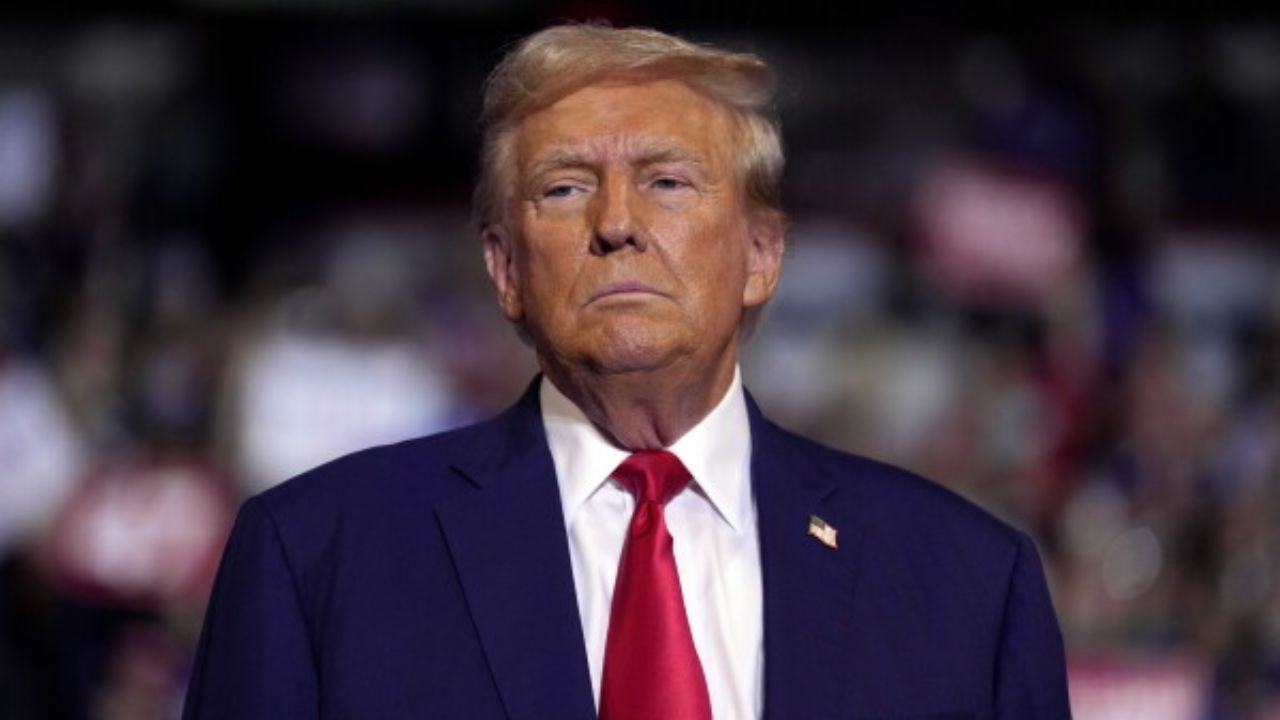



US President Donald Trump has announced a sweeping campaign aimed at completely isolating Iran. He declared it as the “most crushing economic operation” against Middle Eastern nation as peace negotiations to end five-month war remain deadlocked.
Trump on Wednesday wrote on social media platform Truth Social that Tehran had “failed to take” the opportunity to negotiate a peace deal.
He warned that the country would now face “economic warfare and isolation on an unprecedented scale”. The US president threatened severe penalties against any nation continuing commercial ties with Tehran.
“ANY country that allows its financial institutions, businesses, airports, or government entities to provide any type of lifeline to Iran will itself face TREMENDOUS Economic Consequences,” Trump wrote, reports Al Jazeera.
He demanded an immediate halt to activities including oil smuggling, exchange houses, front companies, swap lines, cash transfers, and ship registries, adding “This will be an ECONOMIC D-DAY, and we need all of our Allies to stand with United States of America to isolate, and defeat, the Iran threat”.
Tehran dismisses threats as a ‘diversion’
Iran’s Foreign Minister Abbas Araghchi quickly rejected the warnings, describing them as a “diversion from America’s own crisis, unprecedented debt & surging interest costs”.
Writing on the platform X, Araghchi added that “doubling down on failed policies will only bring further defeat – and enmity of Iranians,” warning that “US economic terrorism threatens global economy and sovereignty worldwide”.
State media in Tehran similarly downplayed the threats. The state-run IRIB broadcaster asserted that US president’s statements followed “the failure of military aggression,” while the semi-official Tasnim news agency commented that the announcement was “not a new development”.
Tasnim added that US had spent years trying to sever Iran’s economic ties, but that Tehran had “learned how to circumvent these restrictions and has become very skilled at doing so.”
Iran’s Deputy Foreign Minister for Legal and International Affairs Kazem Gharibabadi also commented on X, writing that Washington is “forced to create a bigger defeat for themselves each time to cover it up.” He stated, “The military war did not work, so now they have called the next failure ‘economic war’.”
US blockade chokes vital crude exports
Iran is a member of OPEC oil producers’ group, and crude oil remains its primary source of revenue. Prior to the outbreak of the war, Tehran exported roughly 1.3 million to 1.5 million barrels of crude oil per day (bpd). In early February, this trade generated approximately $115 million daily – amounting to roughly $3.45 billion per month.

However, a continuous US naval blockade targeting Iranian ports has severely choked this critical income stream, causing crude exports to plummet to their lowest level in at least six years, dropping below 300,000 bpd in May.
The squeeze intensifies as the June Memorandum of Understanding (MoU) expired on 21 August. Under the MoU, US had granted Iran a temporary 60-day full waiver to sell crude oil during peace negotiations.
Trump had also granted temporary waivers for oil cargoes already at sea to alleviate the energy crisis triggered by the closure of the Strait of Hormuz. On Tuesday, US Department of the Treasury announced the formal reimposition of sanctions on Iranian oil.
Iran’s Central Bank Governor Abdolnaser Hemmati acknowledged on Wednesday that oil exports had declined due to the conflict and sanctions but maintained that Iranian authorities had prepared for these losses.
Non-oil trade declines amid conflict
According to Iranian Customs Administration figures reported by domestic media, Iran’s non-oil exports stood at nearly $15 billion between the start of the Iranian fiscal year on 21 March and 16 August, while imports reached $17 billion.
This represents a 24 per cent decline in trade compared to the same period in the previous year. Between March 2025 and January 2026, Iran’s total non-oil trade was valued at $94 billion. Historically, Iran’s primary trading partners have included the UAE, China, India, Turkiye, and Germany.
However, the economic landscape was altered on Wednesday when United Arab Emirates (UAE) announced an indefinite trade embargo on Iran. Abu Dhabi accused Iranian forces of firing two ballistic missiles at UAE territory earlier in the week, an accusation that Tehran has denied.




Collapse of UAE trade lifeline
The Emirati embargo represents a major setback for Tehran. In 2023, official trade between the UAE and Iran was valued at $6.2 billion, according to data from the Observatory of Economic Complexity (OEC).
UAE exports to Iran totalled roughly $5.8 billion, while Iranian exports to the UAE stood at about $450 million. Key imports from UAE in 2023 included $2.81 billion worth of telephones, alongside computers, tobacco, and nuts. In return, Iran exported nuts, fruits, spices, crustaceans, and building stone.
Beyond official trade, UAE has historically served as a critical informal hub enabling Iran to bypass global sanctions. Analysts note that the embargo will heavily disrupt Iran’s access to financial markets and critical imports.
Frederic Schneider, a nonresident senior fellow at Middle East Council on Global Affairs, pointed out that while UAE embargo is significant, much of the bilateral trade had already collapsed due to the closure of Strait of Hormuz, making physical cargo flows less relevant, whilst financial flows remain difficult to monitor.
Meanwhile, Iran has sought to secure alternative trade channels, finalising an agreement on Saturday to export oil to Tajikistan.
How key global partners respond to US sanctions
The effectiveness of unilateral US sanctions remains a subject of intense debate among experts, who point to Iran’s persistent trade links with other global powers –
China: Believed to be Iran’s largest trading partner, bilateral trade is estimated to be between $10 billion and $41 billion annually, though Western sanctions prevent these figures from appearing in official Chinese data. In 2025, Beijing reportedly bought more than 80 per cent of Iran’s shipped oil, largely through “shadow fleets” that evade US sanctions by disabling transponders and flying false flags.
In May, China invoked its blocking law for the first time, barring domestic firms from complying with US sanctions.
Russia: Economic ties have deepened since US unilaterally withdrew from the 2015 nuclear agreement in 2018 and reimposed comprehensive sanctions. Russian Energy Minister Sergey Tsivilyov reported that bilateral trade turnover reached $4.8 billion in 2024, a 16 per cent increase since 2018.
Russia exports grain, metals, machinery, and industrial products, while importing agricultural goods, food, petrochemicals, and military equipment, including low-cost Shahed drones. Analysts suggest Tehran may increasingly bypass the Gulf blockade by utilising railways, Caspian Sea ports, and sanctions-era trade networks connected to Russia.
Turkiye: Turkish exports to Iran were $2.3 billion in 2025, while imports from Iran stood at $2.2 billion for 11 months of that year, though trade has fell since the war began.
Turkiye has maintained since 2018 that it will not participate in unilateral US sanctions. On 15 August, Turkish President Recep Tayyip Erdogan stated that reopening the Strait of Hormuz is a priority for Ankara.
India: Bilateral trade was approximately $1.6 billion in 2025. India exports basmati rice, fruits, vegetables, and pharmaceutical products, while importing dry fruits, nuts, organic chemicals, minerals, and petrochemicals.
Although New Delhi stopped importing Iranian oil in 2019 under US pressure, Indian media reports suggest Trump’s latest warnings may prompt India to scale back trade even further.
Germany: Germany remains Iran’s top trading partner within the European Union. During the first 11 months of 2025, Iranian exports to Germany rose by 1.7 per cent to €217 million ($253.6 million), while German exports to Iran fell by 25 per cent to €871 million ($1.02 billion).
Overall EU-Iran trade has declined this year following new sanctions imposed in January over human rights violations and Iranian support for Russia’s war in Ukraine.
Iraq: Before the conflict erupted in late February, Iran exported $12 billion worth of goods and services annually to Iraq, including $4 billion in gas and electricity directly to the Iraqi government.
Iraq has promised to settle its outstanding debts to Tehran, but the country faces financial pressure due to the closure of the Strait of Hormuz and disrupted oil revenues.
Legal obstacles and risks of escalation
Experts have raised questions regarding Trump’s ability to enforce a global embargo unilaterally.
Shantanu Singh, an international trade and public law attorney, explained that no individual country has the legal authority to impose a total embargo on trade with another sovereign nation without UN Security Council authorisation.
“What the US President is authorised to do under US law and has done in the past is to impose unilateral sanctions that disable the use of US financial institutions for international trade with Iran,” Singh noted.
Paul Musgrave, an associate professor of government at Georgetown University in Qatar, agreed that enforcing unilateral “economic consequences” is highly difficult without multilateral backing from the permanent members of the UN Security Council (P5), such as Russia and China.
Frederic Schneider added that while Washington has applied maximum pressure through 14 sanctions packages and threatened a 25 per cent tariff on nations trading with Iran, these measures “cannot end” trade, but merely raise its cost.
Reporting from Washington, Al Jazeera’s Mike Hanna suggested that Trump’s announcement reflects frustration over the five-month deadlock.
Hanna noted that whilst Iranian officials might view the statements as empty threats, Trump’s real target audience could be an American public that remains opposed to the conflict.
However, the risk of a wider confrontation remains high. Ali Vaez, deputy programme director for Middle East and North Africa at the International Crisis Group, warned that if the economic blockade severely worsens Iran’s internal situation, Tehran might use force to break the naval cordon.
“Trump believes that economic warfare is an alternative to war. It’s a prelude to it,” Vaez warned.
Hassan Barari, a professor of international relations at University of Jordan, added that the impact of US move on the Iranian public cannot be underestimated, nor can “the Iranians’ desire to at least emerge strategically on equal footing with United States”.
In response to the mounting pressure, Tehran is seeking to strengthen its ties with BRICS alliance. Governor Hemmati announced last week that Iran is preparing to join BRICS New Development Bank to access international finance.
The BRICS group, which includes Brazil, Russia, India, China, South Africa, Iran, Egypt, Ethiopia, Saudi Arabia, the UAE, and Indonesia, has so far failed to issue a joint statement on the US-Iran war due to internal divisions among its member states.