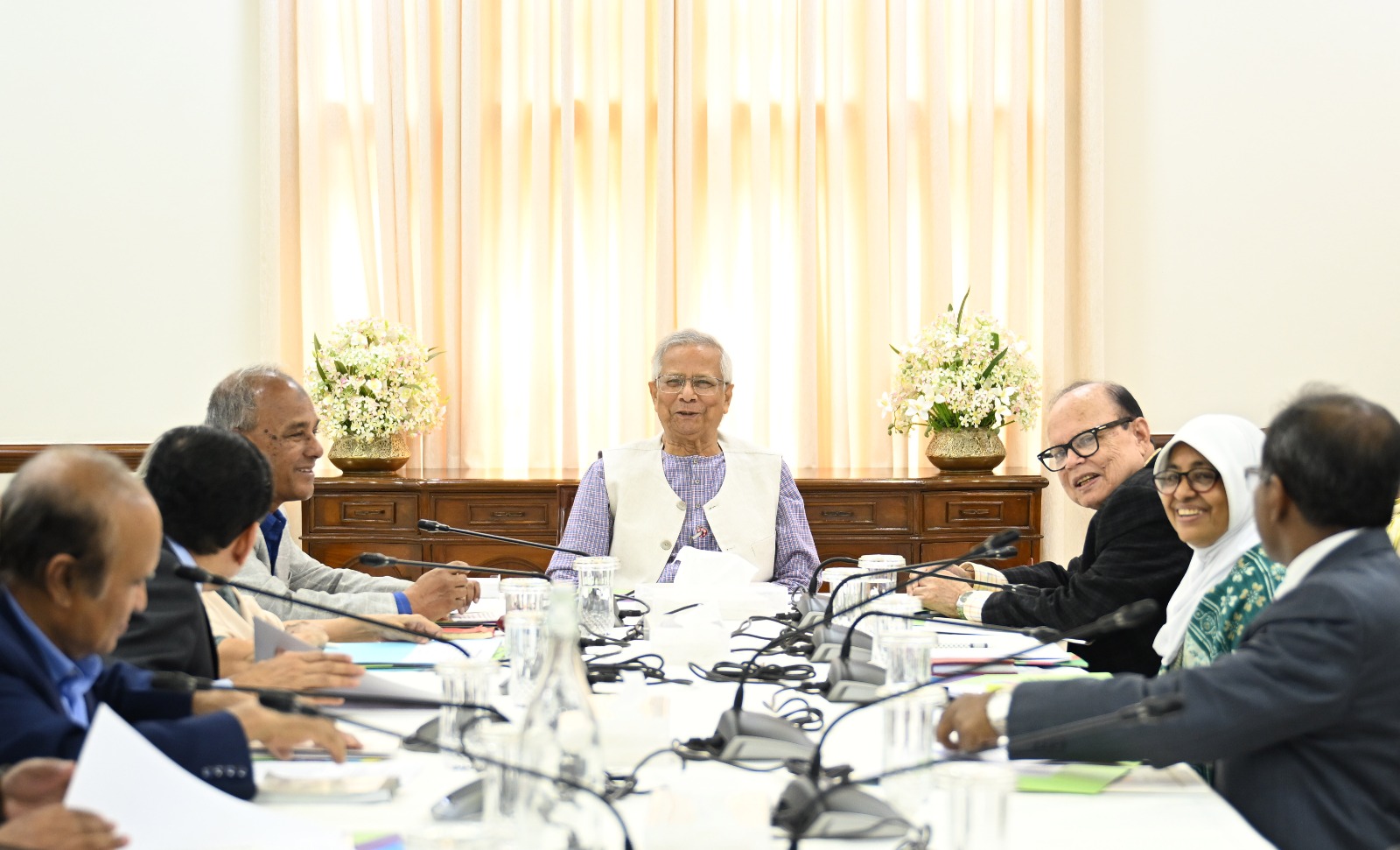

A meeting was held under the chairmanship of Chief Adviser Muhammad Yunus to discuss taking action to address the risks to public health in light of the presence of various harmful chemical substances in food and to prevent food adulteration, according to the Chief Adviser’s Press Wing.
The meeting was held at the state guesthouse Jamuna this Sunday afternoon. Present were Agriculture and Home Affairs Adviser Jahangir Alam Chowdhury, Food Adviser Ali Imam Majumdar, Health Adviser Nurjahan Begum, Fisheries and Livestock Adviser Farida Akhter, National Security Adviser Khalilur Rahman, Special Assistant to the Chief Adviser Syedur Rahman, Principal Secretary to the Chief Adviser Siraj Uddin Mia, secretaries of the concerned ministries, Bangladesh Standards and Testing Institution (BSTI) Director General SM Ferdous Alam, Director General of the National Consumer Rights Protection Directorate Faruq Ahmed, Chairman of the Bangladesh Food Safety Authority (BFSA) Zakaria, and Chairman of the Atomic Energy Commission Md Majibur Rahman.
The meeting discussed in detail foodborne diseases, risks related to contamination, and necessary steps to tackle this crisis.
The chief adviser said, “We know about the existence of various contaminations in food; we must take measures on how to address it. Our children, parents, and loved ones are all victims of this. For our own interests, we all must work together to tackle this crisis. We will discuss the implementation aspects and decide which ones need to be started immediately. We will take urgent initiatives on this matter promptly.”
The chief adviser instructed all concerned to submit written proposals within the next week regarding necessary measures to be implemented to tackle the food contamination crisis.

During the meeting, the Bangladesh Food Safety Authority presented some information and data. They informed that according to World Health Organization research, 1 in 10 children falls ill at least once a year due to foodborne diseases annually. One-third of children affected by foodborne diseases die. Every year, 600 million children worldwide and 30 million children in Bangladesh are affected by foodborne diseases.
The Food Safety Authority informed that four types of contaminants can be present in food. Heavy metals, residues of pesticides and biocides, radioactivity, and biological contaminants. In the last fiscal year, 1713 samples and so far this year 814 samples have been tested. Excessive levels of lead/lead chromate were found in these. Lead was detected in 22 out of a total of 180 samples.
A joint study by Sher-e-Bangla Agricultural University, Agricultural University, and Umeå University, Sweden collected 87 water samples and 23 fish samples from various regions of the country and detected 300 types of drugs, 200 types of pesticides, and 16 types of PFAS.
A UNICEF survey revealed that 35 million children in Bangladesh are affected by lead contamination. Presenting this information, BFSA Chairman Zakaria said, “Lead entering the human body accumulates in the brain, liver, kidneys, bones, and teeth. As children’s bones are soft, lead goes directly to the brain. Consequently, the mental development of children is hindered.”


Furthermore, he informed that research has found lead contamination in 5 per cent of pregnant women as well. He said a 10-year action plan has been made under the planning of the Ministry of Environment to reduce lead contamination.
The meeting discussed what measures have been taken and what further measures can be taken to bring poultry farms under supervision and to prevent the use of illegal pesticides in agriculture.
The food adviser said, sometimes, while ensuring sufficient food, the aspect of whether what we are consuming is safe or not is being neglected. The media can play a role in creating public awareness on this issue.
Daughters of Azerbaijan president meet CA
Leyla Aliyeva and Arzu Aliyeva, daughters of Azerbaijan President Ilham Aliyev, called on Chief Adviser Muhammad Yunus on Sunday at state guesthouse Jamuna.
During the meeting, they discussed ways to deepen cultural, environmental, and people-to-people exchanges between the two friendly nations.

Yunus recalled his many visits to Baku and his meeting with President Aliyev during the COP29 summit late last year. He emphasised the need for stronger trade, energy, and economic ties between Bangladesh and Azerbaijan.
Leyla Aliyeva, Vice President of the Heydar Aliyev Foundation and founder and head of IDEA Public Union, conveyed President Aliyev’s warmest greetings to the chief adviser. She called for enhanced environmental cooperation, particularly in wildlife protection.
This marked the first visit to Bangladesh by the daughters of the Azerbaijani President.
The sisters also stated that the Heydar Aliyev Foundation and the IDEA Public Union are eager to implement joint humanitarian, social, youth, volunteer, environmental, and nature-protection projects in collaboration with relevant Bangladeshi organisations.
Elchin Huseynli, the non-resident ambassador of Azerbaijan to Bangladesh, informed the meeting that efforts are underway to open an Azerbaijani embassy in Dhaka after the upcoming election.
The move follows the chief adviser’s request to President Aliyev last November, noting that an embassy in Dhaka would elevate bilateral relations to new heights.
Lamiya Morshed, SDG Coordinator and Senior Secretary, was also present at the meeting.