The low-lying paddy fields once shimmered under monsoon skies in the villages of Aminbazar on the far edge of Dhaka’s sprawl. Today, they tell a different story. What was once fertile land has turned into one of the capital’s starkest environmental disasters, the landfill site. Here, waste flows unchecked, and hundreds of lives quietly bend under the weight of it.
Each day, more than 3,500 tonnes of unsegregated garbage arrive under the banner of the Dhaka North City Corporation (DNCC). Half of it is kitchen waste, plastics, paper, metal, etc. The site, designed for 55 acres decades ago, now overflows, rising up to 80 feet in parts and stretching the margin of safety to its breaking point.
For the waste-pickers, there is no “future plan,” only present trauma. If the waste-pickers don’t pick through these wastes to find a few scraps, they will starve. They don’t really care about the smelly, poisonous air that might ruin their health.

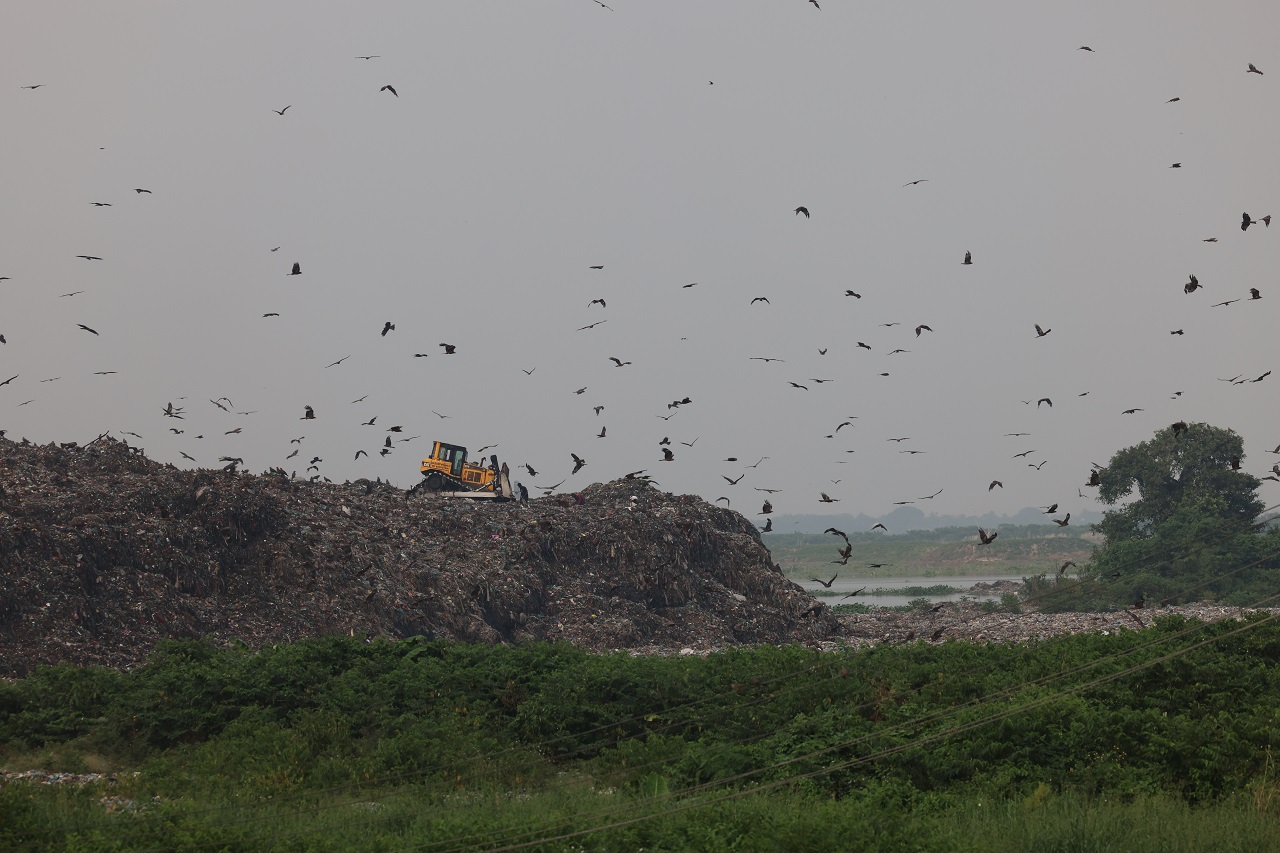
But for the locals, the smell is constant. The waste piles often catch fire by themselves. Methane trapped underground ignites, or the heaps just get too hot and start to burn slowly. The resulting black smoke drifts into homes. A recent study estimates the landfill emits an average of 40 gigagrams of methane annually, making it one of Dhaka’s key hotspots for greenhouse gases.
But the threat is quieter and more insidious beneath the fields. Rainwater washes through the rubbish, creating leachate that seeps down. In the surrounding farmland, scientists found chromium as high as 108.5 mg/kg in soil samples, well above safe limits. Irrigation water, tube-wells and crops are now laced with heavy metals: lead, cadmium, arsenic.




Then there are the effects of “slow poisoning.” Those don’t show up immediately; the generation growing up here may carry the scars. And the land that once drained floodwater, supported wetlands and rice harvests is lost. In its place, waste piles grow, wetlands shrink and natural drainage fails, leaving the area more vulnerable to flooding.
People closer to the area now scavenge for odd jobs, many in brick-kilns, their children playing among the refuse while coughing from the dust and smoke. Officially, the landfill’s environmental clearance expired in 2017. Yet dumping continues, unabated.

The DNCC says the lack of alternative land and resources has forced them to keep using the site. Meanwhile, a new waste-to-energy plant is slated for completion by 2026 next to Aminbazar, but for those living among the waste now, relief doesn’t yet feel inevitable.
The story of Aminbazar is not one of statistics alone, though they are sobering. It is the story of people whose lives, crafts and dreams have been buried beneath the city’s discarded meals. They ask: Who will clean up the mess that isn’t theirs? When will the stench stop? And can they dream of harvests again?