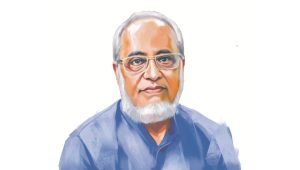
Manzoor Ahmed, professor emeritus at BRAC University, who headed the advisory committee on education quality during the previous interim government, does not expect the BNP government to fulfil its election promise of allocating 5 per cent of GDP to education this fiscal year.
However, he believes the government can still demonstrate its commitment by significantly increasing the budget.
In an interview with Aleem Haider of TIMES of Bangladesh, just days ahead of the new government’s first budget, to be rolled out on 11 June, the educationist noted that educational inequality persists across all levels, beginning at the primary stage, and urged the government to introduce targeted budget measures to address it.
What should be the primary focus for the education sector in the upcoming budget?
Broadly speaking, it is unrealistic to expect a massive, immediate increase in the education budget. Allocating 5 per cent of GDP to education is a political pledge that cannot be easily fulfilled overnight; however, if the government acts in good faith, it could be achieved in the future.
For now, the priority should be to signal a reversal of the long-standing downward trend in education spending.

While funding has steadily declined to just 1.5 per cent of GDP, we might see a modest increase to around 2 per cent this time, which would at least send the right message.
What measures are needed to improve teacher skills?
A vast majority of the education budget, around 80 per cent, is already consumed by teachers’ salaries. Naturally, introducing a new pay scale will increase financial pressures further.
While we absolutely support higher pay for teachers, it must come with the expectation that they deliver in the classroom. This means teachers must be properly supervised regarding their teaching methods and held thoroughly accountable for their performance.




What budget initiatives are required to tackle educational inequality?
Educational inequality is a pressing issue, compounded by the booming private tuition and coaching centre industry. These services are highly expensive, creating a stark divide: families who can afford them ensure their children are thoroughly prepared for exams, while those who cannot are left lagging behind.
To address this, we must couple teacher salary increases with school-based plans to elevate teaching standards across the board.
Furthermore, schools could introduce low-cost, supplementary coaching classes on-site to directly support disadvantaged students. A specific budgetary allocation should be earmarked for this. Finally, funding must be distributed equitably based on student numbers. Currently, resources are allocated uniformly rather than on a need-or-population basis; we must shift to a model where funding directly mirrors a school’s actual student intake.
Should the budget include a distinct plan for educational institutions, such as boarding schools or day-care centres, aimed at the children of low-income working families?
Currently, some NGOs in the garment sector provide these services for a nominal fee, but only on a very limited scale. To properly protect the children of low-income and informally employed parents, legislation should be introduced to mandate factory- and industry-based day-care centres.
To encourage this, the government could offer tax exemptions to organisations that establish these centres and schools. We need laws stipulating that any business with a certain headcount must provide an on-site day-care facility, which could easily be managed by a private partner.
There are over a hundred members of the Bangladesh Early Childhood Development Network, alongside specific organisations like Phulki, already doing this work on a small scale. However, there is a distinct lack of state action. Moving forward, the Ministry of Education must collaborate with the Ministry of Labour and the Ministry of Women and Children Affairs to create a coordinated, national strategy.
What do you believe should be the single greatest change to Bangladesh’s education system over the next five years?
We need a comprehensive blueprint to elevate the quality of education and guarantee equal opportunities for all students. While positive initiatives exist, such as school meal programmes, uniform allowances, and stipends, they are currently fragmented. These efforts must be planned holistically and tailored to the specific needs of different regions.
True transformation requires us to first define our long-term vision for the education system over the next five to ten years. Once that target is set, we must design a phased, year-by-year implementation plan. It is only through these deliberate, incremental annual steps that we will achieve meaningful, systemic change.
How important is it to establish a dedicated research fund at the university level?
While some research funding does exist, it remains severely limited. However, simply increasing the budget is not enough. We must develop a rigorous evaluation mechanism to scrutinise and select research proposals, ensuring that public funds, which come directly from taxpayers in a developing nation, are utilised effectively. While a larger allocation for higher education and research is essential, robust accountability must come first to guarantee that every Taka spent delivers genuine value.
Should the budget include incentives or support for private university students?
The government must accept that private universities are an integral part of our education system and are making a significant contribution to the sector. To support them, the state could offer modest subsidies and introduce student loan schemes specifically for the private sector. For instance, Bangladesh Bank, private commercial banks, and the universities themselves could launch a joint initiative to provide low-interest education loans. This is a proposal well worth considering.
To ensure the efficacy of such a scheme, eligibility could be tied to academic performance, ensuring that only qualifying students receive financial backing. Implementing these merit-based conditions would, in turn, drive up academic standards across private universities as a whole.