



The Bangladesh Standards and Testing Institution (BSTI) has launched a new initiative to control and eliminate industrially produced Trans Fatty Acids (TFA) to reduce the risk of heart disease and other non-communicable diseases.
As part of this effort, a new Bangladesh Standard (BDS) has been formulated, setting the maximum limit of trans fat at 2 per cent for various food products, including edible oil, vanaspati, lachcha semai, decorated cakes, chips, and chanachur.
A stakeholder consultation meeting titled “Promoting TFA-free Edible Oil and PHO Production in Bangladesh” was held on Monday at the BSTI headquarters in Tejgaon, Dhaka. The event was jointly organised by BSTI and the National Heart Foundation of Bangladesh.
Kazi Imdadul Haque, Director General (Secretary) of BSTI, attended the programme as the chief guest, while Professor Dr Sohel Reza Choudhury of the National Heart Foundation was present as a special guest.

Professor Dr Md Abdul Alim from Bangladesh Agricultural University served as the resource person.
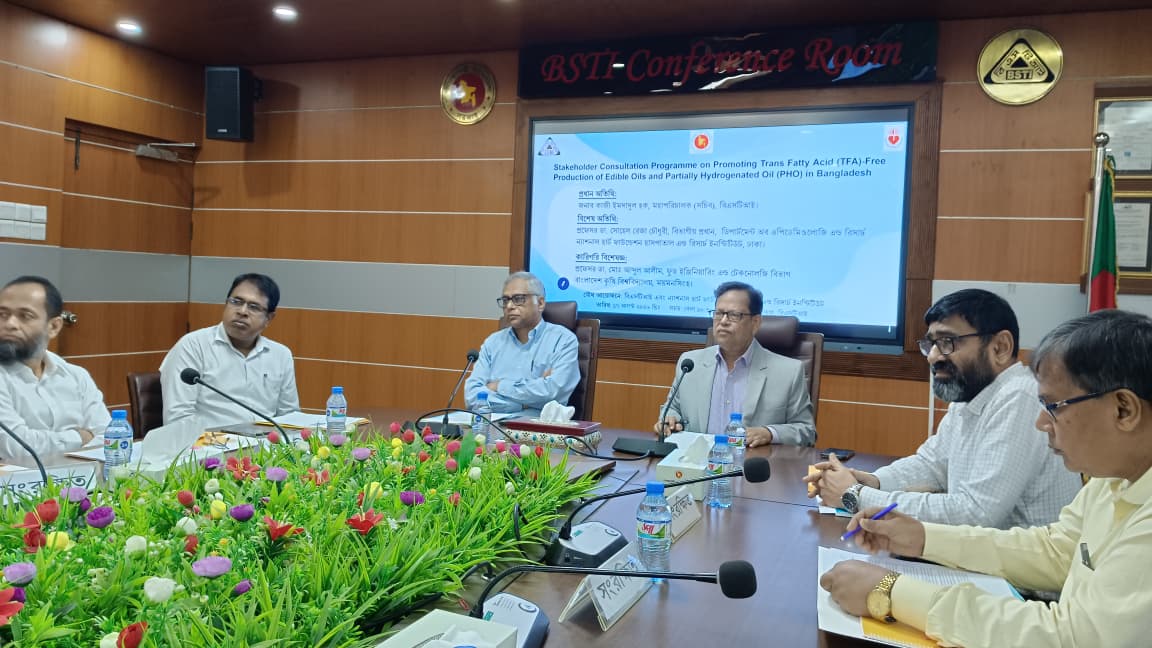
The meeting saw participation from senior officials representing various edible oil production and refining companies, including Bashundhara Group, City Group, TK Group, Bangladesh Edible Oil, and Meghna Group, as well as research institutions. Enamul Haque, Deputy Director (Agriculture and Food) of BSTI, delivered a presentation on “SDG Urgency in Controlling Non-Communicable Diseases and Government Priorities.”




Addressing the session, BSTI Director General Kazi Imdadul Haque emphasised that the role of producers and businessmen is vital in ensuring safe, trans fat-free food.
He noted that effective initiatives would be implemented by considering industrial challenges, technological capabilities, and production processes in coordination with relevant stakeholders.
Industrially produced TFA is globally recognised as a major risk factor for heart disease and other non-communicable diseases. The World Health Organisation (WHO) considers the elimination of trans fat from the food supply an effective and cost-saving measure to prevent premature deaths.
In this context, the government has already framed the “Trans Fatty Acids (TFA) in Foodstuffs Control Regulations, 2021.”
As part of the effective implementation of these regulations, BSTI has revised the national standards for Vanaspati and Non-dairy Vegetable Ghee.
The updated standards incorporate modern requirements for trans-fat control, aimed at creating a supportive environment for the production of TFA-free products.