


Commercial aviation across Europe has faced severe disruption following a coordinated wave of hoax bomb threats, marking the second major outbreak of security alerts within a single week.
Last Thursday, aircraft departing from 16 nations, including Ireland, the United Kingdom, Spain, and Denmark, were grounded, forced to divert, or subjected to emergency security checks, reports BBC.
The operational turmoil persisted into Friday, with at least 17 flights disrupted by midday GMT.
Emergency operations have seen local authorities deploy bomb disposal units and scramble military fighter jets to escort targeted aircraft.
Exhaustive security inspections have yielded no evidence of explosive devices or dangerous materials aboard any aircraft, and no passengers have suffered harm.
Official response protocols and industry impact
When an airline receives a security threat, the details are immediately evaluated by a dedicated team of assessors.

According to Joji Waites, director of flight safety, policy and regulation at BALPA, the British Airlines Pilots’ Association, assessors follow standardised processes to grade alerts as red for credible, amber for partially credible, or green for non-credible, though amber is not used if an aircraft is already airborne.
Once alerted, pilots navigate the aircraft to an isolated position far from airport terminals, where passengers disembark to be screened while border police using sniffer dogs inspect the cabin and hold.
Philip Baum, visiting professor of aviation security at Coventry University, explained that the synchronised nature and sheer volume of these alerts are highly unusual.
While individual airlines routinely receive daily threats that are swiftly evaluated as non-specific without requiring diversions, authorities across multiple European countries are treating these latest warnings as sufficiently credible to mandate ground searches and diversions.



Baum added that each individual flight disruption can cost airlines up to $250,000.
The current disruption follows earlier alerts in the week, including a diverted UK flight on Monday, seven searched or diverted aircraft on Tuesday, and concurrent cyberattacks on European supermarket refrigeration systems.
Summary of targeted flights and routes
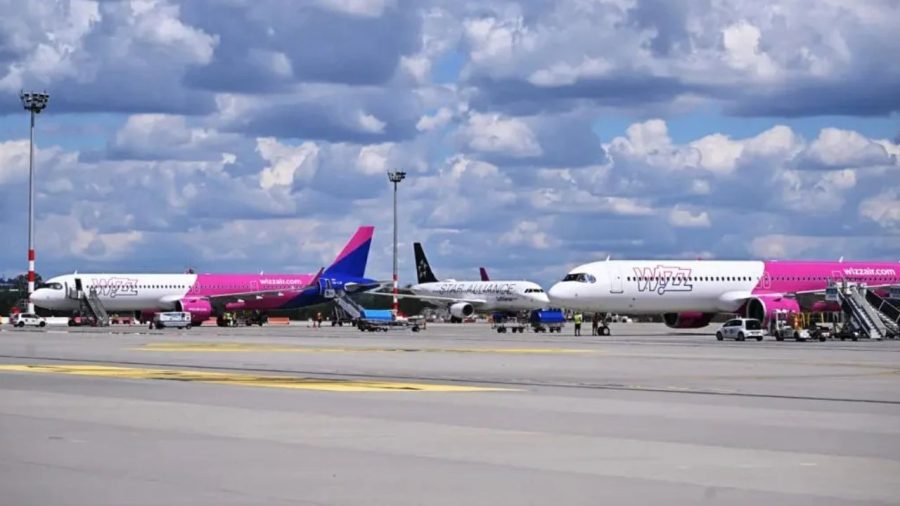
During Friday’s operations, Hungary scrambled fighter jets three times to escort commercial aircraft through its airspace after receiving bomb alerts, including a Wizz Air flight travelling from Brussels to Sofia alongside flights from Prague to Bucharest and Cyprus.
Prague airport confirmed that nine flights were affected by threats on Friday morning, while Bulgarian transport officials reported receiving alerts for two incoming flights to Sofia.
In Portugal, a Ryanair flight landed in Lisbon following a telephoned threat made to Italian authorities, prompting an immediate security deployment.
Italian air traffic controllers at Fiumicino redirected a Paris-to-Rome Wizz Air flight to Venice, where police cleared the landing zone, whilst security checks at Copenhagen airport in Denmark confirmed no danger to passengers.
Thursday’s incidents included Polish authorities halting a Polish Airlines (LOT) flight to Paris whilst taxiing on the runway at Warsaw Chopin Airport, forcing passengers to disembark before searches cleared the aircraft.
Another LOT flight to Paris was grounded in Warsaw, and a LOT flight from London Heathrow to Warsaw was diverted to Warsaw-Modlin Airport. Elsewhere, the Italian Air Force escorted a Finnair flight into Rome following an anonymous email sent to Aeroporti di Roma.

A Ryanair flight from London to Sofia made an emergency landing in Plovdiv, Bulgaria, while Spanish authorities received three emailed threats targeting Air Europa flights from Madrid to Paris and Iberia flights from Rome and Milan.
A flight from Cork in Ireland suffered a 90-minute delay, and a Ryanair flight from Pescara to Charleroi triggered security protocols after the word “bomb” was found written in an aircraft restroom.
Investigation into potential motives
Official responses to the disruptions remain cautious, with the UK government describing the alerts as malicious hoax threats. London Heathrow, Europe’s busiest airport for passenger traffic, was among the primary targets.
The European commissioner for transport noted that it is too early to determine who bears responsibility or whether the incidents across different nations are connected.
While European governments have refrained from directly assigning blame, countries supporting Ukraine remain vigilant regarding potential hybrid warfare tactics.
Germany previously pointed the finger at Russia for drone incursions at Leipzig-Halle Airport, an accusation Moscow rejected. European Union officials remain conscious of potential hybrid operations, following a September warning from the Danish Defence Intelligence Service that such tactics could escalate to pressure Western and NATO allies.
However, Moscow has denied involvement in the aviation alerts, and authorities confirm no evidence exists linking Russia, Iran, or associated proxy groups to the disruptions.