
As Bangladesh prepares for the historic general elections scheduled for 12 February, BNP has articulated a definitive stance on its ideological framework, distancing itself from the concept of secularism while pledging to uphold equal rights for all religious communities.
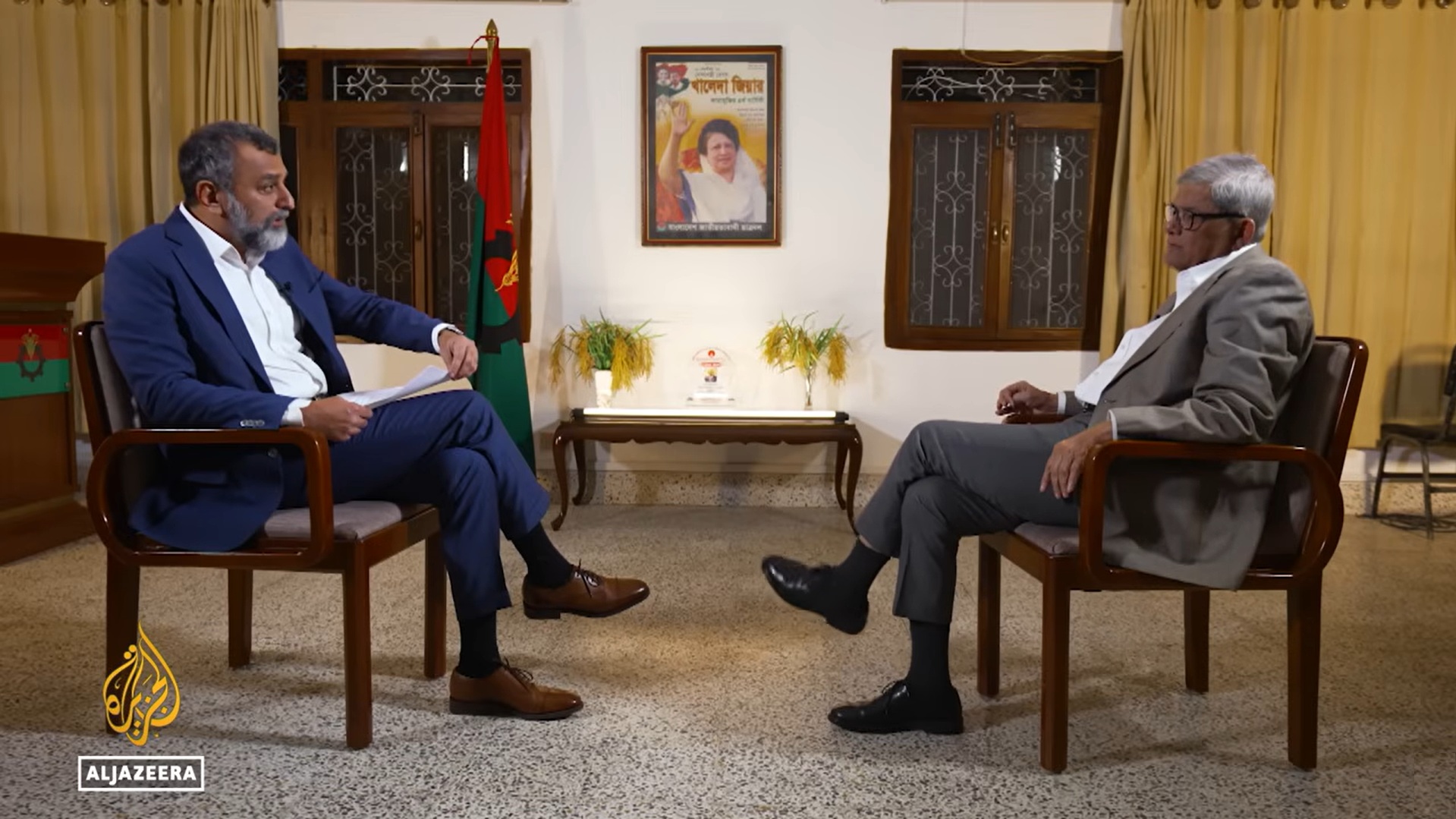
In an interview with Al Jazeera’s Sreenivasan Jain regarding the party’s vision, BNP Secretary General Mirza Fakhrul Islam Alamgir clarified that while secularism is not the party’s objective, the protection of minorities remains a cornerstone of their political agenda.
The upcoming polls mark the first national exercise since the 2024 overthrow of Awami League regime led by the then prime minister Sheikh Hasina.
With the Awami League currently banned from contesting, BNP has emerged as a primary front-runner, buoyed by the return of its chairman, Tarique Rahman, following nearly two decades in exile.
Ideological foundations, constitutional shift
The discourse surrounding BNP’s ideological identity traces back to 1977, when the party’s founder, General Ziaur Rahman, removed the word “secularism” from the Constitution of Bangladesh.
Fakhrul defended this historical move, stating it reflected the party’s core philosophy. “Secularism is not our goal,” He stated, adding that the term is not “congenial” for the political landscape of a country with a 95% Muslim population.
However, the secretary general was quick to distinguish between the rejection of the term “secularism” and the abandonment of pluralism. He asserted that BNP’s goal is to ensure that “all the rights to all the religions to all the faiths” are protected equally.

He maintained that Hindus, Christians, and Muslims would enjoy identical status under a BNP administration, arguing that the party holds the “best record” for safeguarding minority interests in Bangladesh’s history.
When challenged on whether secularism is the very mechanism that ensures such freedom, Fakhrul described that view as a “wrong interpretation.”
He argued that as long as the rights of other communities are ensured, the absence of the specific word in the Constitution poses no problem for the nation’s social fabric.
Tarique Rahman an ‘agent of change’
Central to BNP’s electoral campaign is Tarique Rahman, who returned to a massive public welcome in Dhaka just before the death of his mother, former prime minister Khaleda Zia.


Fakhrul positioned Tarique as an “agent of change” capable of ending dynastic politics and corruption, despite Tarique’s own extensive legal history.
Regarding more than 80 cases previously filed against Tarique – many involving allegations of corruption – Fakhrul dismissed them as “totally baseless” products of a “fascist regime.”
He contended that despite 15 years of investigation, the previous administration failed to prove a single allegation.
The BNP secretary general further rejected testimonies from international agencies, including the United States’ Federal Bureau of Investigation (FBI). When reminded that FBI investigators had testified in court regarding “kickbacks” received by Tarique for government contracts, Fakhrul claimed the reports were “concocted” and “biased.”
He extended this rejection to various international watchdogs and domestic media outlets, such as The Daily Star, which have reported on contemporary allegations of extortion and violence involving BNP grassroots activists.
“The party has suffered for the last 15 years,” Fakhrul said, defending the transition of leadership to Tarique as a choice made by the party and the people, rather than an act of nepotism. He described Tarique as the “most capable man” to lead, noting that even during his exile in London, he remained in constant contact to instruct the party.
Addressing allegations of communal, political violence
BNP’s return to the political forefront has been accompanied by scrutiny of its previous tenure from 2001 to 2006. Human rights organisations, including Human Rights Watch, have cited that period as a “dangerous moment” involving religious violence.
Fakhrul, however, rejected these findings, attributing reports of communal issues to “Indian media” trying to portray political conflicts as religious ones.
Addressing recent reports from the United Nations regarding a spike in violence against minorities, Fakhrul remained defiant, questioning the neutrality of such surveys.
He categorised recent incidents, such as the killing of a Hindu man accused of blasphemy, as property disputes rather than communal acts, though he condemned all atrocities as “acts against humanity.”
On the matter of the Awami League’s current status, Fakhrul expressed a personal distaste for collective bans on political parties.
While he believes individuals responsible for “genocide” during the 2024 unrest must be tried, he argued that banning an entire organisation does not solve underlying political problems.
This stance comes despite his party’s insistence that the Awami League as an entity was responsible for state-sponsored violence using the police apparatus.
Regional diplomacy, the road ahead
The potential return of BNP to power carries significant implications for regional ties, particularly with India. Relations were notoriously strained during BNP’s last term, with New Delhi accusing Dhaka of sheltering anti-India extremists – an allegation Fakhrul dismissed as a “lame excuse.”
Currently, a primary diplomatic friction point involves the presence of Sheikh Hasina in India. Fakhrul confirmed that a BNP government would “diplomatically try” to secure her deportation to face trial in Bangladesh.
He rejected comparisons between Tarique’s stay in London and Hasina’s stay in India, arguing that Tarique was a victim of atrocities while Hasina faces accountability for the events of July 2024.
Despite these tensions, Fakhrul expressed hope for a reset in relations with New Delhi, citing a condolence letter sent by Prime Minister Narendra Modi following the passing of Khaleda Zia as a “very good gesture.”