
Despite a major security clampdown ahead of the national polls, country’s law and order situation has spiralled into violence, with killings, arson attacks, and explosions shaking the capital and several districts.
In Dhaka, a series of crude bomb explosions and bus arsons have stirred fresh panic. And on Monday morning, a man was shot dead in broad daylight near the Dhaka National Medical College, raising questions over the effectiveness of the country’s security measures.
Court-area murder shocks capital
The victim, Tariq Saif Mamun (52), was gunned down as he arrived at the court complex to attend a hearing. He had also been a former accused in murder of film actor Sohel Chowdhury in Gulshan, a case in which he was acquitted last year. Mamun was also accused in the murder of Saeed Ahmed Tipu, brother of former army chief Aziz Ahmed.
His family claims the killing was a targeted attack.
“He went to court to attend a hearing. He was deliberately targeted and killed,” his wife Ripa told TIMES of Bangladesh.
Police officials, however, described him as a “notorious criminal.”
Lalbagh Division Deputy Commissioner Mallick Ahsan Uddin Sami said Mamun had multiple criminal cases against him.
Eyewitnesses said two assailants approached him near the courthouse, opened fire from close range, and fled on a motorbike. He was rushed to Dhaka Medical College Hospital, where doctors declared him dead.

Video footage of the killing, showing the shooters’ faces clearly, went viral on social media — but no arrests have been made.
Long trail of violence and rivalry
Police said Mamun had gone to appear in a long-pending case over the 1997 murder of Zahid Amin alias Himel in Mohammadpur’s PC Culture Housing area.
His brother-in-law confirmed Mamun was a former president of Dhanmondi Chhatra Dal, the BNP’s student wing, and had been acquitted of both the Sohel Chowdhury and Tipu murder charges last year.
Records show that Mamun survived a previous assassination attempt in September 2023, when gunmen opened fire in Dhaka’s Tejgaon Industrial Area, apparently targeting him. Bullets struck motorcyclist Bhuban Chandra Shil, who later died at Popular Hospital in Dhanmondi.
Police had then claimed the attack was carried out by followers of jailed gangster Sanjidul Islam alias Emon, a longtime rival of Mamun. The two once jointly led a notorious outfit called the “Emon–Mamun gang”, which dominated the criminal underworld in Dhanmondi, Mohammadpur and Tejgaon.




Rising violence beyond the capital
While the capital reels from explosions and killings, Mymensingh and Munshiganj saw two BNP activists murdered amid clashes. In Tangail’s Gopalpur, BNP men vandalised an election office, escalating tensions further.
Meanwhile, reports of flash processions allegedly by Awami League, whose activities arre banned, have led police to launch raids and heighten surveillance. Senior police and intelligence officials held several emergency meetings on Monday to assess what they described as a “deteriorating situation.”
Towhidul Haque, associate professor at Dhaka University’s Institute of Social Welfare and Research, told TIMES of Bangladesh that lapses in law enforcement allow criminals to exploit instability.
“When there’s political division over whether an election should happen or not, criminals may seize the opportunity,” he said.
He warned that “if blame is placed solely on the Awami League without identifying and arresting the actual offenders, other criminal groups may take advantage.”
Adviser admits ‘dark forces’ trying to exploit unrest
Speaking on the same day at a Dhaka event, Environment and Climate Change Adviser Syeda Rizwana Hasan acknowledged that “vested interests” were trying to exploit the chaos.
“Certain vested interests remain — whether from the fallen regime or other dark forces,” she said. “Some factors we can analyse, others we cannot. Whenever attempts are made to create unrest, as a government we must do our utmost to control it.”
She added that while preventive measures were being taken, authorities would also respond “reactively” if unrest escalated.
Nationwide clampdown, but violence persists
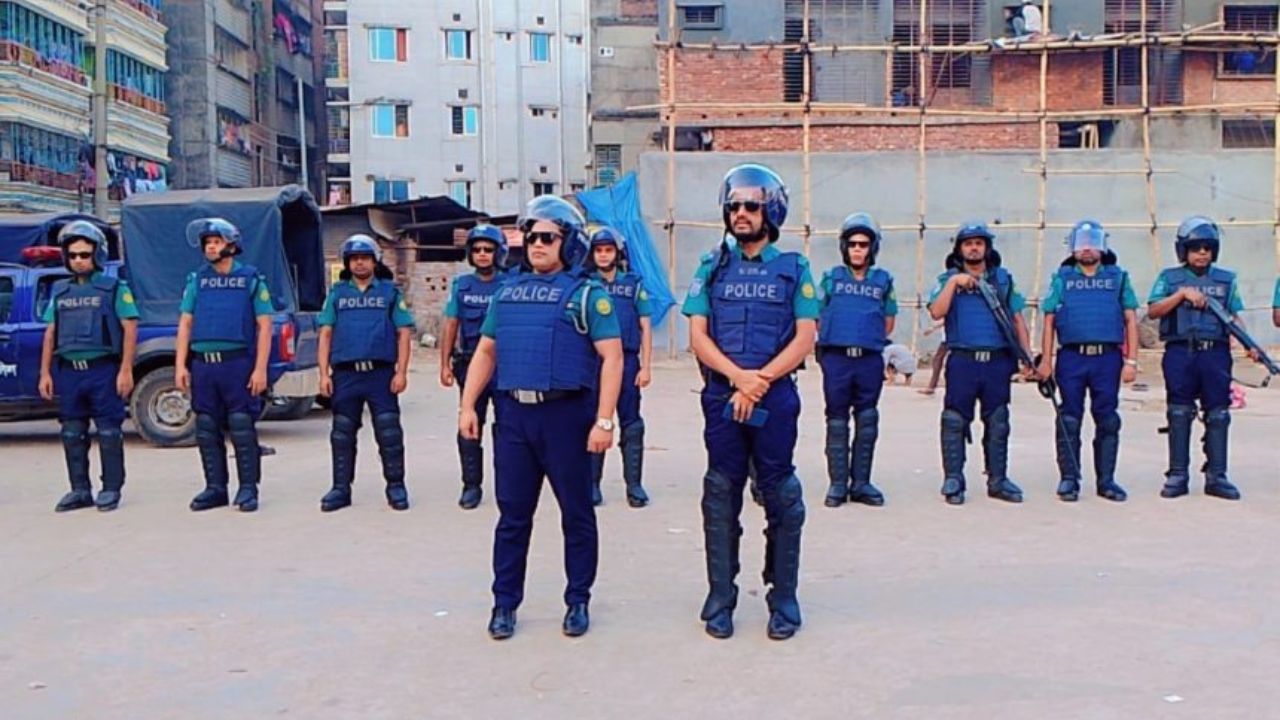
Security meetings held last week at both Police Headquarters and the DMP resolved to tighten protection nationwide. The Home Ministry’s core committee ordered enhanced security for key point installations (KPIs).
Yet within days, crude bomb attacks targeted two churches and St Joseph’s School in Dhaka, while a BNP candidate was murdered in Chattogram during campaigning.
As part of a new deployment plan, police will station 6,829 personnel at 142 locations across Dhaka on 13 November, the day the banned Awami League plans a “lockdown programme.” Mock drills have already been completed.
Despite these measures, law enforcers have struggled to contain unrest. Between Sunday midnight and Monday morning, two buses were set on fire in Shahjadpur and Merul Badda, while seven crude bombs exploded in Mohammadpur, Mirpur, and Dhanmondi.
Attackers on motorcycles wearing helmets threw the explosives and fled. Later Monday evening, a Shanta Mariam University bus was set ablaze near LabAid Hospital in Dhanmondi. No casualties were reported.
Crude bombs also exploded near the Grameen Bank office in Mirpur, at a business firm owned by an interim government adviser in Mohammadpur, and at the MIDAS Centre in Dhanmondi-27.
Police have since erected checkpoints across the city, detaining more than 100 people within 24 hours.
Police on Monday said they had arrested a 28-year-old man allegedly linked to the recent string of cocktail attacks. Investigators claimed the suspect is an activist of the banned Chhatra League, and is being questioned over blasts at St Mary’s Cathedral and St Joseph’s School, both run by Catholic institutions.
In a separate directive, DMP Commissioner SM Sazzat Ali instructed officers to refrain from using mobile phones while on duty, citing growing concerns over discipline.
“Despite being visibly present, some officers are unable to ensure their own or public safety due to mobile phone use during duty hours,” the order said.
Only officers-in-charge will be exempted. Violators will face disciplinary action, especially during the pre-election security drive, it added.
Citing security and public order concerns, the DMP Commissioner also banned all political gatherings, rallies, and processions around the Chief Justice’s residence, Supreme Court, and International Crimes Tribunal until further notice, under Section 29 of the DMP Ordinance (1976).
Authorities warned that no one would be allowed to block roads “under the pretext of protests or demands.”