
In a lab at icddr,b in Dhaka, a scientific breakthrough has taken root that could change how the world fights child malnutrition. This week, Time magazine named the Microbiota-Directed Complementary Food (MDCF-2), a gut-restoring food developed by icddr,b and Washington University in St. Louis, one of its Best Inventions of 2025 in the Social Impact category.
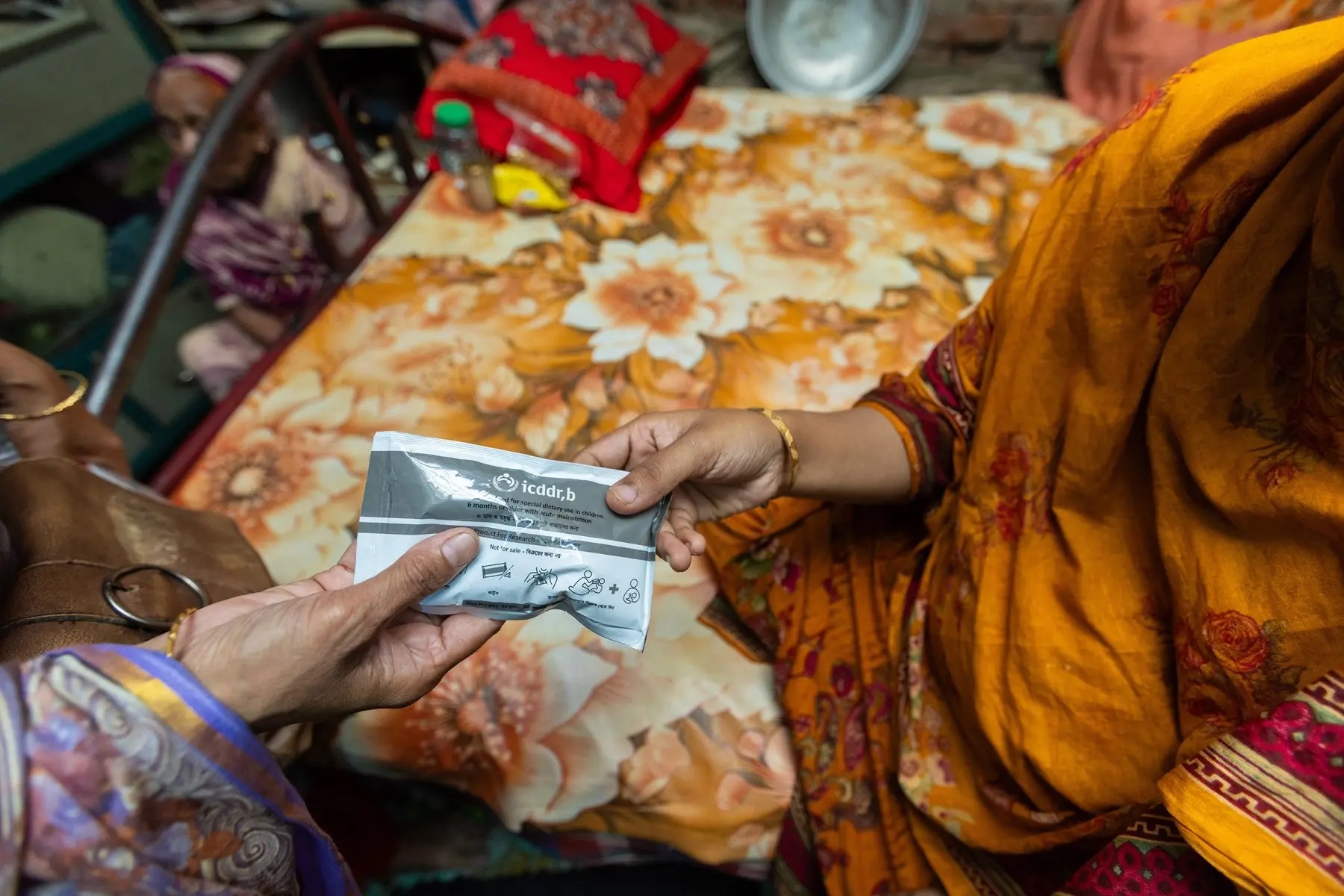
At first glance, MDCF-2 looks like any other complementary food. But behind its simple appearance lies years of research into one of the body’s most overlooked systems: the gut microbiome. Made from chickpea flour, soybean flour, peanut flour and green banana, MDCF-2 is specially designed to nourish beneficial gut bacteria that are essential for healthy growth, strong immunity and brain development in children. In clinical trials, this affordable blend has shown remarkable potential to reverse the biological effects of undernutrition.
The idea grew from a collaboration between Dr Tahmeed Ahmed, executive director of icddr,b, and Dr Jeffrey Gordon, director of the Edison Family Center for Genome Sciences and Systems Biology at Washington University. Combining Dr Ahmed’s decades of experience treating malnutrition in Bangladeshi children with Dr Gordon’s pioneering microbiome research, the team created a formulation that not only feeds the body but also heals it from within.
Supported by the Bill & Melinda Gates Foundation, MDCF-2 is now being tested in India, Pakistan, Mali and Tanzania following successful results in Bangladesh. Despite global progress, undernutrition remains one of the deadliest challenges in child health, contributing to nearly half of all deaths among children under five.
Conflicts, displacement and climate disasters continue to worsen the crisis. Against this backdrop, MDCF-2 offers a rare beacon of hope: an affordable, scalable solution that could give millions of children a second chance at healthy growth.
For icddr,b, long recognised for its global health innovations, Time’s honour is a proud moment. It affirms that solutions born in Bangladesh can transform the world, one bowl of nourishment, one recovering child, at a time.