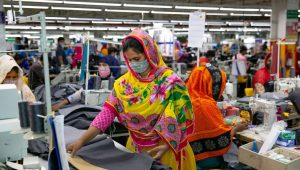
Bangladesh remained the European Union’s (EU) the largest denim supplier in the first nine months of 2026, but its exports declined faster than the overall market, allowing competitors, particularly Egypt and China, to strengthen their positions.
According to Eurostat data, total EU denim imports fell 3.24 per cent year-on-year to €3.42 billion (€3,415.42 million) in January-September 2026, down from €3.53 billion (€3,529.63 million) in the same period last year.
Imports from Bangladesh dropped 5.48 per cent to €1.01 billion (€1,006.88 million) from €1.07 billion (€1,065.23 million). Consequently, the country’s share of the EU denim market declined to 29.48 per cent from 30.18 per cent.
Despite the decline, Bangladesh maintained a substantial lead over its competitors. Pakistan ranked second with exports worth €609.70 million, followed by Turkey at €498.10 million and Tunisia at €243.52 million.
Pakistan’s exports to the EU fell 6.63 per cent during the period, Turkey recorded a sharper decline of 20.27 per cent, and Tunisia slipped 5.73 per cent. Their respective market shares stood at 17.85 per cent, 14.58 per cent, and 7.13 per cent.

Fifth-ranked China and sixth-ranked Egypt moved in the opposite direction. China’s shipments increased 20.23 per cent to €230.54 million, capturing a 6.75 per cent market share, while Egypt’s denim exports to the EU surged 34.97 per cent to €225.76 million for a 6.61 per cent share.
Egypt added €58.49 million in export value and China gained €38.80 million. In contrast, Bangladesh lost €58.35 million in export value compared with the corresponding period of 2025.
Among mid-tier and smaller suppliers, Cambodia’s denim exports to the EU fell 5.89 per cent to €169.61 million (4.97 per cent market share), while Morocco’s shipments declined 10.68 per cent to €73.54 million (2.15 per cent share).
Vietnam and India, however, posted strong growth, although their shares remained relatively small. Vietnam’s exports increased 38.02 per cent to €61.57 million, capturing 1.80 per cent of the EU market, while India’s shipments rose 22.49 per cent to €35.13 million, accounting for 1.03 per cent of total imports.



Meanwhile, denim imports from other countries collectively increased 11.84 per cent to €261.06 million during January–September, accounting for 7.64 per cent of the EU market, indicating that suppliers outside the top exporting nations are also expanding their presence.
The overall market showed signs of recovery towards the end of the reporting period, with EU denim imports increasing 3.66 per cent year-on-year to €453.37 million in September 2026.
Bangladesh recorded modest growth in September, with exports rising 0.70 per cent to €143.12 million from €142.12 million a year earlier. However, major rivals posted far sharper movements during the month: Egypt surged 52.28 per cent to €36.77 million, China climbed 30.38 per cent to €31.65 million, and Pakistan rose 4.96 per cent to €86.66 million, while Turkey dropped 26.01 per cent to €51.41 million and Tunisia edged down 0.12 per cent to €23.23 million.
Smaller suppliers also showed a mixed trend in September. Morocco’s exports rose 22.14 per cent to €9.35 million and India’s jumped 66.36 per cent from a low base to €3.67 million (up from €2.21 million), while shipments from other countries grew 23.15 per cent to €35.45 million. In contrast, Cambodia and Vietnam recorded declines of 2.40 per cent (to €24.76 million) and 2.41 per cent (to €7.30 million), respectively.
Commenting on the development, former Bangladesh Garment Manufacturers and Exporters Association (BGMEA) director Mohiuddin Rubel said Bangladesh remained far ahead of its competitors in terms of export value and continued to hold a strong position in the European denim market.
He said the decline in European imports had affected almost all major suppliers, including Bangladesh, though the country’s export performance and that of several competitors had weakened more than the overall market contraction.

He pointed out that Egypt and China had captured a significant portion of the market share being lost by other suppliers.
“China was making aggressive efforts to expand its presence in Europe, particularly as its position in the US market remained challenging, while Egypt had already established itself as a competitive denim producer,” he said.
Rubel also highlighted the potential of near-sourcing, which could benefit Egypt by allowing European buyers to source products from geographically closer manufacturing destinations.
He expressed optimism that Bangladesh could perform better once demand in the European market recovered, given the country’s established reputation in denim manufacturing. However, he stressed the need to move beyond low- and medium-end denim products and expand into higher-value, more expensive items to strengthen Bangladesh’s competitive position.
M Helal Ahmmed Jony, an economist and research fellow at the research organisation Change Initiative, told TIMES, “Bangladesh’s leading position in the European denim market is an important strength, but maintaining that position requires more than competitive pricing. Manufacturers need to invest in product diversification, technology, design and higher-value production. As global buyers increasingly diversify their sourcing destinations, Bangladesh must improve its competitiveness to retain existing buyers and capture new market opportunities.”
He mentioned that the September growth in EU denim imports offers some encouragement, but sustaining export growth will depend on how effectively Bangladesh’s manufacturers respond to changing demand and rising competition.