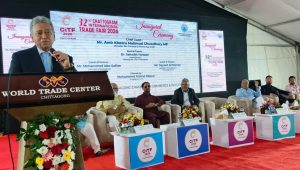
The Government of Bangladesh and the United Nations Industrial Development Organization (UNIDO), through the SWITCH to Circular Economy Value Chains (SWITCH2CE) project, convened a national consultation in Dhaka to review the draft National Circular Textile Strategy for Bangladesh and gather stakeholder recommendations.
Organised in collaboration with the Ministry of Commerce, the consultation brought together government representatives, industry associations, brands, manufacturers, development partners, and technical experts., reads a press release.
This consultation marked the next phase in an ongoing strategy formulation process that commenced with an initial stakeholder meeting in April 2026. Chatham House, serving as SWITCH2CE’s global policy partner, is leading the development of the strategy alongside local partners and under the leadership of the Ministry of Commerce.
The latest consultation focused on refining the draft document and identifying priorities for its finalisation and official endorsement.
Attending as chief guest, Ministry of Commerce Secretary Sharf Uddin Ahmed Choudhury highlighted that circular textiles are an imperative to retain Bangladesh’s post-graduation global competitiveness. He said that the National Circular Textile Strategy should be instrumental in achieving sustainability across the country’s production ecosystem.

Opening the event, UNIDO Country Representative Alamgir Hossain noted that transitioning from linear to circular business models presents a significant opportunity to enhance competitiveness, drive innovation, and foster sustainable prosperity.
He explained that Bangladesh’s Circular Textile Strategy aims to provide a clear direction for both the industrial and financial sectors, offering targeted measures to strengthen competitiveness and support growth amid an evolving global business and environmental landscape.
Addressing international regulatory shifts, Hubert Blom, Attaché – Programme Manager, Climate Change-Green Inclusive Development at the EU Delegation in Bangladesh, shared that the European Union is serious about making its economy circular.




He warned that the ready-made garment (RMG) sector will need to comply with new requirements such as the Digital Product Passport or risk losing access to the European market, noting that the circular textile strategy supports the industry to retain market access and navigate the transition towards circularity.
The draft strategy was presented by Senior Research Fellow at Chatham House, Patrick Schröder and National Project Coordinator of SWITCH2CE KM Asadun Noor.
Schröder said, “Building on lessons from SWITCH2CE and international best practice, the strategy can deepen cooperation between Bangladesh and the European Union as the EU advances its circular economy agenda. As the EU develops textile requirements under its Ecodesign for Sustainable Products Regulation, supply chain traceability and Digital Product Passports will be key areas for cooperation. Working together now can help Bangladeshi manufacturers and European buyers prepare for the new requirements and scale up circular textile production.”
Leading industry trade bodies, including the Bangladesh Garment Manufacturers and Exporters Association (BGMEA) and the Bangladesh Knitwear Manufacturers and Exporters Association (BKMEA), were represented by BGMEA Vice President Vidiya Amrit Khan, and BKMEA Vice President Mohammad Rashed.
They underscored the importance of a co-ordinated approach to circularity, highlighting its growing relevance for Bangladesh’s global competitiveness and the need for a national strategy to support investment in technologies, resource efficiency, and compliance with evolving international requirements.
The discussions emphasised co-ordinated action, an enabling policy environment, investment, and stronger collaboration across the value chain to advance circular production and resource efficiency in Bangladesh’s textile and garment sector.

The event concluded with a session on the way forward moderated by Deputy Secretary Alamgir Kabir, and a vote of thanks by Joint Secretary (Planning Cell, Ministry of Commerce) and National Project Director of SWITCH2CE, Muhammed Badrul Haque.
Participants discussed the timeline for incorporating recommendations, completing final revisions, and proceeding towards the strategy’s endorsement.
The National Circular Textile Strategy aims to provide a co-ordinated framework for advancing circularity across Bangladesh’s textile and garment industry.
By translating practical experiences and stakeholder recommendations into strategic priorities, the strategy seeks to accelerate the transition from pilot initiatives to large-scale circular business models, enhancing resource efficiency and reducing textile waste.
Through SWITCH2CE, UNIDO works with international brands, local manufacturers, industry associations, and technical partners to demonstrate and scale circular models. The global SWITCH2CE project, co-funded by the European Union and the Government of Finland, is led by UNIDO in collaboration with Chatham House, Circle Economy, and the European Investment Bank (EIB).