Bangladesh carries a legacy of dreams, courage, and hope. Yet, more than fifty years after independence, this country remains shackled not by external forces alone, but by a mafia of power-hungry, corrupt politicians who have hijacked the state for personal gain and foreign agendas. Today, the machinery of government, from politics and administration to the judiciary and economy, is ensnared in a web of blackmail, fear, and deception. For ordinary citizens, the promise of democracy and public welfare has become an illusion; the state now serves as a personal playground for those in power.
In Bangladesh, blackmail is not a mere political tactic but a systemic principle. Authorities exploit administrative machinery, law enforcement, and even the courts to crush opposition, extort businessmen, and intimidate ordinary citizens. Arrests, lawsuits, tenders, and licenses are no longer determined by merit or legality. They are granted or denied based on political allegiance. The victims are not only opposition leaders but every citizen whose rights stand in conflict with the political elite.
In reality a businessman must pay “party dues” to protect his property, or a government official must manipulate votes to retain their post. Under such conditions, can Bangladesh truly be called a democracy? The country has become a controlled political system, where blackmail is the primary tool for maintaining power.
Bangladesh’s political decisions are increasingly shaped outside its borders. Regional and global powers exert influence over the country’s internal affairs, making the ruling elite more accountable to foreign interests than to their own citizens. Geopolitically, Bangladesh is seen as a corridor of strategic advantage, forcing national leaders to prioritise external approval over domestic welfare.
India’s role from border security and water-sharing disputes to energy agreements and transit rights, Bangladesh has repeatedly compromised its sovereignty. In return, ruling elites secure political patronage and protection. Chinese high-interest infrastructure loans, and port development projects create economic dependency, with commissions and kickbacks embedded in every deal. Under the guise of human rights and democratic principles, the United States exerts political pressure to secure strategic influence in the region, often at the cost of Bangladesh’s autonomy.

As a result, Bangladesh has morphed into a proxy balancing state, where national sovereignty is subordinated to the whims of external powers.
Corruption in Bangladesh is no longer an individual vice it is the foundation of the political system. Politicians manipulate government projects for commission, inflating costs by 30–40% to ensure personal profit. This is evident across sectors.




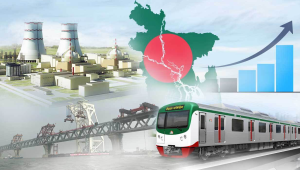
In the Rooppur Nuclear Project, basic supplies have been overpriced, allegedly including pillows costing 6,700 taka each. Power plants receive over 360 billion Taka annually as “capacity charges” even when production is minimal. Non-performing loans in the banking sector exceed 2 trillion taka, primarily benefiting politically connected businesses.
The economy, therefore, operates under a mafia-controlled development model, where public wealth is redirected to private hands, and national growth is secondary.
Elections in Bangladesh have lost their democratic essence. They no longer reflect public choice but serve as formal validation of entrenched power. Ballot-box stuffing, voter suppression, administrative manipulation, and foreign interference have become standard practices. From 2014 and 2018 to 2024, elections have been less a tool for representation than a staged ritual designed to entrench a mafia elite in power.
When citizens are denied the right to choose, the state ceases to be a republic it becomes a private empire of political cartels.
The consequences of this mafia-style governance are stark. Rural students are deprived of quality education, while political influence and private coaching syndicates monopolise access. Public hospitals are rife with corruption, shortages, and negligence, leaving quality care beyond the reach of most citizens. With minimal employment opportunities, young people are forced into political patronage or migration abroad. Enforced disappearances, extrajudicial killings, and fabricated charges have transformed the legal system into a tool for elites, not citizens.
In short, the ordinary people bear the heaviest burden of this corrupt system, trapped in poverty, insecurity, and disillusionment.
Rescuing Bangladesh requires a new political model one that must serve public welfare, not personal enrichment. Foreign interference must be countered through strategic diplomacy and national unity. Electoral reforms should ensure direct public participation and referendums on major decisions. Administrative and judicial institutions must be insulated from political control. A public tribunal should recover assets looted through corruption and restore them to national coffers.
Bangladesh stands at a historic crossroads. State ownership has yet to return to its rightful owners the people. True liberation will not come through political parties embedded in this mafia system; it will come through popular awakening and collective action.
Until the politics of betrayal, blackmail, and corruption end, freedom will exist only on paper. The nation’s future depends not on speeches or slogans, but on the courage, awareness, and direct action of its citizens.
The time has come for a new political covenant: a Bangladesh where the people are sovereign, and politics becomes an instrument of empowerment rather than exploitation.