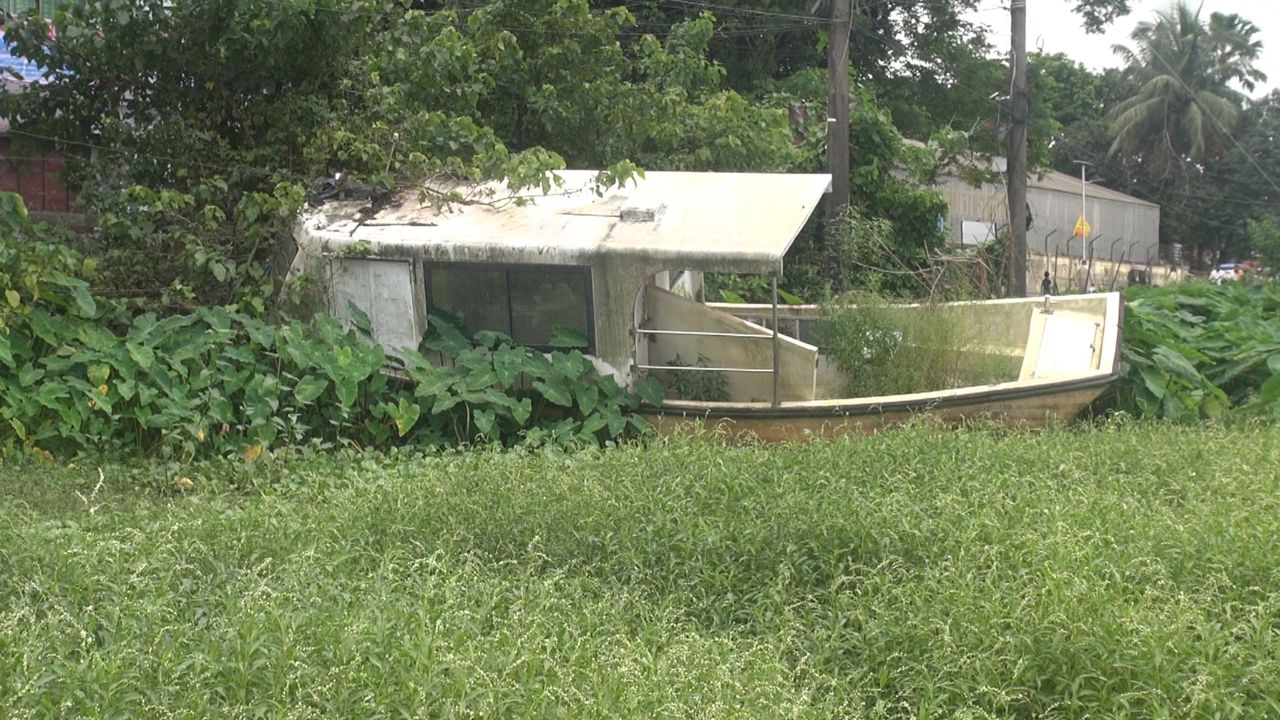



For residents of Sunamganj’s remote haor areas, reaching a hospital during an emergency remains a desperate struggle, despite the government having provided water ambulances specifically to address their healthcare needs.
The four water ambulances, purchased between 2013 and 2018 for haor-dominated Tahirpur, Jamalganj, Dharmapasha and Shalla upazila health complexes, have remained mostly unused and are now lying abandoned due to a lack of drivers, fuel allocation and proper maintenance.
The vessels, each designed as a one-bed floating clinic, were purchased at a cost of Tk30–40 lakh each, bringing the total expenditure to nearly Tk1.5 crore. However, three of the four ambulances were never used to transport a single patient, according to health officials and local residents.
Many residents of the haor areas are not even aware that such emergency services exist.
Ayesha Begum, a woman in her sixties from the remote village of Bardal in Tahirpur Upazila, experienced the consequences firsthand.
Located about 35 kilometres from the district headquarters, Bardal is surrounded by water and resembles an isolated island. In mid-July last year, Ayesha developed severe abdominal pain late at night. With no boat available, she spent the entire night in agony at home.
The following morning, her husband Jamirul Haque borrowed a boat from a neighbour and set off for Sunamganj District Hospital. By then, Ayesha’s condition had deteriorated so badly that she had lost consciousness.
Like Ayesha, many residents in the haor region are forced to endure severe illness and pain at home because they cannot arrange immediate transport to hospitals.
Yet, Tahirpur Health Complex has a government-provided water ambulance.

When told about the existence of the ambulance, Jamirul Haque was surprised.
“I heard from you that there is a water ambulance. We have never seen it or received its service. When anyone falls sick, we keep them at home and pray to Allah. Somehow we spend the night and then take them to hospital,” he said.
Residents of Sripur village also expressed similar frustration.
“We often suffer for hours at night because we do not have a boat to take patients to hospital. We never heard that such an ambulance exists. If it worked, it would benefit everyone,” said local resident Asia Begum.
Abandoned vessels
A visit to the health complexes found the water ambulances in a deplorable condition.
The vessels allocated for Shalla and Jamalganj were found lying unused in front of the respective health complexes. Parts of the boats had holes, while wooden boards and structures had rotted away.




According to official documents, each ambulance was supposed to contain 17 types of medical and maintenance equipment. However, only one or two items could be found during inspection, while some vessels had none. Essential patient-care equipment was missing from all of them.
The Jamalganj Health Complex received its water ambulance in 2018. However, due to the absence of fuel and a driver, it was never put into service.
After a search, the vessel was found abandoned inside bushes near Jamalganj Police Station.
The Shalla Health Complex ambulance was found lying unused in a ditch beside the facility.
The Tahirpur Health Complex received its water ambulance in 2013, but officials said it had never been used. The authorities claimed that it had been kept submerged in a pond beside the hospital.
However, the vessel could not be found there during inspection. Some parts of the ambulance were later found in an abandoned building on the hospital premises. Although the boat originally came with 17 types of equipment, only the engine was found in the room.
The Dharmapasha Health Complex ambulance could not even be traced.
No driver, no fuel
Health officials said the main reason behind the failure of the project was the absence of dedicated drivers and fuel allocations.
The relevant upazila health officials had repeatedly informed the Health Ministry about the issue through official letters, but no effective measures were taken.
A letter from the Directorate General of Health Services dated 28 October 2013 shows that water ambulances were allocated to 10 upazila health complexes in eight districts under package G-1199. Tahirpur was one of the recipients.
The vessel reached Tahirpur Health Complex on 28 December that year. The letter also mentioned that the ambulance would require repairs after three years of operation.
However, in a letter dated 13 January 2014, Tahirpur’s then health officer informed the civil surgeon that there was no driver available from the beginning. As a result, the ambulance had been kept in a river north of Tahirpur Police Station.
The official also requested manpower for maintenance, saying assigning one of the two hospital security guards to look after the boat had created staff shortages.
A report submitted by the health officer in December 2015 stated that the number of drivers working for the ambulance was “none” and that the vessel was being preserved in an “inactive condition”.
Even in June 2023, the Tahirpur health officer wrote to the Directorate General of Health Services requesting a water ambulance driver, saying one was “essential” during the monsoon season to improve healthcare services in the haor region.
Calls for accountability
Tahirpur Sadar Union Parishad Chairman Jonab Ali blamed negligence by the health authorities for the current condition of the vessels.
“The government provided these water ambulances for haor residents, but they are being destroyed because of negligence by the hospital authorities. The boats should be repaired and brought back into operation to ensure healthcare services for people in remote areas,” he said.
Khaleel Rahman, acting president of the Sunamganj chapter of the Sachetan Nagorik Committee, said the project had failed because proper management was never ensured.
“The initiative has brought no benefit to haor residents because fuel and drivers were never provided. Those responsible for managing these valuable assets should be held accountable for why they were allowed to deteriorate,” he said.
Sunamganj Civil Surgeon Jasim Uddin admitted that the vessels had remained unused for years because there was no allocation for drivers or fuel.
“Equipment will naturally be damaged if they remain unused for such a long time. Either the necessary facilities should be provided to operate them or they should be taken back,” he said.
The four water ambulances, purchased at a cost of nearly Tk1.5 crore, were meant to become a lifeline for people living in one of the country’s most difficult terrains.
Instead, they have been left to decay in the haor mud, while residents continue to depend on borrowed boats and risky journeys during medical emergencies.