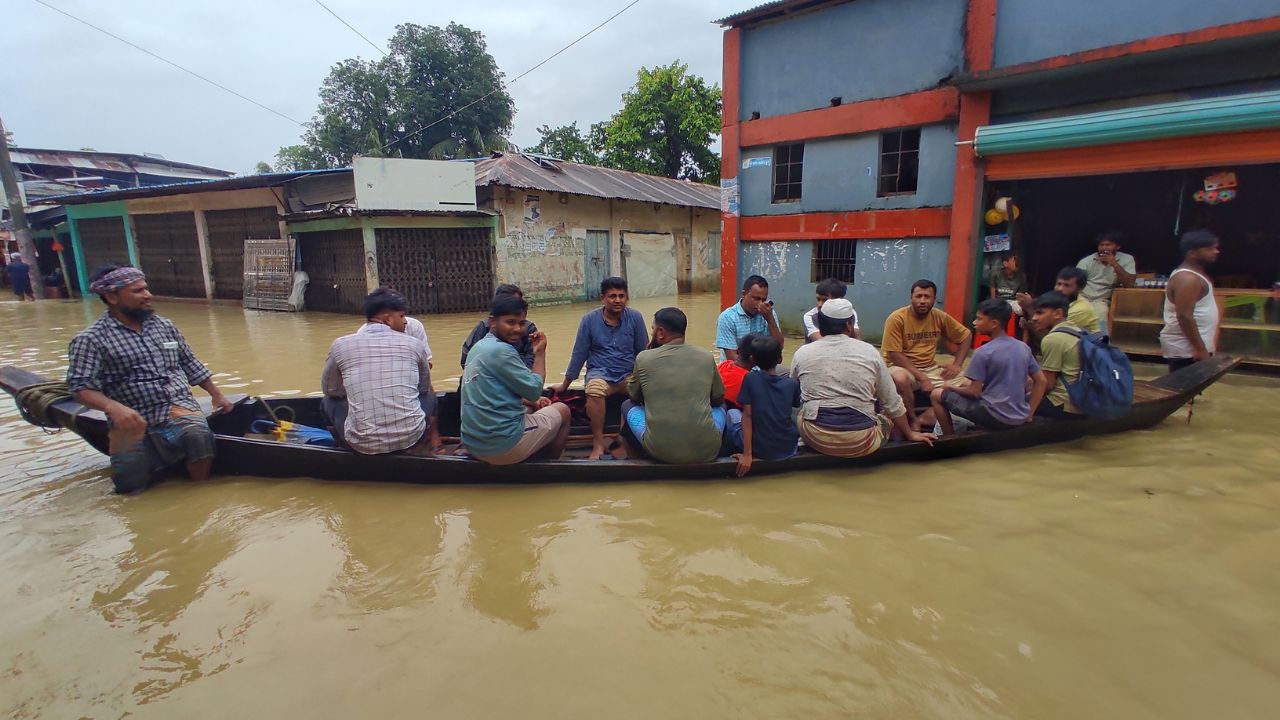



Millions across Bangladesh are enduring flooding, waterlogging, river erosion and severe disruption after relentless rain, with southern Chattogram at the centre of a humanitarian crisis as rivers rise in the northeast and fresh threats loom over northern districts.
On Friday morning, floodwaters surged to a depth of 1.5 to two feet across the Chattogram-Cox’s Bazar Highway at Hashimpur in Chandanaish, threatening one of the country’s busiest routes and the only highway link to Cox’s Bazar.
A Chattogram district administration team, accompanied by a TIMES of Bangladesh correspondent, travelled to the worst-hit upazilas of Satkania and Banshkhali, where communities had become isolated islands.
Roads had vanished beneath muddy water, transport had collapsed and hundreds of thousands faced shortages of food, safe water and medical care.
Chattogram received about 1,175 millimetres of rain over the past week, the highest weekly total in the city’s recent history. Although the downpour eased on Friday, 154.8 millimetres fell in the preceding 24 hours.
Nearly every road to Satkania was submerged, while scarcely any dry ground remained across Satkania and neighbouring Lohagara.
At the flooded Satkania Upazila Complex, Deputy Commissioner Mohammad Zahidul Islam Miah said virtually all of Satkania and Banshkhali were underwater, alongside large areas of Chandanaish, Anwara, Hathazari and Fatikchhari.
Nearly 7,00,000 people are stranded across Chattogram district, with at least 1,00,000 directly affected. The deputy commissioner said the transport network had collapsed and rescuers lacked suitable watercraft. The administration has requested speedboats from the Bangladesh Army.
More than 600 emergency shelters have opened with food, safe drinking water and essential supplies.

But aid remains difficult to reach. In Dhemsha of Satkania, 35-year-old Halima Begum was trapped inside her flooded home even as volunteers distributed food from a nearby truck. The water was too deep to cross.
Dhemsha Union Parishad Chairman Abu Taher said destroyed roads had paralysed relief operations. He said a pregnant woman died on Thursday night after floodwaters prevented her from reaching hospital.
In neighbouring Banshkhali, two children, Miraj and Ashik, were swept away and drowned in separate incidents in Baharchhara on Friday morning.
Water stood waist to chest deep across West Gunagari, Kalipur and Baharchhara. Families took shelter in schools and two-storey buildings, while others remained trapped in partially submerged homes.
In Ward 2 of Gunagari, nearly 300 homes were underwater and hundreds crowded onto the second floor of a building known as Labu’s Shop. Children slept on concrete floors as families waited with little food.
Pharmacist Abdul Gafur, 70, said he had never seen such flooding. Electricity had been unavailable for four days. Ahmed Hossain, 65, who fled with his family, said he had experienced many floods but never felt so helpless.




Farasa Begum escaped with her seven-member family carrying only the clothes they wore. Another resident, Sadia Sultana, is approaching childbirth, but submerged roads and unavailable transport have left no safe route to hospital.
Officials have allocated Tk 20 lakh in emergency assistance, but residents said cooked food was urgently needed because kitchens and fuel remained underwater.
The crisis extends into Cox’s Bazar, where large areas of Chakaria, Pekua and Matamuhuri remain submerged and more than 5,00,000 people are stranded.
Two teenage sisters, Hasnatul Jannat Jharna and Shaorin Moni, died in Chakaria when their boat capsized as they left home for a safer shelter.
At least 24 people have died in landslides, wall collapses and drowning after five days of heavy rain. Chakaria and Pekua are among the worst affected. Pekua Upazila Nirbahi Officer Rafiqul Islam urged residents of low-lying and hill-adjacent areas to remain vigilant.
There were signs of improvement in the hill districts. Water in the Chengi and Maini rivers in Khagrachhari began receding, although Badanala, Lemuchhari and parts of Mahalchhari remained submerged.
Traffic resumed on the Dighinala-Langdu, Dighinala-Baghaichhari, Dighinala-Sajek and Khagrachhari-Rangamati roads.
Bandarban saw four hours of sunshine after five days of rain, while the Sangu and Matamuhuri rivers began receding. Agriculturist Kai Chin warned that waterlogging could rot cucumber, ridge gourd, bitter gourd, pointed gourd and spiny gourd roots.
A notice signed by Bandarban Deputy Commissioner Md Samiul Ferdous said that the tourism ban in Bandarban has been extended to July 12 due to the risk to the communication system due to continued heavy rains.
In Rangamati, all 411 tourists stranded in Sajek returned home. With help from the army and residents, they crossed flooded road sections by boat and bamboo raft. Visits to Sajek, springs, resorts and other tourist sites remain suspended.
Meanwhile, flash floods intensified in Habiganj and Moulvibazar, where broken embankments and rising rivers flooded 22 unions.
Habiganj Water Development Board Executive Engineer Sayedur Rahman said water was entering through two points of the Khowai River embankment, including one where about 100 metres had eroded. Strong currents were preventing repairs.
Floodwater entered Moulvibazar Sadar, Kamalganj, Rajnagar and Kulaura, while the Manu crossed the danger level. Water rose at four of Sunamganj’s five monitoring stations, and officials warned continued upstream flow could rapidly swell other rivers.
The Flood Forecasting and Warning Centre said heavy to very heavy rainfall over the next 24 to 48 hours would keep risks high.
The Sangu, Matamuhuri, Khowai, Manu and Kushiyara were above danger level at several stations. Although water may gradually recede in Bandarban, Chattogram and Cox’s Bazar, the Gomti, Muhuri, Feni, Selonia and Halda could rise above danger level, causing short-term flooding in low-lying parts of Feni, Chattogram, Khagrachhari, Lakshmipur and Noakhali.
In the northeast, the rising Surma-Kushiyara system could worsen flooding in Sylhet and Sunamganj. The Sarigowain, Someshwari, Jadukata and Bhugai-Kangsha may also overflow.
Partha Pratim Barua, sub-divisional engineer of the Flood Forecasting and Control Centre, told TIMES that water was above danger level at nine stations on five rivers, while nine more rivers were on alert.
Lalmonirhat, Nilphamari and Rangpur are under observation. The Teesta may cross the danger level within 48 hours, while the Dharla and Dudhkumar could reach warning level within 72 hours, temporarily inundating low-lying areas of Kurigram and Lalmonirhat.
Barua said there was no immediate threat of prolonged flooding because rivers in hilly areas rise rapidly but usually recede within one or two days once rain stops.
Elsewhere, urban waterlogging has disrupted lives and incomes. In Jamalpur, large parts of the municipality become submerged after heavy rain. Residents blocked the railway line at Gatepar for three hours on Thursday, demanding a permanent solution.
Maisha Binte Majed of Chandra said rain sent water into homes, bringing disease and fears of snakes. Easy-bike driver Shanto said residents staying indoors had sharply reduced incomes.
Low-lying parts of Khulna city were also submerged. Rickshaw driver Hasan Ali, sole earner for a family of four, said he had secured only two passengers by Friday afternoon. Fruit vendor Sohel in Nirala said sales had collapsed and stocks risked spoiling.
In Satkhira’s Mashkhola village, Shahanara Begum said water had entered her kitchen and feared more rain would inundate her home. Van driver Kartik Das said his family had stopped buying rice and pulses as his income dried up, while daily wage worker Mokshed Ali had been unable to work for two days.
Low-income families are suffering most as earnings disappear, food dwindles and relief remains blocked. Even where rain has eased, the challenge is reaching millions facing hunger, illness, isolation and renewed flooding.
Our correspondents from various districts have contributed to the report.