






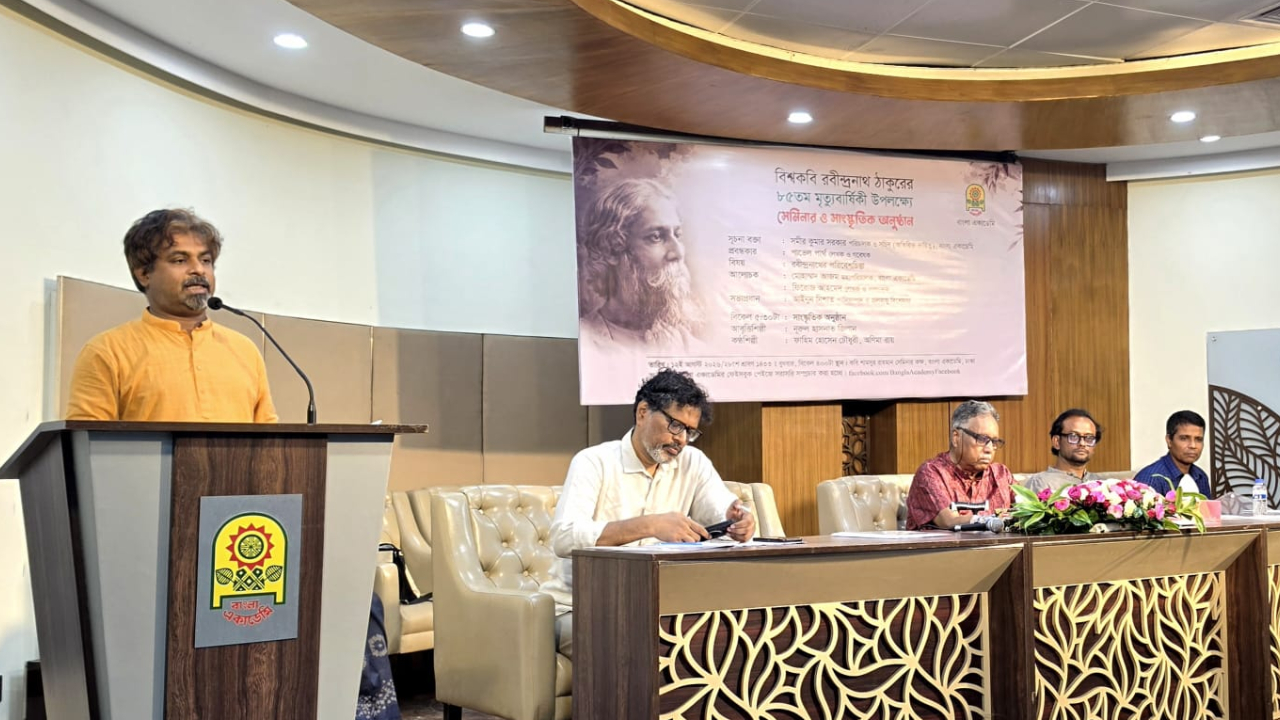
Bangla Academy organised a seminar and cultural programme on Wednesday marking the 85th death anniversary of Nobel laureate Rabindranath Tagore, with discussions focusing on his environmental thought and its continued relevance in the contemporary world.
The programme was held at the Kabi Shamsur Rahman Seminar Hall of Bangla Academy at 4pm on 12 August, corresponding to 28 Shraban 1433.
Samir Kumar Sarkar, director and secretary (additional charge) of Bangla Academy, delivered the opening remarks. Writer and researcher Pavel Partha presented a paper titled ‘Rabindranath’s Environmental Thought’.
Bangla Academy Director General Professor Mohammad Azam and writer and editor Firoz Ahmed took part in the discussion, while water resources and climate expert Ainun Nishat chaired the session.
In his opening remarks, Samir Kumar Sarkar said Tagore had embraced almost every aspect of the world and human life through his thoughts and expressed them in his creative works. He noted that Tagore had reflected on the environment throughout his life and expressed a deep concern for its protection through his writings.
Presenting his paper, Pavel Partha stressed the importance of moving beyond a purely human-centred approach to environmental and development thinking. He highlighted how contemporary development often overlooks the interconnected existence of forests, rivers, plants, animals, birds and other forms of life.
Referring to Tagore’s environmental thought, Partha said the poet encouraged people to understand and embrace their surroundings, recognising the existence and development of all forms of life. He also stressed the importance of learning to perceive life from the perspective of nature and other living beings.
The discussants said Tagore had consistently emphasised the need to ensure a beautiful environment for all forms of life, from human beings to plants, throughout his poems, letters, stories, songs, novels, plays, essays and speeches.
They observed that environmental thought was not a separate category in Tagore’s work, but an integral part of his creative and intellectual outlook. His ideas remain particularly relevant in the era of global warming, they said, as Tagore had long emphasised environmentally responsible progress rather than treating mechanical advancement as the sole measure of development.
Ainun Nishat said Tagore was not only a globally renowned literary figure but also an environmental thinker of international stature. He noted that Tagore had consistently placed the environment at the centre of his thoughts and encouraged readers to become more environmentally conscious.
Nishat added that Tagore had repeatedly warned against environmental degradation and questioned development activities carried out at the expense of nature. His environmental thought, he said, could continue to inspire efforts to ensure a safer and more sustainable environment.
Bangla Academy Deputy Director Kazi Rumana Ahmed Soma conducted the programme.
The cultural segment began at 5:30 pm, featuring recitation of Tagore’s poetry by Nurul Hasnat Jilan. Rabindra Sangeet was performed by Fahim Hossain Chowdhury and Anima Roy.


