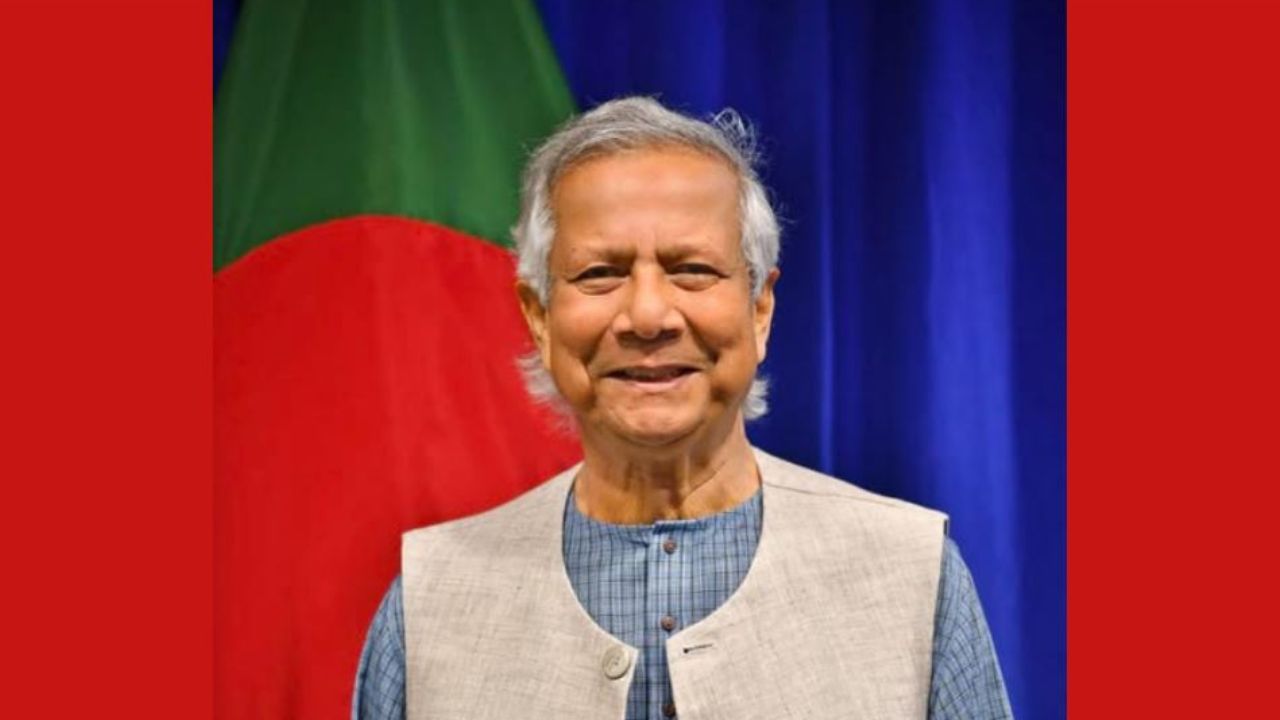



There are times in history when nations are presented with a period in which the nation’s destiny is redefined. For Bangladesh, August 5, 2024, is such a period. Not only did it mark the end of a time when a single political party was dominant, but it also marked the start of a period when Bangladesh began rebuilding its democracy and moving into the future. Looking at this important period of Bangladesh, there is one person who stands out as being central to that transition – Professor Muhammad Yunus. Not many leaders can be asked to accept responsibility for running a country on the brink of uncertainty. Professor Muhammad Yunus has stepped up and assumed the role of leader without seeking any political office or political gain. At a time when Bangladesh is under economic stress and politically polarised, Professor Yunus provides the country with stability.
The July revolution of 2024, which began with a student-led demonstration, became a national demand for democracy, constitutionality, justice, and an end to corruption, suggesting long-standing frustration. With the ascension of the Interim Government under the presidency of Professor Yunus, the country found itself with an economy suffering from inflation, dwindling foreign exchange reserves, low investor confidence, and difficulties in the banking sector. The problem of a lack of confidence was also evident in public institutions. The task was thus not only to run the country but also to restore confidence in the state.
History often distinguishes between politicians and statesmen. Politicians generally respond to immediate political realities, while statesmen seek to shape the future through institutions and national vision. Qualities that are rarely combined in a single leader include international respectability, political impartiality, dedication to humanity, and trust among both national and international stakeholders. The reputation of a Nobel Peace Prize winner assured development partners, investors, international organisations, and democratic nations that, despite an unstable political situation, Bangladesh continued to pursue constitutional government. Maybe his most important achievement in that period was to stop uncertainty turning into instability. In a period when political tensions could easily escalate into conflict, his leadership managed to create an environment in which dialogue and reconstruction became possible.
While it is true that a transition government cannot solve structural problems built up over several decades in a short period, the main concern of the interim government was to restore economic and administrative confidence. The problem of inflation gradually abated, macroeconomic management improved, constructive interaction with financial institutions was ensured, and Bangladesh’s financial reputation remained intact in the international arena. All these factors helped reduce uncertainty and instill confidence among development partners and foreign investors. Equally important was the government’s attempt to increase transparency and accountability in governance. Professor Yunus held that economic development is possible only when there is trust in institutions, and they are not politicised.

If future historians try to pinpoint the main contribution of Professor Yunus during his tenure, they would certainly point to his focus on institutional reform. The Interim Government did not rely solely on its own discretion; it established several independent reform commissions to examine constitutional governance, elections, judicial independence, public administration, corruption control, police reforms, local government, media governance, and civil service reform. It was a recognition that, for a transition towards democracy to be enduring, institutions have to be more powerful than people.
But the most significant result of this process was the July Charter, which sought to translate the ideals of the July Revolution into a coherent system of democratic governance by emphasising constitutional democracy, judicial independence, transparent administration, election reform, decentralisation, anti-corruption, and citizen participation. Whether every recommendation is fully implemented will depend upon future governments. Nevertheless, the Charter has already become an important milestone in Bangladesh’s democratic evolution.



Professor Yunus’s international reputation also proved to be one of Bangladesh’s greatest diplomatic assets during the transition. His leadership strengthened relations with development partners, international financial institutions, investors, and democratic governments. Bangladesh regained an important measure of international confidence at a time when political uncertainty might otherwise have undermined economic cooperation and diplomatic engagement.
His credibility reminded the world that Bangladesh possessed both the resilience and the capacity to pursue democratic renewal through peaceful constitutional means.
No leader is immune from criticism, and the government of Professor Yunus was an exception to that rule. The questions of implementation, law and order, bureaucracy, and incomplete reforms can certainly be discussed in any democracy. However, history is likely to render verdicts different from those in contemporary political disputes. Controversies may fade away, but achievements are likely to survive over time. Governments come and go, but constitutional reforms, developed institutions, transparent governance, and democratic standards continue to shape countries irrespective of particular leaders’ policies. If the people of Bangladesh continue to develop their democratic institutions, maintain judicial independence, fight corruption, promote good governance, and defend their constitutional rights, then Professor Muhammad Yunus will be remembered as not only the Chief Adviser of the transitional government, but as a statesman who assisted in transforming Bangladesh’s democratic tradition.
Future generations who celebrate the 5th of August will probably not do so solely because one government left office. What is more important is that future generations might remember that day for the day Bangladesh started to reshape its democracy. Professor Muhammad Yunus might be remembered as the statesman who answered the call of duty of his country in a time of great uncertainty; who prioritised national reconciliation over political divisions; who restored confidence both locally and internationally; who started the most far-reaching institutional reform program ever undertaken; and who tried to turn the ideals of the July Uprising into institutions.
Ultimately, history rewards those who leave their countries stronger than they were when they started. If the democratic dreams of the July Uprising are kept alive through constitutional reform, responsible government, institutionalism, and development, the legacy of Professor Muhammad Yunus will far outlast his term as president. For it will not be merely that he has guided the country through a challenging period of transition; rather, it will have been his role in reminding the people of Bangladesh and the world that democracy depends not on the victory of the individual but on the power of institutions and the people to seek justice and dignity.
August 5 may thus be seen not merely as an end to a particular era in Bangladeshi politics, but the start of a new one in Bangladeshi democracy, and Professor Muhammad Yunus will long be one of its great architects.
The views expressed in this article are solely those of the author
The writer is the Professor and Former Chair, Department of Journalism and Mass Communications, Savannah State University. E-mail: [email protected]