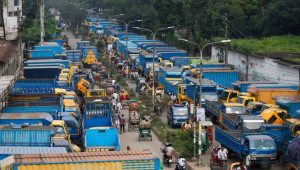
After the Eid holiday, Debashish Biswas remains stranded in Bogura, unable to return to Dhaka. He travelled by motorcycle but now struggles to find the five litres of fuel needed to complete his journey.
Although several filling stations are located just a few kilometres from his home, they remain closed throughout the day.
For instance, the Haque Pump in the Banani area only opens between 8pm and 10pm, while the Betbari Pump was open for just one hour on the day after Eid, providing Debashish with a brief opportunity to refuel.
Debashish also witnessed long queues at the Bogura Filling Station, where customers were forced to wait for hours, only to receive a litre or less of fuel. He reported that while the official price of fuel is set at Tk120 per litre, some stations are charging between Tk200 to Tk300 per litre.
Despite the official shortages, Debashish claimed that local grocery stores are secretly selling fuel, with prices reaching up to Tk300 per litre.
To buy enough fuel to return to Dhaka, Debashish would need to spend around Tk1,500, an expense he is unwilling to incur.
The ongoing fuel supply disruption, triggered by the Middle East conflict, has led to severe shortages in Dhaka and across the country. As queues at filling stations continue to grow longer, uncertainty rises over when the closed pumps, especially in smaller towns, will reopen.

Despite these mounting challenges, the government insists that fuel supplies have returned to normal. However, the persistent shortages and rising prices suggest otherwise, leaving commuters like Debashish trapped in a frustrating cycle of waiting and uncertainty.
Faruk Mia, owner of the Rupnagar Filling Station in Baraiyarhat, Mirsharai, Chattogram, told Times of Bangladesh that fuel deliveries to his station have dropped significantly.
“Previously, we received five tankers carrying around 45,000 litres of fuel each week. Now, it has fallen to just 18,000 litres – a decrease of almost 60%,” he said.
Petrol pumps dry, fuel in shops
In many parts of the country, including Bogura, filling stations remain closed during the day, with fuel secretly delivered to local shops in bottles. Stations open for just one or two hours in the evenings, and even then, not everyone can get fuel, a local resident said.




Ijaz Hossain, a fuel supply expert, described this situation as a “sign of an artificial crisis.”
He told TIMES that while reduced supply from depots is partly true, the real problem lies in the distribution stage.
“The combination of the Middle Eastern situation and internal mismanagement has created a ‘mixed crisis,'” he explained.
The situation in Natore mirrors that of Bogura. A motorcycle rider mentioned that he can only obtain fuel if he is well-acquainted with the pump owners.
Rezwan Ahmed, a resident of Kaliganj, Jhenaidah, reported that local pumps were selling fuel at Tk250 per litre, but customers could only purchase a maximum of two litres. Some stations remain closed during the day, reopening briefly between 3am and 4am. In Kotchandpur, Rezwan had yet to find a pump open.
Meanwhile, in areas like Mallikpur and Kola, grocery stores are openly selling bottled fuel at Tk300 per litre.
“Most of our supply arrives at night, so we’ve been selling it during the night for the past few days,” said Sumon, an employee at Bejpara Pump in Kaliganj.
Zikrul Haque from Saidpur accused filling stations of deliberately closing during the day and only opening at night to create long queues.
“They are diverting the fuel to local shops, where it is sold for Tk300 per litre. I, too, have had to buy at these inflated prices,” he said.
Similar scenes are unfolding in Dhaka, with local stores near Jatrabari, Mohammadpur, and Basila Bridge openly selling fuel at Tk250 per litre. Such sales, conducted without a licence, are illegal, suggesting that a significant portion of fuel from the stations is being diverted to these shops.
What is the solution?
Despite ongoing raids targeting illegal fuel hoarding, the fuel crisis shows little sign of improvement.
As of 2 April, authorities have seized 372,388 litres of fuel in such operations. In connection with these incidents, 2,009 cases have been filed, fines amounting to Tk1.01 crore have been levied, and 24 individuals have been sentenced to prison.
However, the situation remains largely unchanged, with shortages continuing to plague the country.
EM Shafiquzzaman, director of the Consumer Association of Bangladesh, told TIMES of Bangladesh, “While the government repeatedly claims there is ‘sufficient stock,’ the reality on the ground is very different. This has led to a severe loss of public trust.”
Shafiquzzaman emphasised that restoring public confidence requires transparent information and stringent action against stockpilers and those deliberately creating artificial shortages within the distribution chain.
Energy expert Ijaz Hossain advised the government to clarify the actual extent of the fuel shortage. “The situation we are witnessing is difficult to control through administrative measures alone. To resolve this crisis, the government must identify where the gaps are in the supply and distribution pipelines and take exemplary action against those responsible,” he said.
He further pointed out that if a portion of the supply “leaks” out of the official distribution network, it will inevitably lead to an artificial crisis in the market.