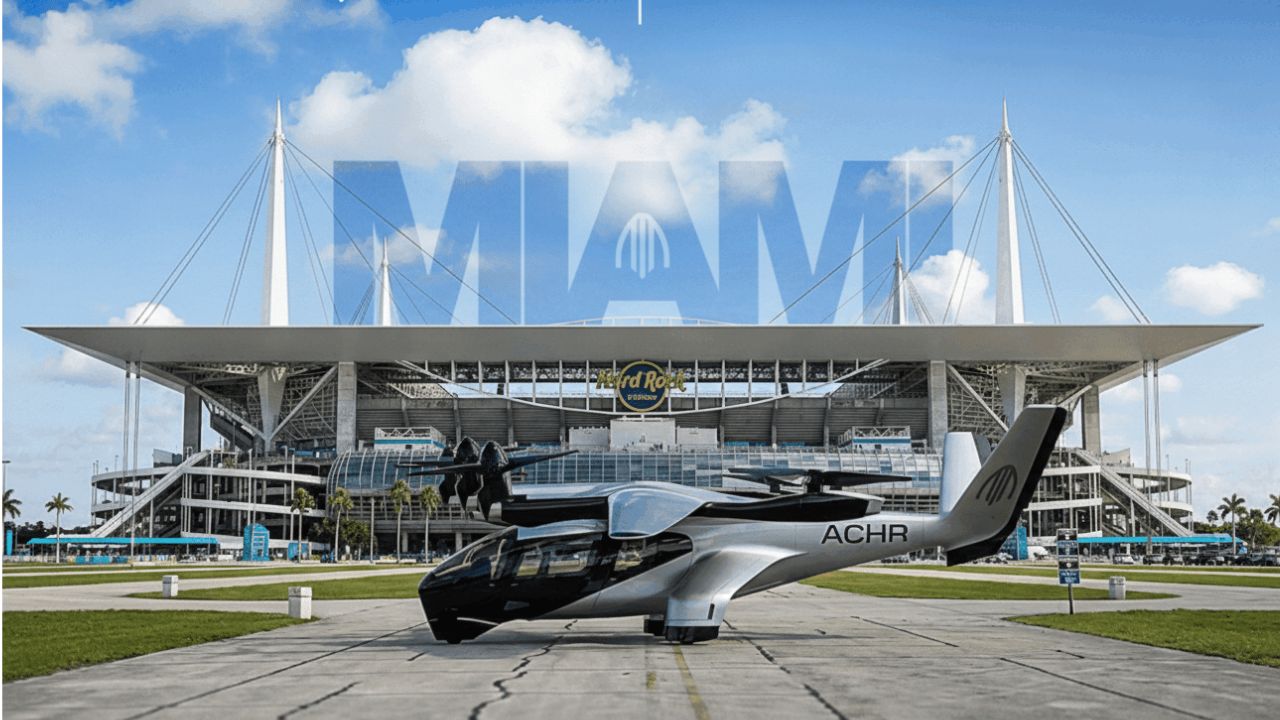

San Jose-based Archer Aviation has revealed plans for a regional electric air-taxi network over Greater Miami, promising to cut through the city’s notorious traffic with its four-passenger Midnight eVTOL aircraft.
The service aims to link downtown Miami with Boca Raton, Fort Lauderdale, West Palm Beach, major airports, and other key destinations via a mix of new vertiports and upgraded helipads.
The network is designed to target the city’s densest travel corridors, providing rapid hops above congested highways where public transit options are limited. Proposed vertiports include West Palm Beach and Miami’s Little Haiti, while upgraded helipads are planned at Hard Rock Stadium and Apogee Golf Club. Five additional general aviation airports will also be connected, pending final approvals.
Riders will initially be premium customers, with early reports suggesting a 30-minute flight from Miami to West Palm Beach could cost around $200. The company has not confirmed launch dates or detailed fares.

Once operational, air taxis are expected to reduce commutes of up to 90 minutes on the road to under 20 minutes in the air, provided ground access to vertiports is efficient.
Regulatory hurdles remain significant. Archer’s Midnight aircraft must secure FAA type certification, a process that can take five to nine years.




The company is in late-stage review and could participate in federal pilot programs allowing limited operations of pre-certified aircraft under strict supervision. Safety, noise standards, and community acceptance will all play a role in shaping the network’s rollout.
Archer faces competition and legal challenges from rivals such as Joby Aviation and Eve Air Mobility, who are also courting cities and airports. Joby recently sued Archer over alleged executive poaching and attempts to disrupt a real estate deal, highlighting the high stakes involved in securing vertiport sites.
Beyond Miami, Archer has announced plans for air-taxi service in Saudi Arabia, the UAE, and for the 2028 Los Angeles Olympics, along with partnerships with United Airlines connecting Manhattan and downtown Chicago to nearby airports.
For Miami commuters, the proposed system promises predictable travel times, bypassing gridlock, though early access may be limited to high-paying users.
Investors and policymakers will be watching progress on certification, vertiport construction, and pilot operations closely. Archer’s Q3 2025 report showed a net loss of $130 million on $45 million income, underscoring the capital-intensive nature of scaling both aircraft production and supporting infrastructure.
If successful, Miami could become one of the first U.S. cities with a functioning eVTOL corridor network, ushering in a new era of urban mobility above the city streets.