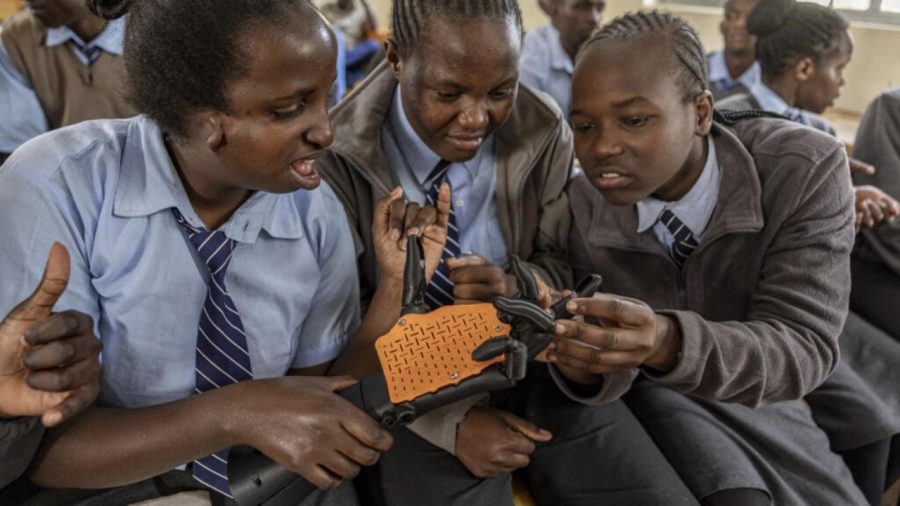

Children at a school for the deaf in Kenya signed with excitement as a team demonstrated how a robotic arm could transform the way they study.
The technology, developed by Kenyan start-up ZeroBionic and co-founded by 22-year-old Norah Kimathi, is designed to address educational challenges faced by hearing-impaired pupils, reports AFP.
The innovation uses a mechanical hand to translate a teacher’s speech into sign language in real time, enabling deaf children to learn alongside their hearing classmates.
According to the Kenya Society for Deaf Children, around 300,000 children in the East African country have a hearing impairment. Yet, as of 2024, only 20,000 were enrolled in schools.

Many deaf children in Kenya rely on a patchwork of makeshift signs, while the local dialect lacks many technical terms needed for subjects such as maths and biology.
At Kasarani Treeside Secondary School for the Deaf in Nairobi, deaf teachers are also testing the technology to record and store signs using an imported bodysuit.
The process is helping build a database of technical terms drawing on English, American and Kenyan sign languages, with the aim of expanding the language and making communication and learning easier for deaf pupils.




Speaking to AFP at ZeroBionic’s small laboratory in Nairobi, Kimathi said the lack of existing data was the team’s biggest challenge.
“The biggest challenge we faced actually was in Africa we don’t have a standardised African sign language dataset,” she said, adding that because no one else on the continent had created one, her team had to start from scratch.
For 19-year-old Sharon Mumbe, a pupil at the deaf school, the invention has brought renewed confidence.
“I’ll be able to understand different concepts better,” Mumbe told AFP, saying the project gives her “hope for the future”.
At Kimathi’s laboratory, prototype limbs cover the work surfaces as the development team works alongside Africa One, a humanoid robot built in-house to refine and expand the signs produced by the mechanical arms.
To keep costs and environmental impact down, the team designs and manufactures all components in-house using recycled materials and 3D printers that operate constantly in the background.
Each mechanical hand costs about $350 and can operate for up to two years. The technology has already been deployed in 78 schools across Kenya.
Kimathi said the system has achieved a 92 per cent speech-to-sign accuracy rate, making the team’s long hours in the laboratory worthwhile.
“We know we’re going to put a smile on someone else’s face,” she said.