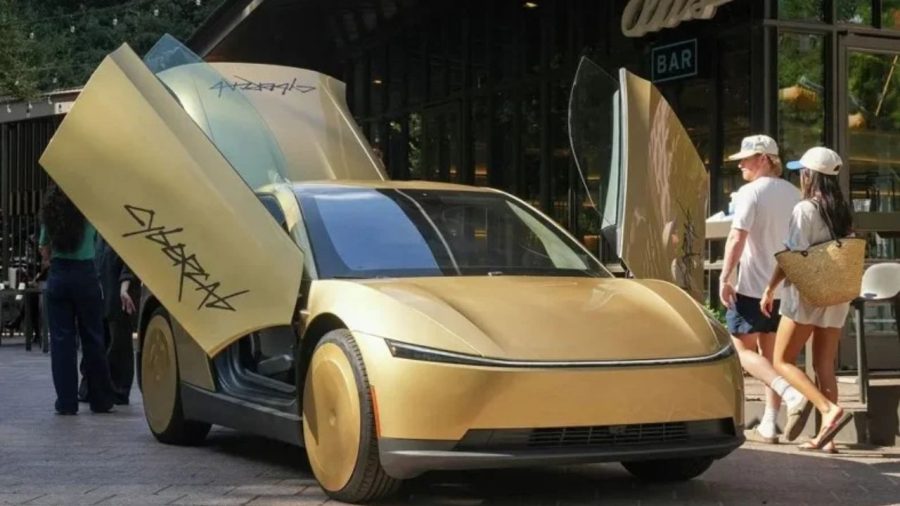



Electric-vehicle maker Tesla has unveiled its self-driving robotaxi, the “Cybercab”, as it seeks to compete with ride-hailing giants such as Uber and autonomous vehicle company Waymo.
First introduced in October 2024, the gold-coloured Cybercab has no pedals or steering wheel. Designed specifically for driverless taxi services, the vehicle can carry two passengers.
Tesla CEO Elon Musk on Thursday posted a picture on X showing a Cybercab towering over Austin, the Texas capital where Tesla is headquartered, with a cloud of dust behind it, reports AFP.
Cybercabs had already been spotted on Austin’s streets ahead of the launch, while passengers can now select the new vehicle through Tesla’s updated dedicated app.
“This is “humanity changing,”” Graham Sprigg, a tourist from Australia, told AFP.

“It’ll change transportation from owning your own car to actually just getting transportation as a service, which is fantastic for disabled people and old people like I’m becoming,” Sprigg added.
Musk forecast a “storm of Cybercabs” in Austin, where Tesla held an invite-only event at an entertainment venue that was not open to the media.


According to the Austin American-Statesman, attendees at the event were the first to take rides in driverless Cybercabs. The vehicles are scheduled to become available to the public from Friday. Social media posts showed fans arriving at the event, with some wearing gold to match the vehicle.
Tesla’s posts highlighted what the company described as the Cybercab’s safety and ease of use for disabled people, calling it “democratizing clean transportation for all.”
Tesla launched its self-driving cars in Austin last year using Model Y SUVs, with its “Robotaxi” service gradually expanding to several other cities across Texas, Florida and California.
However, state laws require many of the vehicles to have a human supervisor or driver ready to take control if necessary. Waymo, the self-driving vehicle subsidiary of Google parent company Alphabet, currently operates in 11 US cities.
According to FSD Database, based on data from the Texas Department of Motor Vehicles, Tesla had registered 314 robotaxis in Texas as of Wednesday, including 45 Cybercabs.
Itay Michaeli, an analyst at TD Securities, told AFP he expects a “slow launch” of the Cybercab, similar to the rollout of the Robotaxi. Tesla is likely to consider feedback from early users before expanding the service, he said.
Texas has regulations favourable to autonomous vehicles, making the state one of the preferred testing grounds for several such services. Waymo and Zoox already operate there, while Motional is conducting trials.
“Tesla is really just getting started,” said Anthony Townsend, a senior research associate at Cornell Tech, a policy research organisation in New York.
Townsend said it remains to be seen which company in the crowded autonomous vehicle market has the strongest business model.
“It’s always been the promise that AV taxi companies will become cheaper than human-driven rides, but it’s not clear that’s even within sight,” Townsend said in a note, adding that it is also unclear when the companies could break even.