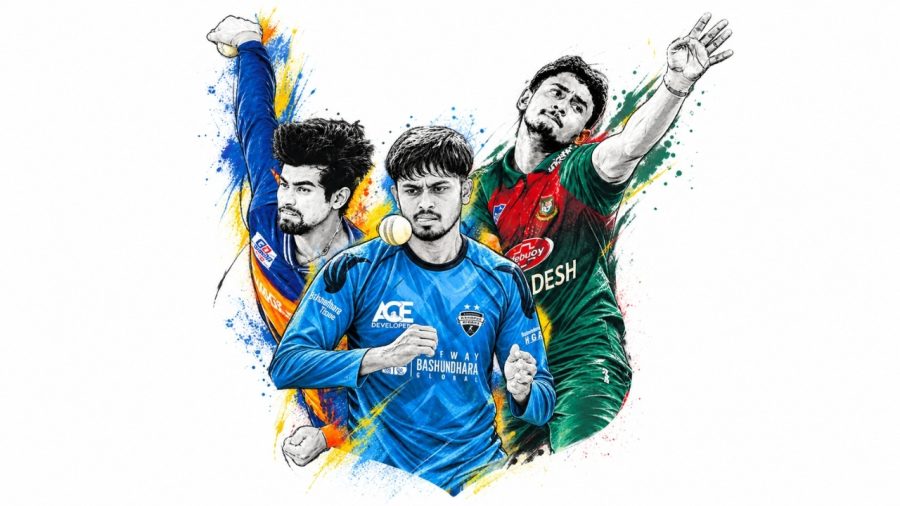

Leg spin has long remained an unfamiliar art in Bangladesh cricket. It would perhaps not be wrong even to call it a dying art. For something to die, it first needs the chance to live.
Bangladesh have produced generations of left arm and off spinners. Mohammad Rafique built a career with left arm spin. Abdur Razzak, Shakib Al Hasan followed and became two of the country’s greatest cricketers. But wrist spinners have rarely found the same path. Before Rishad Hossain, the country’s wrist spin sector only produced big headlines when Alok Kapali went on to become Bangladesh’s first bowler to take a hat-trick, and when the likes of Jubair Hossain, Tanvir Haider and Aminul Islam Biplob first came into the scene, only to fade away later on.
The problem had become serious enough for the Bangladesh Cricket Board to intervene directly.
In 2019, the BCB instructed National Cricket League teams to field leg spinners. When Dhaka Division left Jubair Hossain out of their playing XI and Rangpur Division did not include Rishad Hossain in their squad for the second round, the board replaced coaches Jahangir Alam and Masud Parvez Rajon.
Years later, one of those two leg spinners would finally break the barrier.
Rishad’s rise, however, was hardly a product of regular domestic opportunities. Chandika Hathurusingha, during his second spell as Bangladesh head coach, backed him despite his limited domestic experience. It was not the first time Hathurusingha had taken that route. During his first spell, he had also pushed Jubair towards international cricket without the conventional domestic foundation.
With Rishad, the gamble worked. Hathurusingha later said Bangladesh had backed Rishad for a year because they believed he could win matches. After Rishad’s match winning performance against Sri Lanka at the 2024 T20 World Cup, the coach pointed towards something deeper than one player’s success.
“We don’t understand the value of a leg spinner,” Hathurusingha said.
Rishad eventually became an important part of Bangladesh’s white ball attack. But his rise left another question behind. Did Bangladesh finally build a pathway for leg spinners, or did one leg spinner succeed because a national team coach was determined to push him through a pathway that was still not working?

Shadhin Islam is one of the brightest names on the current circuit. The 18 year old impressed in the recently concluded Game Development Trophy 2026, a competition involving Bangladesh U17, U19 and U23 sides.
Shadhin took 9 wickets in three matches at an average of 8.67 while conceding only 3.55 runs per over. He bowls his leg spin with some pace and likes to keep things tight around the stumps.
His senior record is still developing. Shadhin has nine List A wickets from eight bowling innings at an average of 32.77 and an economy rate of 5.07. At 18, there is plenty of time. The more important question is how much cricket that time will contain.
Rakibul Hasan Rusafi, a leg-spinning all-rounder took three wickets in two matches in the same Game Development Trophy and conceded 4.38 runs per over.
But leg-spinning all-rounders can find themselves used less with the ball than finger spinners.
Debashish Sarkar Deba’s story makes that problem more striking.



Bangladesh were defending only 198 against India in the final of the 2024 ACC Men’s U19 Asia Cup. Debashish did not take a wicket, but figures of none for 17 from six overs (most economical that day) hardly tell the whole story.
He gave the ball flight. He turned it and directed his googlies well and, most importantly in a small chase, stopped India from scoring freely. The pressure grew and Bangladesh’s other bowlers took advantage. India were dismissed for 139 as Bangladesh won the title by 59 runs.
Almost two years have passed. Debashish has played only four List A matches and has bowled in just one innings.
For a young bowler who had already attracted attention outside Bangladesh, the contrast is difficult to miss.
Wasi Siddiquee, 19, has received comparatively greater exposure. He has 13 first class wickets from 14 bowling innings, 27 List A wickets from 21 innings and three T20 wickets from four innings.
Among young Bangladeshi leg-spinners, that represents a reasonable body of work. Yet even Wasi’s opportunities raise the question of how his number of opportunities compares with finger spinners of the same generation.
Mehedi Hasan Sohag knows that difference particularly well. Now 25, Sohag has spent time around the Bangla Tigers programme and Bangladesh HP setup. He has also been with Rangpur Riders during the BPL. Hathurusingha worked with him while coaching Bangladesh.
Sohag revealed in a 2025 interview that the former Bangladesh coach had continued to keep track of him even after leaving the job.
“Chandika Hathurusingha still asks about my whereabouts. He invites me to reach out to him if I ever visit Australia,” Sohag said.
Yet camps have not translated into much competitive cricket. Sohag has three List A wickets from four bowling innings. In recognised T20 cricket, he has played only two matches and taken one wicket.
Aminul Islam Biplob reached somewhere the others are still trying to reach.
After Jubair faded from the national setup, Aminul emerged as another possible answer to Bangladesh’s long search. He took 12 wickets in 10 T20I innings at an economy of 7.59.
Aminul was also working on adding the googly to his bowling. But his international career is stalled now.
His most recent performances came for Bangladesh Emerging in South Africa. In the one day tri-series involving South Africa Emerging and University Sport South Africa, he produced figures of 1/34, 2/9 and 2/28. But whether another national opportunity comes remains uncertain.
For Bangladesh spin bowling coach Sohel Islam, the problem begins much earlier than international selection.
“In the age group, or in the List A level, the contest is usually result oriented. Everyone runs after results, and the leg spinners are not nurtured eventually,” Sohel said.
“Building a leg-spinner is not an easy job. Those who want results don’t usually take the risk of playing them. They fear that the leg-spinners will get hit, leak runs. You will get many wrist spinners in the nets, but not in the matches. If they’re not allowed to play, how will they develop?”
His explanation goes beyond selection.
“Another thing is that our pitches are skiddy. Proper leg-spinners will find it hard to shine here. Even in the IPL, you’ll see the skiddy kind of leg-spinners shining, not the proper ones,” he said.
There is also the power of tradition.
“We don’t have many examples. Mohammad Rafique, Shakib Al Hasan, all of the big names are finger spinners.”
That may be the circle Bangladesh leg spin has struggled to escape. Rishad showed that the circle can be broken. But his story also showed how much patience, protection and faith it can require.
Behind him are Shadhin, Rusafi, Debashish, Wasi, Sohag and others still waiting for enough overs to discover how good they can become.
The wrist spinners are there. The harder question is whether Bangladesh cricket is prepared to let them bowl.