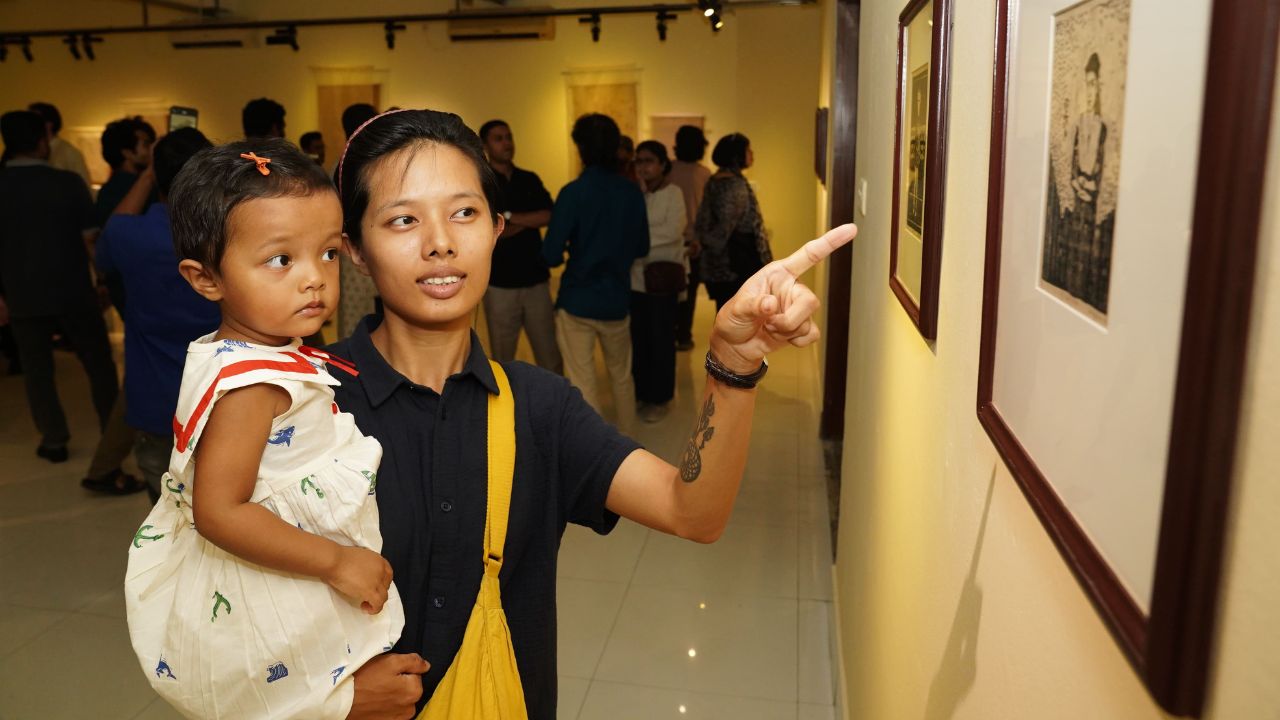



Alliance Française de Dhaka inaugurated Chowkath, the second solo exhibition by Dhaka-based multidisciplinary artist Sarah Jabin, on Friday, 31 July, at La Galerie, Alliance Française de Dhaka in Dhanmondi, the organisers said in a press release.
The exhibition, which explores the relationship between women, domestic spaces, memory, identity and the cultural traditions passed down through generations of Bengali households, will remain open to the public until 8 August, with daily visiting hours from 3pm to 9pm. The inauguration ceremony was attended by artist and writer Mustafa Zaman and Baptiste Lebret, Cultural Attaché at the Embassy of France in Bangladesh.
Drawing on research, personal observation and material culture, Chowkath examines the often-unseen roles women play as custodians of family memory and cultural heritage. The exhibition takes its title from the Bengali word for a threshold or doorway, framed as a symbolic space between the private and the public, the past and the present, and individual memory and collective history.

The show brings together four distinct bodies of work, each rendered in a different material and artistic language. In Bon Void, linocut prints trace the evolving identity of women from childhood to adulthood, while The Diminished Time uses soap as a sculptural medium to revisit the architectural heritage of Old Dhaka’s homes from the 1950s to the 1990s, reflecting on the gradual disappearance of familiar domestic spaces.




In the textile-based series Sharshi, Jabin turns her attention to household interiors and the enduring yet frequently overlooked presence of women within them. The exhibition is completed by delicate copper-wire line drawings capturing rituals, traditions and fragments of a cultural landscape gradually fading with time.
Through the works, Jabin positions herself as both an observer and a witness to a society in transition, bringing together objects, spaces and memories that connect generations. For older audiences, the pieces may evoke memories of familiar homes, customs and lived experiences, while for younger viewers they offer a window into the everyday worlds inhabited by their mothers and grandmothers.
By transforming the chowkath into a conceptual space of reflection, the exhibition invites audiences to consider what is preserved, what is lost and what remains embedded in the spaces called home, offering what the organisers describe as a deeply personal yet collectively resonant reflection on the changing landscape of Bengali life.