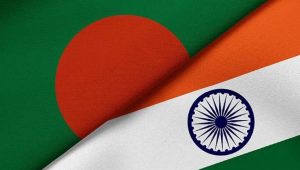


On the second year commemoration of the July-August uprising that brought down the AL government, the press conference in India by members of the proscribed party has, on one hand, triggered the question as to how India aims to normalise relations with Bangladesh and, on the other, relayed a message about AL’s unrelenting dogmatism plus intransigence.
Honestly speaking, unless one is completely consumed by partisan emotions, watching the full press conference is cringeworthy.
All throughout the event, undermining everything that happened in Bangladesh post Aug 2024 seemed to be the key objective.
When one of the Indian journalists asked a question about the UN approved number of deaths which took place during the July-Aug crackdown, the response from the son of the deposed and now exiled PM was to evade the deaths of civilians and refer to the killings of police personnel plus members of the student wing of the AL.
Sadly, this blatant sidelining of the question was not protested and neither did the journalist ask: if the men in uniform became victims of people’s rage, then what was the cause?
No one is denying that the police came under attack in the last days of the July-Aug Uprising and it’s also a fact that many members of the AL regime also faced the wrath of the masses but that’s how revolutions unfolded over the centuries.
A revolution borne out of indignation, repression and outrage, aiming to bring down a rotten system that had lost the trust of the people has never been and will never be about total restraint – we just need to look at history for proof.

However, any killing, even if it’s in retaliation to acts of brutality, is condemnable and, therefore, the deaths of police personnel can never be condoned.
The total disregard for the savage killings of young men, children and maiming of thousands indicates that AL has either not undergone some soul searching or is determined to brazen it out till the end.
At the conference, another journalist of Bangladeshi origin was raising concern about the spirit of 1971 being under threat.
This fear that unless one party is in power the whole essence of the glorious War of Liberation will be imperilled has become a bit of a cliché now.
Bangladesh has already crossed 54 years, the country is secure, the values of 1971 still shape our ethos, irrespective of the political entity in place.


Objectively speaking, as one of the leading parties of Bangladesh and one which has played a pivotal role in the birth of the country, AL will never be out of the political equation.
However, when this party has made glaring blunders, committed human rights violations, was complicit in disappearances, was instrumental in creating a Faustian Past with the media, held back to back sham elections and, was intolerant towards dissent then there needs to be some admission of guilt.
The problem is, no one wants to say sorry when a sincere apology can open grounds for reconciliation.
The AL has always had a habit of denouncing elections not held under its authority or, in which it failed to win and there have been similar lines of condemnation on the February 2026 elections in which, BNP emerged victorious.
Naturally, with such implacable animosity towards BNP, hearing any line of approval for the February polls, overwhelmingly acknowledged and monitored by internationally recognised election observers, would be too much to expect from the banned party.
If one remembers correctly, about a year before the July-Aug Uprising, an AL stalwart and a lawyer, in one of many grovelling addresses in parliament, requested the then head of government to be given the charge of the BNP, which, in his opinion, was in shambles and on the verge of implosion.
That guy should be eating humble pie for the rest of his life!
One does not have to be an international relations expert to understand that the press conference won’t facilitate the efforts for an Indo-Bangladesh détente.
The bi-lateral relations soured post July-Aug movement because of three reasons: 1. India had blindly endorsed the travesty in the name of national elections in which AL came out the winners 2. The members of the ousted government took refuge in India, 3. Indian media was regularly churning out specious narratives about the movement that brought down the AL government, which came to power with a democratic mandate and overwhelming support but, gradually, turned totalitarian.
But let bygone be bygones because India and Bangladesh are neighbours and their support in 1971 is still recalled with gratitude.
However, one preferred party cannot be in power forever.
Setting aside years of grievances of the people, suppression of dissent, indoctrination of one particular narrative and all the other aberrations, there’s one factor, often not given due importance: The rule of nature, under which no entity, whether in politics, sport, trade or power, can remain on top forever.
Back in the 80’s, while in school, we read a Bangla essay called ‘Shomoyer Proyojone’ in which the key protagonist was telling his comrades that the Liberation War, like all other events in life, is taking place because time and nature demanded it.
Won’t be wrong to say that July-Aug Uprising was the demand of the time and changes following it another illustration of the “Rule of Nature”.
As a common person understands, the holding of the press conference in Delhi could not have happened without the permission of the government.
Does this mean, India cannot think of resetting relations without taking AL into the picture?
For the ‘Entente cordiale’ to return, the ground realities need to be taken into account along with adopting a strategy to reach the masses and not a particular party.
Political hubris never brings a positive result, while a conciliatory tone is not a sign of weakness.
Regrettably, no one wants to make a strategic retreat for a better tomorrow!