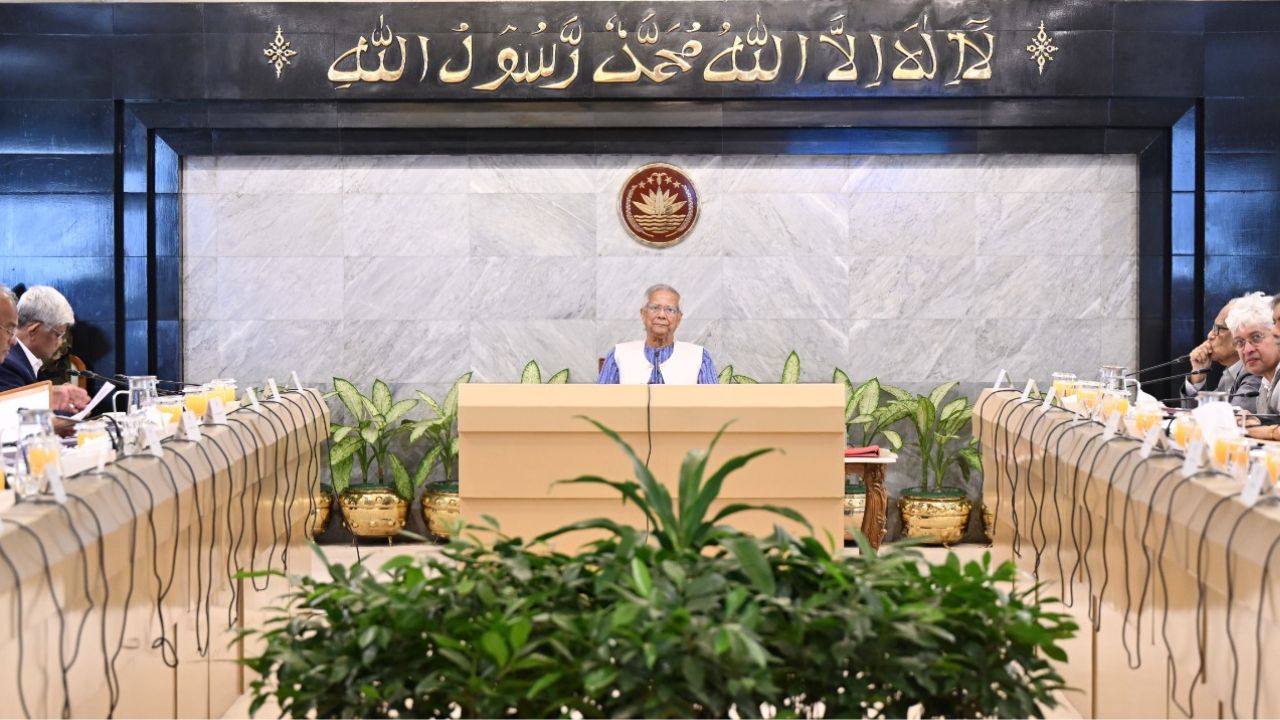



The advisory council, chaired by the Chief Adviser, on Thursday gave policy-level approval to several draft ordinances and policies.
Chief Adviser’s Press Secretary Shafiqul Alam briefed the media on the decisions at a press conference at the Foreign Service Academy after the meeting.
He said the draft Bangladesh Private Export Processing Zones (Repeal) Ordinance 2026 had received policy approval. The law, enacted in 1996, paved the way for private export processing zones in the country and led to the establishment of the Korean EPZ.
With the formation of the Bangladesh Economic Zones Authority BEZA, the law has since lost its relevance. Under the new decision, the Korean EPZ will now operate under BEZA’s supervision.
The press secretary said the draft Negotiable Instruments (Amendment) Ordinance 2026 had also been approved. A sharp rise in cheque dishonour cases has created a severe backlog in lower courts.

To ease the pressure, judicial jurisdiction has been reorganised. Magistrate courts will try cases involving amounts up to Tk500,000, while cases above that threshold will go to district joint judges or joint metropolitan judges.
Although the council held extensive discussions on the draft ordinance on money laundering prevention, it did not approve it on the day, citing the need for further review.
Shafiqul Alam said funds have been siphoned abroad from Bangladesh for years through multiple layers. Allegations suggest that around USD 34 billion was laundered during the tenure of Sheikh Hasina. Given the seriousness of the issue, the council felt the law must be made stronger and more effective through detailed scrutiny.



Press Secretary said the draft Bangladesh House Building Finance Corporation (Amendment) Ordinance 2026 had received policy approval. Until now, the corporation had to deposit all profits with the government, creating liquidity constraints. Once the ordinance takes effect, it will be able to retain a portion of its profits. This is expected to enhance its lending capacity and strengthen housing finance for middle- and lower-income groups.
The council also approved in principle the draft Gambling Prevention Ordinance 2026. By updating provisions of the Public Gambling Act of 1867, the law brings online and digital gambling under its scope. It defines 19 forms of gambling, including online betting, totalisator operations, bookmaking, match fixing and spot fixing. The ordinance sets out 15 types of penalties depending on the offence, with a maximum punishment of a Tk10 lakh fine or five years’ imprisonment, or both.
Repeat offences will attract double penalties. The press secretary said the law would play an effective role in curbing match fixing in sports, including cricket.
He also said the council approved the Mutual Legal Assistance Treaty MLAT between Bangladesh and Malaysia. The agreement will allow law enforcement agencies of the two countries to cooperate in criminal investigations, evidence collection, asset seizure and case proceedings.
Shafiqul Alam said partial amendments to the Right to Information Act had clarified the definition and scope of information and the application process. He noted that the changes would further strengthen the right of citizens and journalists to access information.
The meeting discussed the Bangladesh–Japan Economic Partnership Agreement EPA. Calling it a historic deal, the press secretary said 7,379 Bangladeshi products would receive immediate duty-free access to the Japanese market under the agreement. It will be Bangladesh’s first EPA with the world’s fourth-largest economy as an LDC. Japan will open 120 service sectors to Bangladesh.
The government believes the agreement will not result in revenue loss and that the experience will help future trade talks with Singapore, Malaysia, South Korea, the European Union and the United States.
The council approved the draft National Poultry Development Policy 2026. Around six million people are directly and indirectly involved in the sector, with women accounting for about 40 percent.
The policy emphasises protection for small farmers, control of antibiotic use, disease surveillance, cold chain development, feed price regulation and export expansion through compliance with international standards such as HACCP and ISO.
The press secretary said the council approved the Dhaka Central University Ordinance 2026. The aim is to resolve long-standing administrative complications by bringing seven government colleges in Dhaka under a unified academic framework.
The ordinance provides for a full administrative structure, UGC oversight, student union elections and research opportunities.
On the elections, Shafiqul Alam said the announcement of results may face some delay as the parliamentary election and referendum will be held on the same day and more than 1.5 million postal ballots will need to be counted. He said the public had already been informed of the matter.