






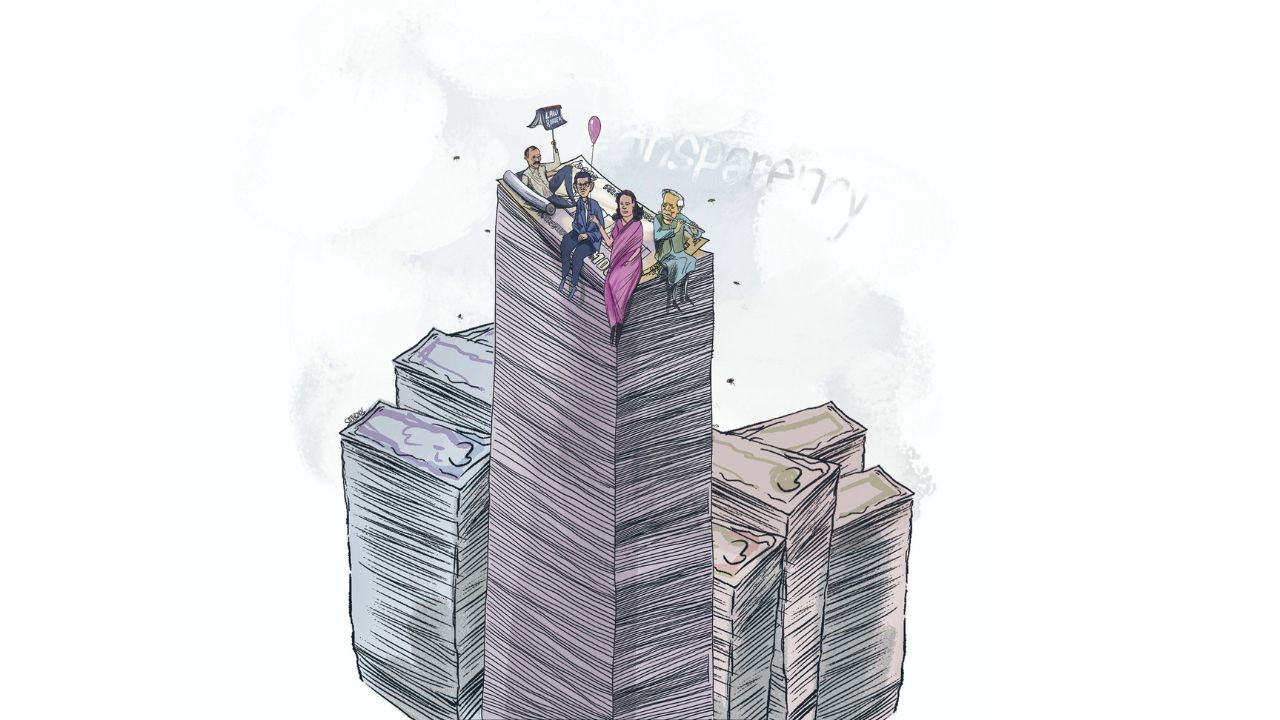
When Muhammad Yunus addressed the nation shortly after assuming office as chief adviser of the interim government, he made a promise designed to draw a clear line between his administration and the fallen Awami League government.
Transparency and accountability, he said, would define the new order. As a first step, all members of his advisory council would publicly disclose their income and assets.
Months on, that pledge remains unfulfilled.
Despite repeated assurances from senior figures in government, not a single adviser’s wealth statement has been made public. With just three weeks remaining before the parliamentary election, analysts say the silence has not only raised questions about political will but has also weakened the interim government’s claim to moral distinction.
Yunus delivered his first address to the nation on 25 August 2025, barely two weeks after assuming office. In that speech, he pledged swift action to institutionalise transparency.
“The current government has taken a clear stand against corruption,” he said at the time. “All our advisers will, at the earliest opportunity, publish detailed statements of their income and assets. This practice will be gradually extended and made mandatory for all public officials.”
The declaration raised public expectations that the interim government, formed in the aftermath of a student-led uprising, would establish a new benchmark for openness. The previous government’s ministers had faced widespread allegations of corruption and abuse of power. Yunus’s administration promised to be different.
That expectation, many now argue, has not been met.
Almost a month after the speech, on 1 October, the government issued a formal notification introducing a policy titled Income and Asset Disclosure Policy for Advisers and Equivalent Office Holders of the Interim Government, 2024. The policy required advisers to submit detailed declarations of their income and assets, including those held by spouses, within 15 working days of the income tax filing deadline.
However, the policy stopped short of making public disclosure mandatory.
Instead, it stated that the chief adviser may publish the information “if he deems it appropriate” and “in a manner he considers suitable”. No timeline was specified.
According to analysts, this clause marked a fundamental departure from the spirit of the original pledge. While submission was compulsory, disclosure was left entirely to discretion, effectively placing transparency at the mercy of political goodwill.
As time passed without publication, scrutiny intensified.
Questions have also emerged over whether state policy decisions under Yunus have disproportionately benefited institutions linked to the Grameen network, with which he has long been associated.
Within two months of his appointment, Grameen Bank was granted tax exemptions until 2029, while the government’s ownership stake was reduced from 25 percent to 10 percent — a significant shift in financial policy.
During the same period, approval was granted for a new university using the Grameen name, licences were issued for overseas manpower export, and Grameen Telecom received permission to operate a digital wallet service. These developments have fuelled debate over potential conflicts of interest, even as wealth disclosures remain absent.
Allegations of misconduct have also begun to surface against members of the advisory council. A video circulated on social media appeared to link one adviser to an extortion incident at the residence of a former Awami League MP. The government dismissed the claim as baseless but did not announce any independent investigation.
There have also been accusations involving advisers’ family members and personal staff, some of which are reportedly under preliminary review by the Anti-Corruption Commission.
Transparency International Bangladesh has been among the most vocal critics.
Its executive director, Iftekharuzzaman, told TIMES of Bangladesh that the chief adviser’s original commitment was unambiguous.
“He clearly said that wealth statements would not only be submitted but published,” he said. “Formats were prepared, and the promise was made in the strongest possible terms.”
“That promise has not been honoured. This is deeply embarrassing and sets a negative precedent. This government had the responsibility of leading state reform. Many advisers came from civil society and built their reputations advocating transparency and accountability. Failing to uphold this commitment is a failure the government must own.”
He said the delay inevitably raised uncomfortable questions.
“If there was nothing to hide, why not disclose? And if there is something to hide, what is it? The public has a right to know,” he said, adding that voluntary disclosure would have been the least damaging course.
A similar assessment came from Dhaka University’s professor of Political Science, Mamun Al Mostafa.
“The interim government has clearly broken the promise made in the chief adviser’s first address,” he said. “Neither have all advisers submitted their declarations, nor has any information been presented to the public.”
He argued that the failure had undercut public expectations of accountability.
“For years, politicians have been accused of corruption and disregard for public scrutiny. Civil society figures were expected to be different. But when they came to power, they too placed themselves beyond accountability.”
Speaking to TIMES, government figures insist the process is still underway.
Adviser Muhammad Fouzul Kabir Khan confirmed that he had submitted his income and asset statement but said publication was not the responsibility of individual advisers. Planning adviser Wahiduddin Mahmud said discussions on disclosure had taken place at a recent advisers’ meeting, noting that many had already submitted returns for two tax years.
Information adviser Syeda Rizwana Hasan said all advisers would submit both last year’s and this year’s declarations after the income tax deadline of 31 January, though she could not specify when publication would follow.
Cabinet Secretary Sheikh Abdul Rashid described discussions on disclosure as informal rather than official but said the information would be published before the interim government’s term ends.
“There are still about 20 days,” he said. “We will release them within this time, God willing.”
However, he also acknowledged that at least one adviser, who does not receive a salary, had neither submitted nor agreed to publish an asset declaration. He declined to name the individual.
The chief adviser’s press secretary, Shafiqul Alam, said he was only authorised to comment on formal cabinet decisions and referred further questions back to the cabinet secretary.


