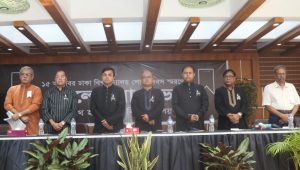
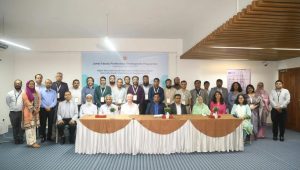
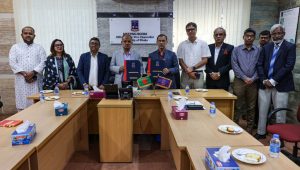
A high-level dialogue intended to shape the future of Bangladesh’s higher education descended into a chaotic scramble on Friday, as public university vice-chancellors openly jostled for floor time in front of key government policymakers.
The summit, hosted in Savar by the University Grants Commission (UGC) under its Higher Education Acceleration and Transformation (HEAT) project, was designed as a strategic exchange with Finance and Planning Minister Amir Khosru Mahmud Chowdhury and Special Adviser Mahdi Amin. Instead, the opening day exposed deep-seated institutional dysfunction, aggressive self-interest, and the grim reality of a university system expanded far beyond its capacity.
Vice-chancellors said at least 25 public universities are currently operating from rented buildings without a proper university environment.
Private university vice-chancellors used the platform to demand the withdrawal of taxes. Responding, the finance and planning minister said zero tax could be considered next year if institutions improve research, education quality and rankings.
“However, it is also your responsibility to ensure that students receive the benefits of this facility,” he said.
Mics snatched, sole female voice sidelined
What was meant to be a structured discussion on reform quickly turned unruly. When Amir Khosru Mahmud invited candid feedback on management failures, decorum collapsed. Eager to air personal grievances and secure funding, several vice-chancellors clamoured over one another, forcing UGC officials to intervene to restore order.
The aggressive atmosphere effectively silenced Professor Tahmina Akhtar of Rabindra University, the only female vice-chancellor among the nation’s 58 public universities. Despite standing repeatedly to speak, she was repeatedly drowned out by louder male colleagues.

The minister himself was forced to intervene, invoking gender equality to grant her the floor. When Professor Akhtar finally spoke, she pulled no punches:
“Simply increasing the number of universities cannot be called infrastructure development,” she warned, demanding overhauled recruitment policies and genuine academic environments.
Her intervention, however, was abruptly cut short by a UGC moderator citing time constraints and repetitive points.
Housing, vehicles and infrastructure complaints
Professor AKM Motinur Rahman, vice-chancellor of Islamic University in Kushtia, urged the government to revise housing rent deductions for teachers, saying many senior faculty members avoid staying on campus because of high charges for university quarters.
“Professors can live in a good house in Kushtia city if they pay Tk15,000 to Tk18,000. However, if they stay in university quarters, Tk30,000 to Tk35,000 is deducted as rent,” he said.



He said keeping teachers on campus was essential for improving research and academic standards.
Professor Dr Md Nurul Islam, vice-chancellor of Central University, meanwhile, expressed frustration over not receiving an official vehicle despite holding the post of vice-chancellor.
He also questioned how the newly formed university would function with teachers from the BCS education cadre, saying many lacked research experience and the mindset required for university-level teaching.
‘Nothing exists’ at Naogaon University
Professor Dr Md Hasanath Ali, vice-chancellor of Naogaon University, painted a bleak picture of the institution, saying it has no administrative building, health centre, male student hall or safe accommodation facility for female students.
When asked how many departments the university had, he said the institution, launched in 2023, was currently running academic activities in two subjects under two faculties.
The finance minister responded that establishing universities without proper planning was not the right approach.
Calls for research funding and modern education
Professor Mustafizur Rahman, vice-chancellor of Gazipur Agricultural University, demanded increased allocations for agricultural research and internships, saying funding was available only for veterinary students.
He also called for easier access for foreign students, improved visa procedures and the recruitment of international faculty members to raise the quality of higher education.
The vice-chancellor sought government financial and administrative support for securing patents for innovations developed by teachers and students.
National University faces curriculum crisis
National University Vice-Chancellor Professor ASM Amanullah said nearly 4 million students are linked with the institution and around 70 per cent of graduates come from it every year, yet annual allocation per student is only US$10.
“How is it possible to make a student capable of becoming employable with this amount?” he questioned.
He said the university’s curriculum was not even aligned with the First Industrial Revolution, far behind the needs of the Fourth Industrial Revolution. He also criticised excessive politicisation of governing bodies of nearly 2,500 affiliated institutions.
Open University seeks more funds
Professor Mohammad Siddiqur Rahman Khan, vice-chancellor of Bangladesh Open University, warned that the institution’s activities could eventually stop if government allocations were not increased.
He said the university operates in seven countries and benefits from Bangladeshis living abroad who send remittances.
The minister asked whether the university was helping workers who lose jobs due to changes in industries by providing new skills. The vice-chancellor replied that 63 skill development projects were ongoing.
UGC drafting 5-year strategy
The question-and-answer session was brought to an early close after a break was called for prayers and lunch.
Before the session ended, UGC Chairman Professor Mamun Ahmed said the commission was preparing a five-year strategic document aimed at ensuring sustainable transformation in higher education.
“We have already held discussions with the authorities of several universities. The UGC is prioritising discussions with all universities soon to address the problems faced by each institution,” he said.