


The University Grants Commission (UGC) of Bangladesh has initiated a plan to introduce third language education programmes in 30 public and private universities across the country by January 2027.
According to the press release, the initiative aims to enhance students’ multilingual skills alongside Bengali and English, making them competitive in the international job market and contributing to national workforce development.
To ensure that no region within the country’s eight divisions is excluded, the committee responsible for university selection, language determination, resource planning, and location mapping has been reconstituted. The programme will be implemented by considering local manpower demands, public interest, university capacity, and existing infrastructure.
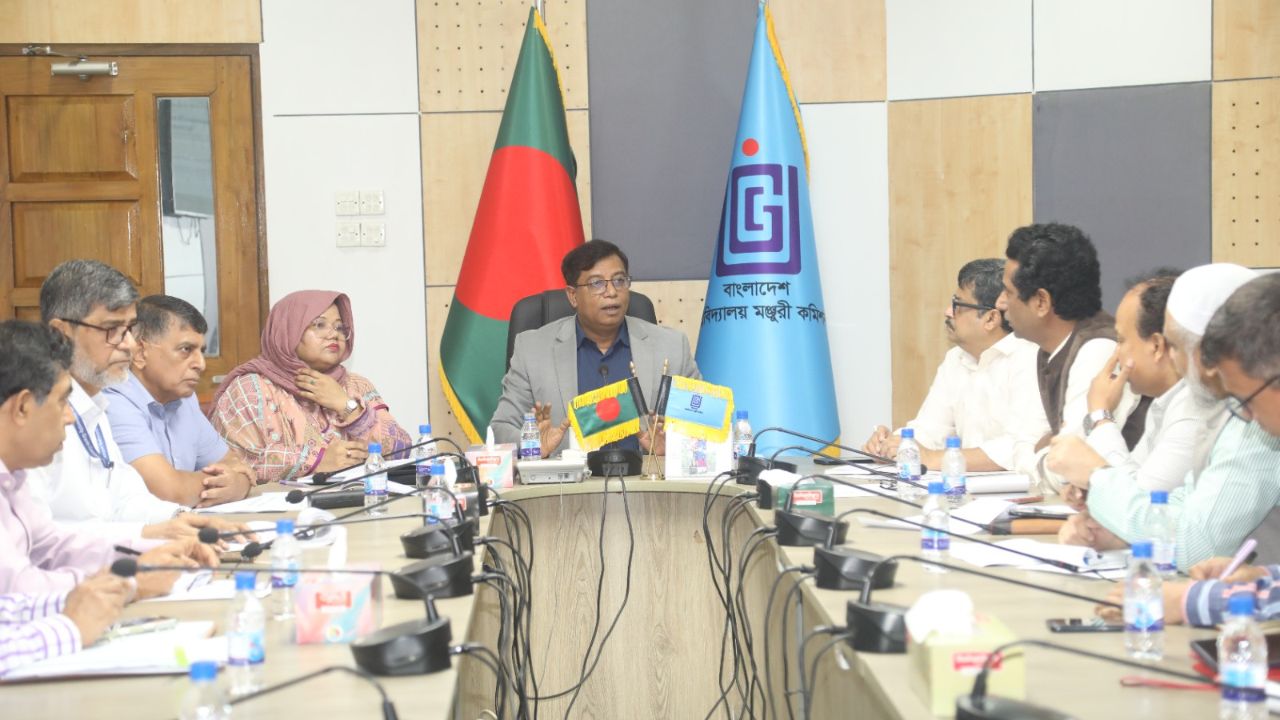
The announcement was made by UGC Chairman Professor Dr Mamun Ahmed while presiding over a meeting on the third language education initiative at the UGC office on Wednesday.
The meeting was attended by UGC members Prof Dr Masuma Habib, Prof Dr Abdullah Al-Mamun, Prof Md Mehedi Hasan Khan, Prof Dr Md Aslam Hossain, and Prof Dr Niaz Ahmed. UGC Secretary Dr Md Fakhrul Islam and several divisional heads of the commission were also present.

Speaking at the meeting, Prof Dr Mamun Ahmed said that the commission plans to introduce a total of eight languages as a third language, selected in view of government priorities and future job market demands.
This initiative is expected to enhance students’ linguistic and professional skills, build international communication capabilities, and open up new employment opportunities both at home and abroad. He added that the programme would also play a critical role in national skill development and building a skilled workforce.




In the initial phase, efforts will be made to establish new language education centres or modernise the capacity and infrastructure of existing centres in 30 public and private universities. Selection of these universities will place a strong focus on regional workforce demand, local public interest, and the prospects of regional and international labour markets.
The UGC Chairman explained that data from the Bangladesh Bureau of Manpower, Employment and Training (BMET) and other relevant statistics would be analysed to identify which languages are in high demand in specific regions. Based on this analysis, a realistic mapping of demand-based language selection and university-level activities will be prepared.
The eight languages planned for inclusion in the programme are Arabic, Chinese, Japanese, Korean, French, German, Spanish, and Italian. During the meeting, initial priority was discussed for Arabic, Japanese, Korean, Chinese, and Italian.
However, the specific language course offered at each university will be finalised based on regional demand, university capacity, required manpower, and infrastructural facilities.
Currently, 10 universities in Bangladesh have language learning centres, with Dhaka University offering the largest facility with up to 13 languages. The UGC will review the capacity, ongoing courses, instructors, manpower structures, and infrastructure of these existing centres, while also determining where new centres are needed.
To ensure successful implementation, special emphasis will be placed on developing a skilled and trained team of instructors. Apart from training university teachers and relevant personnel, the UGC plans to seek cooperation from experienced language experts and institutions from the respective countries.
The UGC will play a supervisory role and ensure educational standards across the centres. It will assist in formulating manpower structures, setting up modern language laboratories, and facilitating the use of technology-based teaching materials.
Prof Dr Mamun Ahmed stressed that the commission will closely monitor these centres to ensure they do not turn into commercial enterprises and that students can access quality language education at affordable costs.
Furthermore, alongside regular university students, other interested individuals will also have the opportunity to learn languages at affordable rates under specified guidelines. This is intended to expand university-centric knowledge and skill development to the wider public.
To ensure a smooth, coordinated, and sustainable roll-out, the UGC will formulate a uniform policy and operating framework. This policy will cover key areas including language selection, course operations, instructor recruitment and training, quality assurance, infrastructure, technological integration, and overall supervision of the centres.