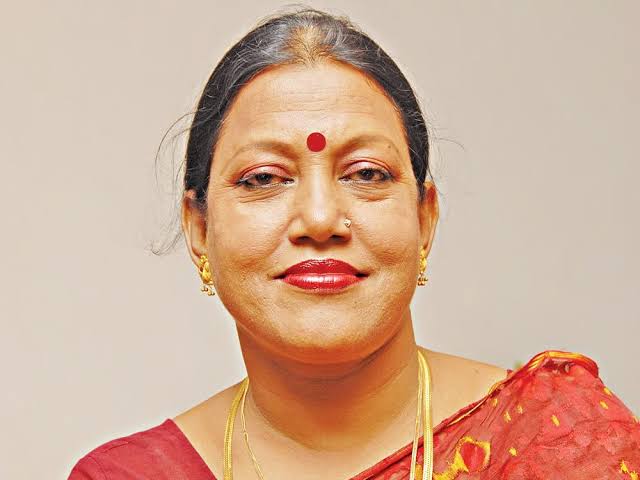

For a long time, Lalon’s songs were confined to Baul gatherings in rural Bengal, far from the ‘polite society’. The artist who first brought these songs to mainstream audiences was none other than Farida Parveen. Baul songs have always shared deep connections with Sufism and Vaishnava Sahajiya traditions. The works of Lalon Shah, in particular, bear a strong influence of Sufi philosophy. In his songs, this humanist saint emphasised humanity above all, rising above divisions of religion, caste and creed.
Born into a culturally inclined family, music shaped her life from an early age. “Music is the first inspiration of my life,” she once said. For her, music was never merely a profession but a way of life; a path to inner harmony and peace. This philosophy was deeply reflected in her singing.
As a child, she would listen to her mother’s melodious voice and accompany her on the harmonium. Her formal training began with Ustad Kamal Chakraborty. Later, she studied classical music under Ibrahim Khan, Rabindranath Roy, Osman Gani and Motaleb Biswas. She also learned Nazrul songs from Ustad Mir Muzaffar Ali and Ustad Abdul Qadir.
Although deeply rooted in Lalon’s philosophy, Farida Parveen admired many other singers. In an interview, she fondly recalled her fascination with Sandwipa Mukherjee’s voice. She also enjoyed the works of Pintu Bhattacharya, Manna Dey, Manabendra Mukhopadhyay, Shyamal Mitra, Hemanta Mukhopadhyay, Jagannath Mitra and Jatileshwar Mukhopadhyay.

Among Bangladeshi artists, she appreciated Nilufar Yasmin, Ferdousi Rahman, Shahnaz Rahmatullah and Subir Nandi, as well as younger performers like Priyanka Gope, Bijan Mistry and Yusuf Ahmed Khan.
Farida Parveen’s career began in the 1960s when she was enlisted as a Nazrul singer at Rajshahi Betar. She first gained widespread attention in 1973 with ‘Ei Padma, Ei Meghna’ and Lalon’s ‘Shotto Bol Shupothe Chol’.
It was Mohammad Ali Sai who introduced her more deeply to Lalon’s songs, inspiring her lifelong devotion to them.




Through Farida Parveen, Lalon’s philosophy travelled far beyond Baul circles, reaching audiences across Europe, America and beyond.
What was once a tradition nurtured only by wandering minstrels became a global cultural treasure, in no small part thanks to her tireless efforts.
She also worked to institutionalise Lalon’s legacy by regularising Lalon festivals and establishing the Lalon Academy. Later, she founded the Farida Parveen Foundation to inspire the youth to pursue authentic Lalon music. “You cannot become an artist through any shortcut,” she often reminded aspiring singers.
Although Lalon’s songs brought her fame and recognition, Farida Parveen also lent her voice to film music. In 1993, she won the National Film Award for Best Female Playback Singer for ‘Ondho Prem’. She received the prestigious Ekushey Padak in 1987, as well as numerous other honours, including the Fukuoka Asian Culture Prize in 2008.
The singer, widely known as “The Queen of Lalon Giti”, was born on December 31, 1954, in Natore and grew up in Kushtia. She had long been suffering from various health complications, including chronic kidney disease and had been admitted to intensive care several times in recent years.
For years, the singer had been undergoing dialysis twice a week as her kidney problems worsened. On September 2, she was taken to Universal Medical College Hospital for her regular dialysis session.
Soon after, her condition deteriorated, and doctors advised hospitalisation. Since then, she had been under treatment in the ICU. When her health further declined last Wednesday, she was placed on ventilation. Despite all medical efforts, she passed away, leaving her family, admirers and countless fans in mourning.
On Saturday at 10:15 pm, she breathed her last at Universal Medical College Hospital in Mohakhali. The news of her death was confirmed by Ashish Kumar Chakraborty, Managing Director of the hospital. She was 71.
Farida Parveen is survived by her husband and four children.