On a sunlit Friday morning at a Refugee Camp in Ukhiya, thousands of displaced Rohingya gathered on a dusty football ground, carrying the weight of years of exile and trauma.
Standing directly amongst them, Khalilur Rahman, president of the 81st session of the UN General Assembly and foreign minister of Bangladesh, chose not to speak from distant diplomatic halls in New York, but to address the refugees face-to-face following a historic legal turning point.
Just a day earlier, on 19 November, the International Court of Justice (ICJ) in The Hague delivered its final judgment in the case brought by The Gambia, explicitly designating the 2017 military atrocities against the Rohingya as genocide.
Addressing the quiet crowd, the UN official emphasised that court rulings cannot remain mere words on paper, but must translate into real protection, dignity, and a safe return to their ancestral homeland in Myanmar.
A historic truth in The Hague
The long-awaited verdict from the UN’s highest judicial body marked the culmination of a seven-year legal battle initiated by The Gambia in November 2019 under the Genocide Convention.
The court found conclusive evidence of systematic killings, widespread sexual violence, targeted attacks on women and children, and the deliberate destruction of Rohingya villages by Myanmar’s security forces.


Documenting at least 10,000 deaths, the ICJ concluded that these acts were committed with the specific intent to destroy a substantial portion of the Rohingya population in northern Rakhine State.
Crucially, the tribunal recognised the Rohingya as a distinct ethnic group with deep, multi-generational ties to Myanmar.
While no judicial decree can restore lost lives or fully heal profound psychological wounds, the foreign minister highlighted that international judicial recognition of the truth forms the indispensable foundation of justice.
Four pillars for justice and return
Outlining the road ahead, the UN General Assembly president detailed four mandatory pillars required of Myanmar to fulfil its international legal obligations.




First, Myanmar must immediately investigate, prosecute, and punish all individuals reasonably suspected of genocide-related crimes, whilst amending national laws to prevent any future recurrence.
Compliance with the ICJ ruling is binding and non-negotiable under international law.

Second, Myanmar must establish conditions for the safe, voluntary, and dignified repatriation of all displaced Rohingya, whether sheltered in overseas refugee camps or displaced internally.
This mandate encompasses family reunification, restitution of stolen property and land, medical care for survivors, tracing missing persons, and culturally respectful reburials.
Central to sustainable return, the foreign minister pointed out, is the restoration of full citizenship rights, freedom of movement, and protection from systemic discrimination.
Until safe repatriation is achieved, he urged the international community to expand humanitarian funding for camp essentials like child education, healthcare, and shelter, noting that Bangladesh cannot carry this heavy responsibility alone.
Third, the ICJ directed Myanmar to pay comprehensive individual and collective compensation for unrecoverable losses, requiring a formal compliance report within two years.

Fourth, institutional reforms, security force retraining, and civilian oversight must be enforced in Myanmar to guarantee non-recurrence, with Article 94 of the UN Charter offering recourse to the UN Security Council should non-compliance persist.
Echoes of hope and lingering anxiety
For the refugees listening in Ukhiya alongside UN interim resident coordinator Carol Flore-Smereczaniuk and refugee relief and repatriation commissioner Mizanur Rahman, the address brought both solace and sobering reality.
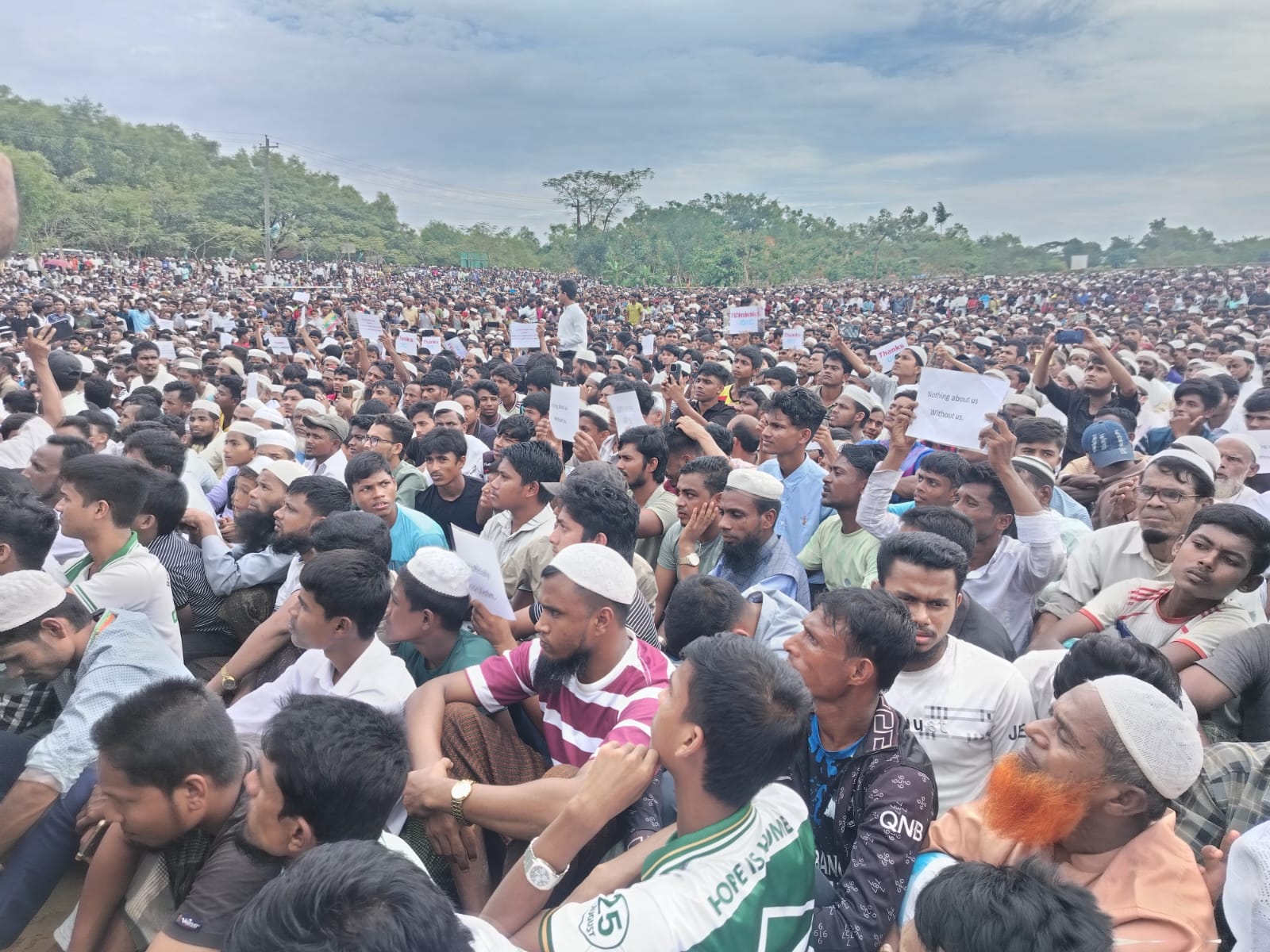
Expressions of gratitude were extended to The Gambia, the Organisation of Islamic Cooperation, intervening nations, and courageously testifying Rohingya women whose voices shaped the court’s findings.
Yet, human feelings in the camps remain complex. Khin Maung, president of the United Council of Rohingya (UCR), voiced deep appreciation for the visit while stressing that refugees refuse to languish indefinitely in camps and yearn for home under guaranteed protection.
Syed Ullah, founder president of the UCR, welcomed the court’s global validation of their suffering, but observed that true justice remains incomplete until the perpetrators face actual trial and a UN-supervised safe zone is established in Rakhine State.
Youth activist Mujibur Rahman and camp leader Mohammad Rafique echoed that long-awaited hope must now translate into concrete accountability for those who burned their villages and shattered their lives.
Closing his address, the UN General Assembly president pledged to convey their voices to all 193 member states, expressing his earnest hope that 19 November will mark the historic beginning of their journey home, ensuring that “never again” truly means never again.