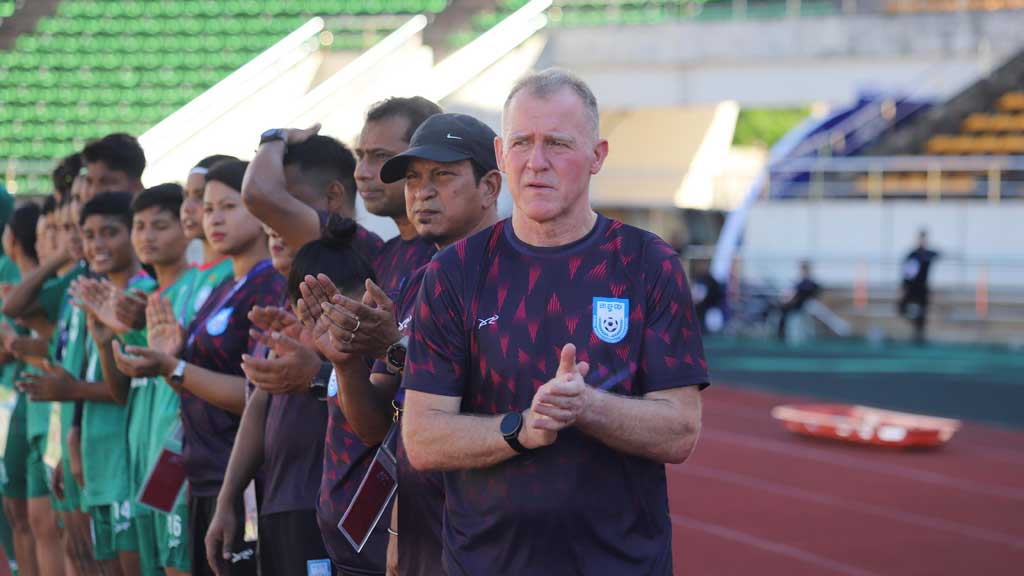

Bangladesh women’s football head coach Peter Butler has defended his high-line defensive system despite facing intense criticism following two heavy defeats against Thailand. The team, preparing for their maiden AFC Women’s Asian Cup campaign next March in Australia, returned home yesterday after conceding eight goals across two friendlies in Bangkok.
The back-to-back defeats have brought Butler’s tactical philosophy under scrutiny. Critics argue that his insistence on keeping the defensive line high against faster, stronger opponents is leaving Bangladesh exposed. Yet, speaking after a cash award ceremony hosted by the National Sports Council in Dhaka, where the players received BDT 5 million promised by Youth and Sports Adviser Asif Mahmud Shojib Bhuiyan. Butler made it clear that he would not abandon his system.
“Whether you like it or not, the high-line defence is part of our system and it will stay,” said the British coach. “I make adjustments, but I don’t change the core. I take responsibility for the results good or bad. Bangladesh qualified for the Asian Cup and won the SAFF Championship playing this way.”

Butler’s approach has come under fire before. The Bangladesh U-20 side had previously suffered a 6–1 defeat to South Korea using the same defensive shape, and similar problems resurfaced against Thailand. By pushing the defensive line close to midfield, Butler’s side allowed Thailand’s pacy forwards to exploit the open spaces behind.
Butler, however, remains firm in his conviction. He argues that facing stronger teams is part of a learning curve. “Conceding goals is normal, especially against a team like Thailand. People often forget that we play all our matches away. Without home advantage, it’s difficult. Sometimes heavy defeats happen, but I’m realistic we learn more from losing than from winning,” he explained.


The coach also addressed questions about squad selection. Several senior players, including Rituparna and Rupna, are currently playing league football in Bhutan, while others like Sabina and Masura, despite performing well there, were not called up to the initial training camp. “I understand and respect their decision to play abroad,” said Butler. “They go to earn money and get more playing time, which is completely fine. In Bangladesh, we still lack regular league football and proper facilities, so I can’t blame them.”
Butler also dismissed speculation about internal conflicts with senior players. Referring to midfielder Ritu Rani, he said, “I spoke to Ritu, she’s a wonderful girl. Sometimes misunderstandings happen. Maria Manda, for example, returned and performed brilliantly. My feedback is always constructive, not criticism. Media often misreads that, but in professional football, honest discussions are part of improvement.”
Despite the setbacks, Butler is already looking ahead to the Asian Cup, where Bangladesh will face powerhouses such as North Korea and China. “The difference will come down to physical ability,” he noted. “Our players need to get stronger and fitter. That’s why we’ve brought in Cameron Lord from Australia as our new fitness coach. He’ll play a key role in preparing us for the tournament.”
As Bangladesh count down to their first-ever Asian Cup appearance, questions remain over whether Butler’s high-line defence can withstand Asia’s top-tier attacks. But for now, the Englishman is unwavering convinced that his philosophy, if executed correctly, will one day deliver results.