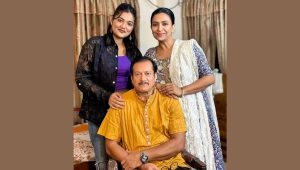
Nearly three decades after the mysterious death of popular Bangladeshi film star Salman Shah, a Dhaka court has ordered that the case be treated as murder, granting a long-awaited breakthrough for the actor’s mother Neela Chowdhury and his family, who have consistently rejected the suicide narrative.
The order came on October 20, when Dhaka’s Sixth Additional Metropolitan Sessions Judge Jannatul Ferdous Ibne Haque directed Ramna Police Station to investigate the case as a murder. The court also imposed a travel ban on 11 accused, including Salman’s wife Samira Haque, producer Aziz Mohammad Bhai, and film villain Don, instructing police to submit their report by December 7.
Salman’s mother had earlier filed a revision petition challenging the Police Bureau of Investigation (PBI) report from 2020, which concluded that the actor had died by suicide due to “romantic and family conflicts.”
In 2021, a magistrate accepted the report and released the accused, prompting Neela Chowdhury to appeal the decision.
Her lawyer Faruk Ahmed told reporters that the PBI investigation was “neither neutral nor thorough,” and that the court’s latest order finally acknowledges the family’s claim that Salman was murdered.
A death, that shocked the nation

On September 6, 1996, Bangladesh woke to the shocking news of Salman Shah’s death. The actor, then 25, was found dead in his Eskaton Plaza flat in Dhaka. While the initial police, CID, and PBI reports described it as a suicide; however, Salman’s family and fans insisted otherwise, claiming he was the victim of a conspiracy.
According to Neela Chowdhury, her husband was initially barred from entering the apartment that morning. “When he forced his way in, we found Salman lying on the bed, his nails blue. I knew instantly my son was gone,” she recalled in a past interview.
The day before his death, on September 5, Salman Shah was busy with the dubbing of the film ‘Prem Piyasi’. Actress Shabnur was present there. Seeing Salman joking playfully with Shabnur, his wife Samira became angry and stormed out.
Samira then got into a car with her father but did not speak to Salman, who chased her to the FDC gate but failed. After she left, Salman chatted for a while in front of the main entrance, and returned to his New Eskaton flat around 11 pm.




Film director Shah Alam said that Salman had been under mental stress due to family tensions and a ban imposed by the Producers’ Association.
A 29-year legal battle
Salman’s father Kamar Uddin Chowdhury filed an unnatural death case the day his son died. Over the years, multiple investigations by the CID, DB, and judicial inquiries all came to the same conclusion, suicide. The family rejected each report.
In 2014, the case was handed to the PBI at Neela’s request. Their 2020 report maintained the suicide claim. But now, the court has ruled that the matter warrants a full murder investigation.
Confession that changed the course
The court’s decision reportedly draws on the 1997 statement of Rezvi Ahmed Farhad, one of the accused, who testified under Section 164 that Salman was murdered under contract. Rezvi alleged that Salman’s mother-in-law Latifa Haque Lucy offered Tk 12 lakh to have him killed, with notorious underworld figures Don, David, Faruk, and Javed involved.
Rezvi claimed that the killing was planned at a bar in Gulistan on September 5, 1996, and carried out later that night. He alleged that Samira, Lucy, and others were present during the act, and that Salman was rendered unconscious with chloroform before being injected and later hanged to stage a suicide.
A mother’s relief
Following the court’s order, Neela Chowdhury expressed gratitude and vindication. “My son’s body bore signs of murder, not suicide,” she said. “I have said for 29 years that Salman would never take his own life. The court’s decision proves I was right.”
She also alleged receiving threats from actor Don in recent weeks. “They think they can silence me, but I will fight until my son gets justice,” she vowed.
Samira claims innocence
Over the years, fingers have often pointed toward Samira Haque, but she has consistently denied any involvement. Speaking to Channel 24 in a past interview, she reiterated: “People who take their own lives don’t announce it to others… it was suicide.”
Responding to Neela’s allegations, she said, “If someone dies by suicide in a house, their parents aren’t remanded. Why should I be?”
Samira also claimed that Salman had been “suicidal by nature,” adding, “Before our marriage, Salman had attempted suicide three times; twice at Metropolitan Hospital and once elsewhere.”
The renewed order to treat the case as murder has reopened old wounds and hopes alike. For many, Salman Shah was not just an actor but a symbol of youthful charisma that defined an era.
Now, nearly three decades later, the question that haunted millions: “Did Salman Shah really take his own life, or was he silenced?,” may finally get an answer.