Twelve years after Bangladesh passed a landmark law guaranteeing rights and protection for people with disabilities, the promises remain largely unfulfilled. From government offices to public transport, inaccessible infrastructure continues to trap millions in daily struggles, making the law little more than ink on paper.
In 2013, the then government enacted the “Rights and Protection of Persons with Disabilities Act, 2013,” but its implementation is still lacking. According to the law, all public establishments are required to follow the rules of the Building Construction Act, 1952 (East Bengal Act II of 1953) to be disability friendly. However, the reality is that this rule is not properly enforced in most buildings, roads, terminals, stations, or naval ports.
Despite clear legal obligations, disability-friendly features are rare. Ramps are missing, lifts are unusable, Braille systems are non-existent, and specialised toilets are unheard of. Public transport, except for the metro rail, remains practically inaccessible. On city footpaths, wheelchair users find themselves battling vendors and motorcyclists instead of moving freely.

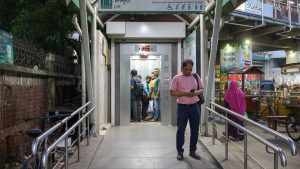
Stakeholders say the problem is not the law itself but the lack of accountability. Authorities tasked with supervision have failed to act, allowing inaccessible infrastructure to multiply unchecked.
In an interview with the Times of Bangladesh, a physically disabled woman named Kamrun Nahar said, “I struggle every day because accessibility is not ensured in society and the workplace. I can’t travel comfortably on any public transport except the metro rail. There are also no specialised toilets designated for us in offices or other places, which is a huge challenge for us.”



Nur Mohammad, another physically disabled man, said, “There are no facilities for wheelchair users like us in public transport. It becomes almost impossible to move on a wheelchair on the footpath due to vendors and motorcyclists. Yet, I haven’t seen any effective action from the government.”
University student Rashed Ahmed shared his frustration at being forced into expensive alternatives. “We can only use the metro rail and even there, we often find that our designated lifts or seats are occupied by others. General public transport is not usable for us, so we are forced to take alternative transport, which is expensive compared to our incomes.”
These voices echo a shared truth. The absence of accessibility is not just inconvenient; it is discriminatory.
The 2013 Act clearly mandated inclusive infrastructure, but weak monitoring and enforcement have left it toothless. Many government and private institutions ignore the requirements with impunity. Critics argue that without strict penalties for violators and strong political will, the law will remain a hollow promise.
Experts and activists insist that accessibility is not a matter of charity or goodwill; it is a basic human right. Bangladesh has ratified international conventions committing to inclusion, but domestic progress has stalled.
Twelve years on, people with disabilities are still waiting for a society that sees them not as burdens, but as citizens with equal rights.