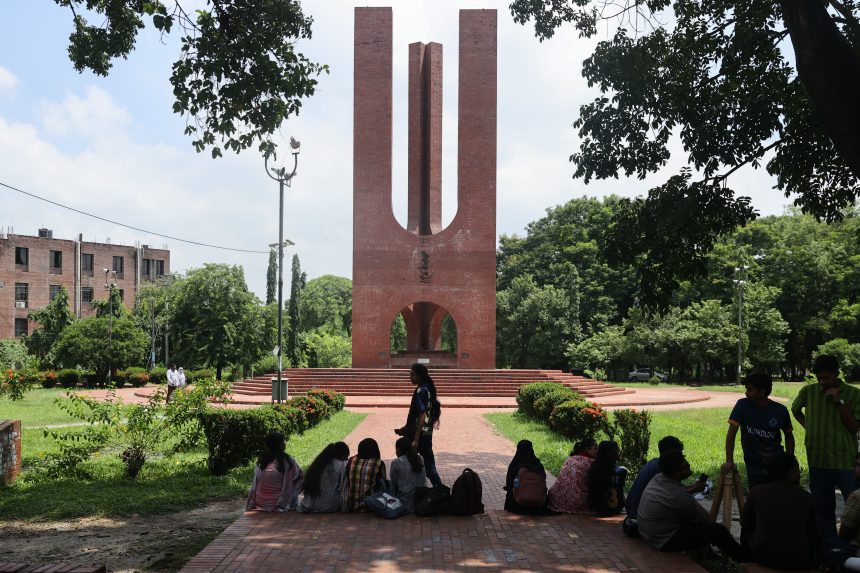

The long-awaited election for the Jahangirnagar University Central Students’ Union (Jucsu), held after 33 years, was marred by chaos and controversies from the outset. The election, which had been highly anticipated, saw multiple incidents, raising concerns among students and the wider university community.
As the days progressed following the announcement of the election schedule, the number of incidents continued to rise, further escalating tensions. However, the situation worsened after the voting began, with the counting process taking an unprecedented 48 hours for fewer than 9,000 votes cast, sparking fresh questions about the transparency and fairness of the process.
Despite the turmoil, the official results were announced on Saturday evening at the university’s Senate Building by Chief Election Commissioner Professor Md Moniruzzaman.
Abdur Rashid Jitu, representing the Shotontro Shikkharthi Panel, was elected as the tenth vice president (VP) of Jucsu. Meanwhile, Mazharul Islam, supported by the Islami Chhatra Shibir and the Shomonnito Shikkharthi Jote panel, secured the position of general secretary (GS).
In addition, the newly elected assistant general secretaries (AGS) are Ferdous Al Hasan (Male) and Ayesha Siddiqa Meghla (Female), both representing the Shibir-backed panel.
The election results reflect the current political dynamics within the campus, with the Shibir-backed panel securing significant positions in the Jucsu leadership.

While the outcome of the election is now official, the unrest surrounding the process has left many wondering about the future of student politics at Jahangirnagar University and whether the election can be considered a fair representation of the student body’s wishes.
Chaotic, controversial polls process
From the very beginning, multiple candidates and panels raised concerns about the Election Commission’s activities.
Issues included the cancellation of a VP candidate’s nomination, delays in drug test reports, the decision to use OMR (Optical Mark Recognition) ballots followed by a change in counting methods, the boycott of the election by Chhatra Dal and four other panels, the resignation of five faculty members from the commission, and the tragic death of a faculty member.
Additionally, protests erupted on campus during the vote count, with results being delayed and later leaked on social media hours before the official announcement. All these factors contributed to a chaotic and controversial election process.


In the official results, the Shibir-backed Shomonnito Shikkharthi Jote emerged victorious, winning 21 out of 25 contested positions. Independent candidates won the VP post and three other secretary positions.
The closest competitor for the VP position was Arifulah Adib, backed by Shibir. In each category, candidates supported by Chhatra Dal lagged behind by a significant margin.
Abdur Rashid Jitu, the newly elected VP, is the convener of the Gono Obbhutthan Rakkha Andolon platform. Although he was previously involved in Chhatra League politics, he left after being attacked by fellow party members during the quota reform movement.
He later became the coordinator of the Anti-Discrimination Students’ Movement, from which he also resigned after alleging irregularities.
Controversies and delays
Jahangirnagar University Vice-Chancellor Dr Mohammad Kamrul Ahsan met with the Election Commission for about an hour on Friday afternoon, during which the vote counting was paused.
After the meeting, counting resumed, raising questions about the delay. Before this, Professor Shamsul Saleheen, the provost of Kazi Nazrul Islam Hall, faced student protests during voting, to which he responded, “So what if we are stealing?”
Chief Election Commissioner Professor Md Moniruzzaman admitted the commission’s failure but claimed that no evidence of electoral fraud was found.
He explained that while they were aware digital machines would be used for counting, no preparations had been made for manual counting, leading to delays. “Due to manual counting, the announcement of results was severely delayed,” he said.
Allegations of vote rigging under the guise of Chhatri Sangstha led to the resignation of several professors, including Professor Shamima Sultana from the Bangla Department and Dr Nazrul Islam from the Mathematics Department.
These faculty members were affiliated with the JU unit of the Jatiyabadi Shikkhok Forum.
More resignations and accusations
By 9 pm on Friday, Mafruhi Sattar, a member of the JUCSU Election Commission and a faculty member in the Pharmacy Department, also resigned, citing undue pressure and a lack of knowledge regarding key decisions such as the disqualification of VP candidate Amartya Roy.
Dr Rezwana Karim Snigdha, another commission member, submitted her resignation, stating, “Invisible pressure is hindering my ability to work as a member of this commission.” Her resignation raised further doubts about the election process.
Voting and counting process
A total of 177 candidates contested for 25 positions in the JUCSU election, with 8,016 students casting their votes. The election took place across 21 halls, with 224 voting booths. Voters had to cast ballots for 40 positions in total, including both central and hall unions.
Voting and counting were delayed due to a lack of experience among the election staff, many of whom had not previously been involved in such a process. The commission had to set up 13 counting tables in stages to process the votes.
Professor Lutful Elahi, a member of the Election Commission and Provost of Shaheed Tajuddin Ahmad Hall, stated that 90% of the vote counting had been completed by 2:30 PM but indicated that the results would not be announced until the evening due to procedural delays.
This election was the first JUCSU election in 33 years, and the involved officials had little experience working with the voting process. Despite receiving training on 11 September, the lack of preparation led to significant delays.
Pro-Vice Chancellor (Education) Dr Mahfuzur Rahman confirmed that the key reason for the delay in counting votes was the inexperience of the staff.