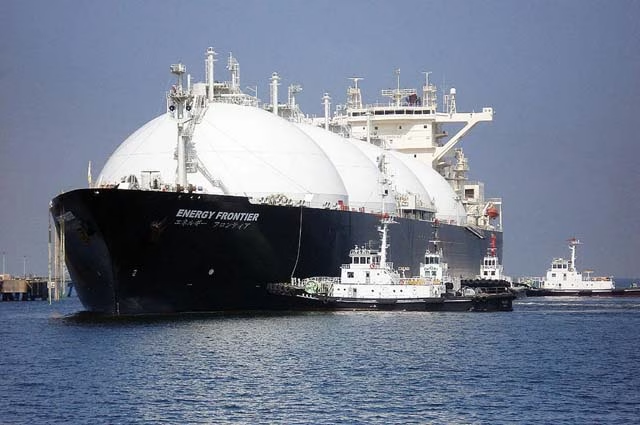

The government imported 11 cargos of Liquefied Natural Gas (LNG) in August this year, totaling approximately 3.65 crore MMBTu, to meet the increasing energy demands in the country.
AKM Mizanur Rahman, director of Petrobangla, informed BSS that LNG is being regularly imported under both long-term and short-term agreements, as well as through spot markets, to ensure sufficient energy supply for the country.
He also mentioned that Bangladesh will receive 10 additional LNG cargos in September, totaling around 3.32 crore MMBTu, through these agreements and spot market transactions.
Under the long-term contracts, QatarEnergy supplied three LNG cargos, each containing approximately 32 lakh MMBTu. Additionally, Oman’s OQ Trading (OQT) provided two cargos and one cargo under a short-term deal.

To ensure the country’s energy needs are met, the government also procured five LNG cargos from the spot market.
Looking ahead to September, the government is set to receive 10 more cargos of LNG, each containing about 32 lakh MMBTu.




QatarEnergy will supply four cargos under the long-term agreement, while OQT will provide one cargo under the same agreement. Furthermore, OQT will deliver two cargos under short-term deals, and three cargos will be sourced from the spot market.
The government’s purchase committee previously approved separate proposals for LNG imports to meet the country’s growing gas demand.
On August 19, 2025, the government approved proposals for importing three cargos from Total Energies Gas and Power Limited, UK, at an approximate cost of Tk480.68 crore per cargo (with each MMBtu priced at $11.44), Tk476.47 crore (at $11.34 per MMBtu), and Tk484.88 crore (at $11.54 per MMBtu) through international quotation methods.
After the purchase committee meeting, the Finance Adviser mentioned that there had been significant pressure to increase energy prices, including gas, every month or two.
However, the interim government has refrained from raising prices, thanks to various calculations by the Energy and Mineral Resources Division. “This is a positive development,” he added.
“Our goal is to ensure a steady supply of LNG to avoid any pressure to raise energy prices, as such increases could negatively impact consumers and industries alike,” the finance adviser concluded.