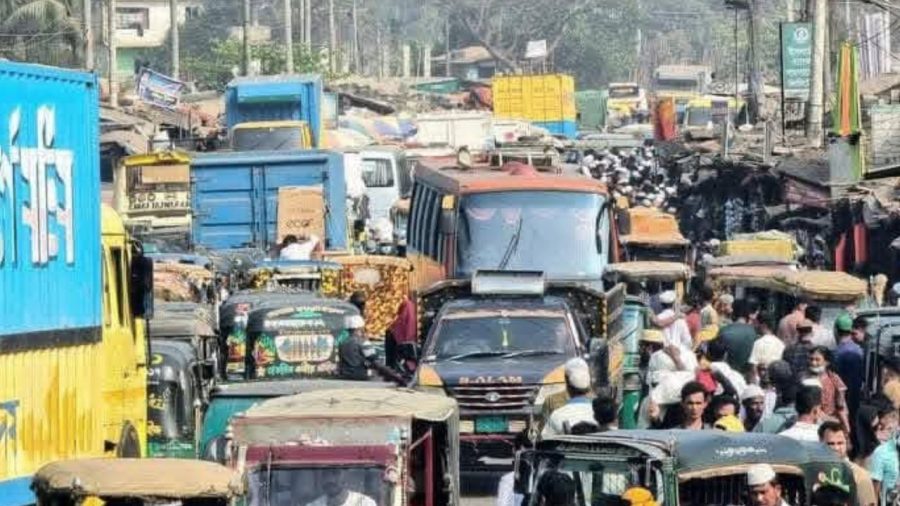



Illegal roadside markets, makeshift stalls and unauthorised parking along both sides of the Cox’s Bazar-Teknaf regional highway at Kutupalong in Ukhiya have triggered severe daily traffic congestion, turning a journey that should take a minute into one that can last more than an hour.
The gridlocks cause immense hardship for residents, students, commuters, traders, ambulances carrying critically ill patients, officials of national and international organisations working in Rohingya refugee camps and even VIP motorcades.
Locals alleged that despite years of encroachment on the highway, the authorities have taken no effective action. They claimed an influential group controls the illegal shops and parking areas, collecting substantial sums every day. Taking advantage of weak oversight and administrative inaction, the network occupying the road continues to expand.
Concerns have also been raised over the leasing of Kutupalong market. Residents alleged that the market was leased at more than twice the government-fixed price to conceal irregularities and toll collection practices and retain control within the family of Helal Uddin Member. Most recently, Borhan Uddin secured the lease for Tk2,41,40,000.
A visit to the area found rows of shops on both sides of the highway in the Kutupalong market area. Fruit and daily essentials are sold directly on the road, while CNG-run auto-rickshaws, easy-bikes and other small vehicles are parked along traffic lanes and pedestrian spaces.
A continuous line of makeshift stalls on the western side has further narrowed the road, forcing pedestrians to walk dangerously close to moving vehicles.

The problem is not confined to Kutupalong. Similar conditions prevail at major markets across Ukhiya, including Kotbazar, Morichya, Balukhali, Thaingkhali and Palongkhali.
Local sources said an influential syndicate allows traders to occupy highway space for shops and parking in exchange for regular payments. Each roadside shop reportedly pays Tk250 to Tk400 a day, while vehicle parking brings in Tk50 to Tk100 per vehicle.
Although the money is collected as ‘hasil’ or toll fees, questions remain over the legality of using highway land for commercial activities. Allegations have also emerged that some local administration officials are being managed to ensure the collections continue uninterrupted. Those implicated could not be reached for comment.
Emergency services and daily commuters bear the brunt of the congestion. Ambulances carrying critically ill patients are repeatedly at risk of being trapped in traffic. School and college students struggle to reach their institutions on time, with journeys that normally take five minutes stretching to as long as an hour.



The situation is particularly severe during the morning rush, when vehicles often remain virtually stationary. Office-goers are forced to leave home well ahead of their working hours.
Residents also questioned the effectiveness of traffic police deployed along the highway, saying officers have failed to ease congestion or remove encroachments.
Amin, a Kutupalong resident, said a trip to the market often means spending hours in traffic. Emergency patients suffer particularly badly, he said, as CNG-run auto-rickshaws occupy one side of the road and makeshift stalls the other.
Sayedur Rahman, who sells pomelos on the highway, said he had been forced to set up his stall on the road because he was not given space inside the market. He said he pays Tk250 in daily hasil and argued that he was not personally responsible for trading on the highway.
Students at Kutupalong High School said they have to leave home much earlier than necessary because traffic congestion frequently brings vehicles to a standstill.
Javed, an employee in the Kutupalong market area, said he leaves home an hour and a half early every morning because traders and parked vehicles have effectively taken control of the highway.
A roadside trader at Kotbazar said shopkeepers pay an additional Tk150 to Tk250 a day to a collector to conduct business on highway land without facing trouble.
A parking lineman said drivers pay fixed parking fees on the instructions of higher authorities. He argued that roadside parking could not be eliminated without providing safe alternative parking facilities.
Rubel, general secretary of the Kutupalong Market Traders’ Association, called for the immediate removal of illegal shops. He said persistent traffic congestion in the mornings and evenings was making it difficult to run businesses and that a lasting solution required strict oversight of the market lessee.

Sub-inspector Fazlul Haq, officer-in-charge of Shahpuri Highway Police, said an eviction drive would soon be conducted in coordination with the market association, the lessee and the local administration.
He said traffic police were working actively and conducting regular drives at Kotbazar, but acknowledged that lasting relief would require coordinated action by the administration.
Ukhiya Upazila Nirbahi Officer Panna Akter said efforts were under way to clear illegal stalls and parking structures, with joint eviction drives planned shortly. Legal action would be taken against anyone occupying the Kutupalong road, she said, adding that no one was above the law.
On allegations that the market lease price list had not been made public, she said regulations required it to be prominently displayed at the beginning of the lease term. However, it had not been displayed for reasons that remained unclear.
After taking office, she drafted the price list and sent it to Cox’s Bazar for approval. It would be made public once approval was received, she added.
Residents warned that temporary eviction drives alone would not resolve the problem. They called on the authorities to identify and penalise those involved in illegal toll collection, publicly disclose the market boundaries and authorised toll rates, and ensure regular monitoring.
Without such measures, they said, traffic congestion and public suffering at major markets across Ukhiya would continue.