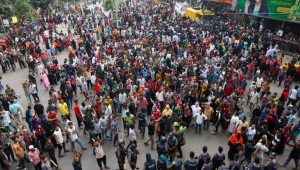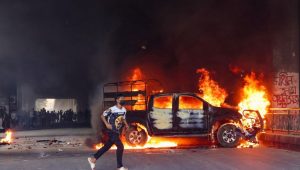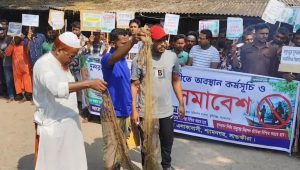



A familiar pattern is unfolding in Bangladesh’s garment sector. Workers demand a substantial wage increase, protests intensify and sometimes turn violent, and the eventual settlement falls well short of their demands.
This time, workers want the minimum monthly wage raised from Tk12,500 to Tk30,000. The government has announced the formation of a new minimum wage board, but factory owners have yet to submit a proposal.
Several factory owners told TIMES that an increase of this magnitude would be unrealistic, warning that even a much smaller rise could threaten factory operations.
The current minimum wage was set in December 2023, with operators in higher grades earning several thousand taka more than the Tk12,500 paid to helpers.
Under labour law, the government may direct the wage board to review and revise minimum wages every three years. A new board was therefore due to be formed.
However, four consecutive years of high inflation have placed workers under mounting financial pressure, prompting fresh demonstrations.
Smriti Akter, a leader of the Garment Workers Solidarity Federation in Gazipur, said workers could no longer make ends meet on their current wages. She also alleged that political elements might be influencing the protests.
“There is political instigation in the movement. Many people with bracelets on their hands and long hair have taken to the streets. They do not even have identity cards around their necks,” she told TIMES.
However, Smriti said neither she nor her organisation had demanded a specific minimum wage of Tk30,000.
“Neither I nor my organisation is demanding Tk30,000 or any particular amount. My position is that wages should be increased in line with the rise in living costs, calculated on the basis of current market prices and the research conducted by BILS, CPD and Asia Alliance in 2023.”
She pointed to rising household expenses in Gazipur, where many homes lack piped gas connections.
Cooking gas cylinders cost Tk2,200 to Tk2,500, while renting accommodation for a family of five costs at least Tk8,000, she said.
“How can people manage, even if two members of a family are employed?”

Medical expenses have also become difficult to meet.
“We receive Tk750 as a medical allowance, but a doctor’s consultation fee alone is Tk800 to Tk1,000,” she said.
Although Tk12,500 is the minimum wage for helpers, operators in higher grades receive between Tk13,550 and Tk15,035.
Their wages have risen somewhat over the past three years through an initial 5 per cent increment, followed by annual increments of 9 per cent.
Factory owners acknowledge the pressure of rising living costs but say any increase must be affordable enough to keep factories operating.
Several owners told TIMES they were prepared to raise wages, taking workers’ circumstances into account, but not to a level that would jeopardise their businesses.
Labour leaders, meanwhile, warned that a token increase could make the protests harder to contain. They called for a settlement that would protect workers’ livelihoods without making factories financially unviable.
The minimum wage board has yet to schedule its first formal meeting or invite proposals from either side.



One factory owner, speaking on condition of anonymity, warned of widespread closures if wages were increased sharply.
“I can guarantee you that if wages are increased by even Tk5,000, at least 800 factories will close within the next six months,” the owner told TIMES.
Former Bangladesh Garment Manufacturers and Exporters Association (BGMEA) president Faruque Hassan expressed similar concerns.
“Even if the minimum wage rises to Tk16,000 or Tk16,500, it will become difficult for us to operate. We will no longer be able to compete in the global market and will lose orders,” he said.
Bangladesh’s garment exports depend heavily on low-priced products, for which buyers offer limited scope to accommodate higher labour costs.
Factory owners also face rising electricity and gas tariffs, higher fuel and transport costs, and declining orders.
Concerns about the threat of war in Europe and a possible contraction in the US market because of the war involving Iran have added to their worries.
Bangladesh Knitwear Manufacturers and Exporters Association (BKMEA) President Mohammad Hatem said factory owners would assess how much wages could rise without disrupting factory operations.
“We will calculate how much wages can be increased while keeping factories operational and determine our proposal accordingly. At the same time, we will consider workers’ circumstances amid rising commodity prices. We will submit our proposal after taking everything into account,” he told TIMES.
Labour organisations want the new wage structure announced by December so that workers can receive higher pay from the beginning of the new year.
The wage board, however, says it cannot commit to a timetable before holding a meeting.
Bangladesh Garments and Sweaters Workers Trade Union Centre General Secretary Kazi Ruhul Amin warned that further delays could aggravate the unrest.
“The formation of the wage board is already six months overdue. If the new wage structure is not implemented by December, the situation could become even more complicated,” he told TIMES.
BGMEA representative on the wage board ABM Shamsuddin said a timely agreement would depend on the willingness of all parties.
“If everyone agrees, it will take five seconds to make this decision. But if they do not agree, it may not be implemented even in six months. Therefore, everyone must act responsibly in reaching a decision,” he said.
The history of garment wage negotiations shows how far apart workers’ demands and final settlements have often been.
The first minimum wage board for garment workers was formed in 1984, setting the minimum monthly wage at Tk627. Ten years later, it rose to Tk930.
In 2006, workers demanded Tk3,000 a month. Widespread protests, violence and clashes with police disrupted public life before the wage was eventually fixed at Tk1,662.50, which workers accepted.

In 2010, workers demanded Tk5,000, but the minimum wage was set at Tk3,000.
Three years later, workers sought Tk8,114. Following a series of demonstrations, the wage was fixed at Tk5,300.
In 2018, workers’ representatives on the wage board proposed Tk12,020, while several labour organisations demanded Tk16,000.
Factory owners initially offered Tk6,360. The eventual settlement was Tk8,000.
The gap remained substantial during the last revision in 2023.
Labour organisations demanded Tk25,000, while workers’ representatives on the wage board proposed Tk20,390. Factory owners initially offered Tk10,400.
The board eventually fixed the minimum wage at Tk12,500.
Workers protested against the decision, but the unrest gradually subsided.
The reported increases over previous wage levels were approximately 68 per cent in 1994, 79 per cent in 2006, 77 per cent in 2013, 51 per cent in 2018 and 56 per cent in 2023.
Under the current wage structure, garment workers are divided into four grades based on their positions and skills.
Helpers occupy the lowest grade, Grade 4, with a minimum monthly wage of Tk12,500.
The minimum wage is Tk15,035 for Grade 1, Tk14,273 for Grade 2 and Tk13,550 for Grade 3.
New or trainee workers generally enter at Grade 4.
Factory owners say a Grade 4 worker can earn around Tk18,000 to Tk20,000 a month by working two hours of overtime daily.
With attendance and incentive bonuses, monthly earnings can reach Tk20,000 to Tk22,000, according to the owners.
They also say Grade 4 workers are promoted to Grade 3 after six months, increasing their basic wages.
Workers employed as supervisors, operators and inspectors can earn between Tk25,000 and Tk35,000 a month, including additional payments.
Akter, however, presented a different picture of overtime earnings, saying helpers receive only around Tk3,000 extra for working 100 hours of overtime a month.