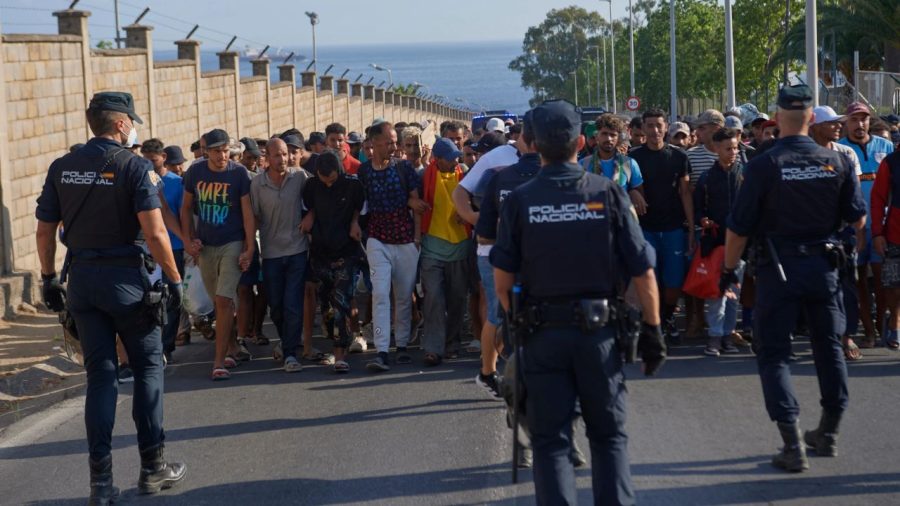



Spain is rushing to clear a backlog of thousands of migrants in its North African enclave of Ceuta, nearly three months after a chaotic mass border crossing on 30 July, and NGOs fear the shortcuts it is working on risk violating migrants’ rights, according to Reuters.
Prime Minister Pedro Sanchez’s government, under pressure from the EU and a frustrated public and facing a snap election on 29 November, is working on shortcuts for asylum applications so that most people can be sent home, mainly to Morocco, as economic migrants rather than genuine asylum-seekers.
Sanchez, one of Europe’s few remaining left-leaning leaders, said this week that Spain was managing the flood of cases “responsibly, with a sense of solidarity and respecting migrants’ human rights”.
Yet more than 20 interviews with migrants, lawyers, NGOs and security forces showed that many of those who remain have clear grounds for asylum or humanitarian protection.
They include unaccompanied minors, LGBT Moroccans who fear imprisonment if deported, and families classified as vulnerable under EU law.
Among them is Fatna, 21, who arrived heavily pregnant with her disabled son during the chaotic crossing, hoping to be high on the authorities’ list for help.
Her newborn daughter now has kidney problems, and the family urgently needs to reach mainland Spain for specialist hospital treatment.

But travelling while an asylum claim is under review requires a permit that Spain’s socialist government, ordinarily a staunch advocate of immigration, has been reluctant to grant to any of the thousands of migrants remaining in Ceuta.
Last week, eight charities including Oxfam and Amnesty International filed a complaint with Spain’s ombudsman alleging “grave rights violations” in the enclave, including forced returns of migrants from conflict-hit countries and denial of interpreters and legal assistance.
Government spokespeople did not respond to requests for comment on the accusations.
Right-wing and far-right parties, angered by the legal status granted to nearly 1 million irregular migrants earlier this year, have cast July’s crossing as a deliberate invasion by Morocco, which denies it, and demanded that all migrants be returned. Current rules, however, require case-by-case assessment.



While most migrants are Moroccan, the government estimated in August that more than 1,000 of those remaining came from sub-Saharan countries whose nationals are granted asylum in over 90 percent of cases in Spain.
The EU’s new pact requires border-zone processing for faster deportations but does not oblige applicants to stay where they arrived, allowing transfers elsewhere in Spain to ease pressure on Ceuta.
Such transfers are the “only option” for properly assessing vulnerable migrants’ cases, said Juan Miguel Morales, director-general of NGO Sur Acoge.
While 262 minors have been moved to the mainland since July, the government’s strategy for the remaining adults has been to convince as many as possible to return of their own volition.
It said this week that 12,000 had chosen to cross back since mid-August.
“There are no covert deportations under any circumstances,” Interior Minister Fernando Grande-Marlaska said, describing the returns as voluntary and adding that up to 1,200 asylum applications had been received and 700 resolved.
However, at least nine NGOs say migrants they support were coerced to return.
Asociación Elin said in the ombudsman complaint that Sudanese and Chadian migrants were summoned by police on 24 and 25 September and deported without warning.
In text messages to volunteers at German NGO Mission Lifeline, Moroccan migrant Azhaar Chaouni said he and others faced the same fate after police collected them in buses from beach camps and said they were being taken to reception centres.
“They deported us without explanation,” wrote Chaouni, who said he was in Morocco.
Frontline workers say Ceuta has exposed the EU pact’s 12-week limit for processing asylum claims as unrealistic.
Only around 100 cases were being registered daily by 14 October because of a lack of resources, from staff to working computers, said police union representative Raul Piera.
His union estimates 7,000-8,000 more migrants are still scattered across the city, sleeping rough or in charity-run facilities. “Looking at the remaining workload, this will last well into next summer,” Piera said.
Doctors at Ceuta’s only hospital are treating migrants for scabies, tuberculosis and gastrointestinal infections, and at least seven women have given birth.
Fatna and her husband Mohamed are desperate to stay in Spain, fearing for the baby and convinced their 3-year-old disabled son will die in Morocco.
“We are doing everything for our son,” Mohamed said.