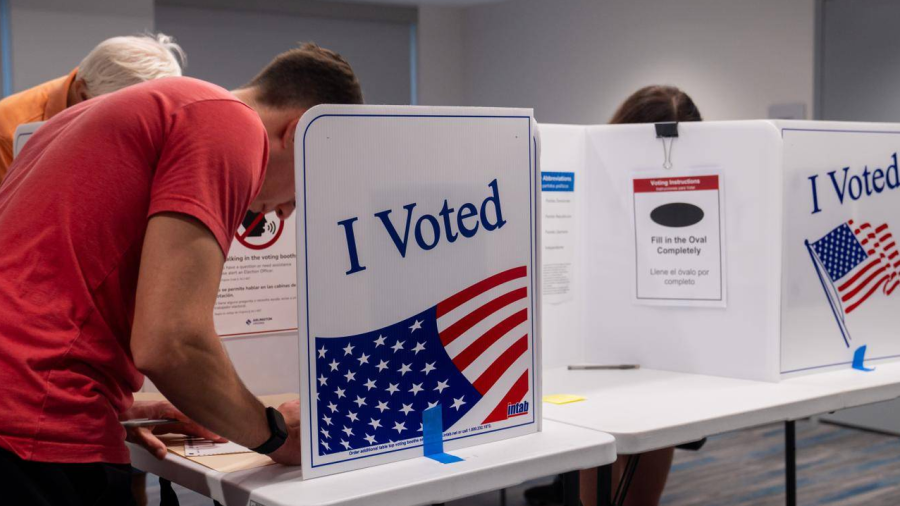



On November 3rd, the United States will hold a highly consequential midterm election. American voters will decide which party will control Congress. Historically, the incumbent party has lost at least one chamber of Congress in a midterm election. But this year, both chambers might shift power. Such a change can check and balance the executive branch vis-à-vis President Donald Trump. According to various polls, Trump’s job approval rating is currently hovering around 33%. This is an incredibly low number for a president to campaign with for hotly contested Republican candidates; many are therefore breaking from Trump. As a result, analysts predict a solid Democratic blue wave in Congress.
Two main factors are driving the blue wave: the unpopular Iran war and the economy. Nearly 70% of Americans oppose the Iran war. Since the war began in February, gas prices have been out of control. For example, a gallon of diesel now sells for an average of $6.38, compared with $3.52 before the war. As diesel prices keep rising, interstate and transborder shipping and delivery costs soar, and farmers are getting hammered with additional business expenses. All this translates into higher grocery bills and further strains already high living costs. Thus, when affordability becomes a serious challenge for ordinary Americans, the president and his party in Congress take a serious drubbing.
However, Republicans are deploying counterstrategies to sap Democratic momentum. For instance, the Republican Party recently held its midterm election convention in Dallas, Texas. At the gathering, Trump urged MAGA voters to show up and vote as if he were on the ballot. He often stokes fear among Republicans that if the Democrats win, they will turn America into a socialist country, reverse immigration policies, and erode law and order. Moreover, he sugar-coated a promise that is hard to ignore: a $5,000 ‘Trump Dividend’ for all Americans if the Republican Party wins the elections. It’s not an official US government policy; rather, it’s a win-at-all-costs strategy. Some call it bribery, while others see it as desperation.

Even after such a grandiose dividend offer, many Republican candidates are lagging or running neck and neck. This is telling: Kansas, Iowa, Alaska, and Texas have long been Republican strongholds, but they now face serious competition. For example, Kansas has not elected a Democratic Senator since 1932; nevertheless, Democratic candidate Adam Hamilton is deadlocked with incumbent Senator Roger Marshall. Alaska has been a red state; it has elected only one Democratic Senator in the past 50 years. Yet Republican Senator Dan Sullivan trails former Democratic representative Mary Peltola. Iowa has leaned Republican over the last decade. Still, Republican nominee Ashley Hinson trails Democrat Josh Turek for the state’s open Senate seat. Lastly, Texas, a Republican bastion that last elected a Democratic U.S. Senator in 1988, is witnessing a seismic change. Democrat James Talarico is leading Republican nominee Ken Paxton. This grim reality stems from Trump’s unpopular war and his mishandling of the economy.
On foreign policy, the midterm election is a pivot point in the war with Iran. Trump has reiterated that the war will end after the midterm election. Is there a viable diplomatic solution? That possibility remains unclear. What will he do after the midterm that he cannot do now? It’s hard to predict. But the US is currently deploying a 3rd aircraft carrier and 10,000 soldiers to the Middle East. Such a deployment signals a military buildup aimed at escalating attacks on Iran. An escalatory mission will push energy prices even higher, and scarcity will further dampen both the US and global economies.




If the Democrats take both chambers, Trump will effectively become a lame-duck president. For example, Congress might curb his war powers, leaving the president with limited authority to conduct military missions abroad without congressional authorisation. If the Iran war persists into January, Congress may force the administration to end it. The Ukraine-Russia war will also be affected by the midterms. Congress has little appetite left for providing Ukraine with financial support or military hardware. Additionally, Trump’s trade and tariff policies will be reassessed, as will US-Canada trade relations. The US political environment is changing rapidly. Accordingly, American public sentiment toward Israel has swung significantly since Israel’s genocidal operations in Gaza. As a result, legislative support for military and financial assistance to Israel may dwindle. That could rein in Israeli military operations in the Middle East.
Furthermore, the Democrats will likely launch a slew of congressional investigations. They may look into Trump-linked cryptocurrency firms; oil and gas companies for any special tax breaks; and war spending. They can use their subpoena power to compel government officials to testify before oversight and select committees. Congress may impeach Trump again, but that will be merely theoretical. It takes 67 Senate votes to impeach a president, and the Democrats cannot reach that number. However, the American people will demand an assertive and proactive Congress. Democrats should internalise that message. Otherwise, in the 2028 presidential election, they will bear the brunt of voters’ wrath.
For 2028 Republican presidential candidates, this midterm election is a yardstick for gauging patterns among American voters. For example, Vice President J.D. Vance, Secretary of State Marco Rubio, or a Trump family member as a potential presidential candidate must present and persuade voters of their distinct ways to lead the nation. It’s a quandary, though. On the one hand, if Trump’s low approval rating persists, engaging him in their presidential campaigns becomes a burden. On the other hand, support from Trump’s MAGA base would be crucial. Their success in winning the presidential election will largely depend on MAGA support. Hence, Trump’s endorsement is essential. This puzzle warrants a strategic and viable resolution. To do that, the Republican Party has to go back to the drawing board and chart a path forward.
Although it will be tempting, the Democratic congressional leadership should avoid legislative revenge or grandstanding. They have to do their jobs: be accountable to the public and hold the government accountable. Otherwise, the blue wave will undoubtedly turn red in the next election year. Therefore, this midterm election is monumental and deserves closer attention.
The views expressed in this article are solely those of the author
The writer is a Doctoral Researcher, International Relations, Universiti Sains Malaysia (USM)