



In a time of political decay and moral drought, some propose a dangerous hypothesis that religion is the root of our failures. The fusion of politics and faith has produced division, not unity. That communalism is religion’s inevitable child. This is a seductive but shallow reading of history. In truth, religion, when rightly understood and strictly practiced, is not the problem but the only enduring solution to Bangladesh’s chronic political illness.
Let us not conflate faith with fanaticism, nor confuse spiritual order with sectarian disorder. The corruption of religion into communalism is not a failure of faith, but of those who claim to represent it while pursuing power. Religion did not fail us; our deviation from it spawned the crises we now endure.
In our pursuit of modernity, we have exalted experiential knowledge, trial, error, observation, and science over wisdom revealed by the Divine. But can experience alone deliver a moral compass? Can it account for justice, compassion, and humility? No, because experience varies wildly from person to person, shaped by privilege, geography, and desire. A capitalist billionaire and a village farmer learn different truths through experience. Only revelation – stable, transcendent, and eternal – can anchor a society’s moral order.
Islam provides a code beyond conjecture, one that curbs the excesses of rulers and defends the dignity of the weak. The Torah and Bible echo this, offering divine laws meant to establish justice, not chaos. When rulers turn away from divine command, division festers. Pharaoh denied Moses not because he misunderstood him, but because he feared losing power. Every tyrant since has shared that fear. They fear not faith, but the accountability it demands.
Bangladesh, like much of South Asia, is still haunted by unspoken caste and class hierarchies. The ideology of secular governance has failed to dismantle them. Without a divine framework, power concentrates among a corrupt elite.

Religion offers what secularism lacks: a path to genuine equality. The Prophet Muhammad (peace be upon him) stood in front of his followers and declared, “No Arab is superior to a non-Arab, nor a white man to a black man, except in piety.” When Bilal, a formerly enslaved African, was made the first muezzin of Islam, it was not political theatre; it was divine justice enacted in human affairs.
Even today, we find practical models of this. In Malaysia, Islamic fusion with public life has provided social stability and uplifted a previously marginalised Malay population. Their Islamic financial system offers an ethical alternative to interest-based banking that enslaves people with low incomes. In Türkiye, though secularism was brutally enforced for decades, the recent resurgence of Islam in public discourse has not led to chaos; it has revived charity, education, and family values that secular systems failed to uphold.




Contrast this with Bangladesh. Here, religion is tolerated but never embraced in governance. As a result, we see rituals without responsibility, prayer without ethics, and politics without morality. We see a nation that fasts during Ramadan but schemes year-round. Where sermons are grand, but governance is grotesque.
The ruling classes have consistently used religion for their ends while ignoring its principles. During British colonialism, both Hindu and Muslim elites invoked religion to gather support, but never allowed their egalitarian spirit to influence land reforms or class relations. After independence, our leaders mouthed slogans of democracy and secularism while building dynasties. Even those who fought valiantly in the Liberation War misunderstood secularism to mean freedom for all religions to flourish side by side, without realising that this too can breed competitive sectarianism if not grounded in justice.
True secularism, as the West once conceived it, sought to restrain religious institutions from becoming centers of political power. But in our case, it turned into a pretext for moral anarchy. Religion was sidelined, not reformed; replaced, not reconciled. The result? A generation that is spiritually hollow, politically cynical, and economically oppressed. A society fragmented not because it is religious, but because its religion has been gutted, repackaged, and sold as ritualism rather than a system of life.
History shows us that when religion is sincerely followed, not politicised, societies prosper. The early Islamic caliphates saw unparalleled advancements in law, medicine, mathematics, and governance, all grounded in the belief that knowledge is sacred when it serves truth. Contrast this with modern systems based on human whim: what is legal today becomes immoral tomorrow; what is ethical now is scandalous next week.
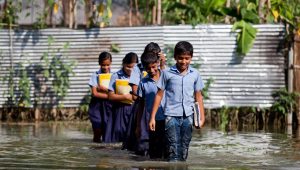
In Bangladesh, when religion has been practiced purely, it has healed. After the famine of 1974, it was not government aid but mosque-based charity that provided food for thousands. During floods and cyclones, religious organisations often arrive before state agencies. The Zakat system alone, if institutionalised, could eliminate poverty, yet it is sidelined as ‘personal faith.’
It is time to end this hypocrisy. Bangladesh does not need more slogans. It requires submission, not to politicians, not to parties, but to principles higher than all. It needs Islam not as a label but as a lifeline. It needs religion not as an ornament, but as an operating system.
If rulers fear God, they will not exploit man. If policies are based on divine justice, no child will beg on the streets while contractors siphon public funds. If leaders look to prophets rather than profiteers, no mother will mourn her son felled by police bullets in a protest for rice.
The path is not easy. But it is straight. It is narrow, but firm. It does not promise immediate wealth or power. It promises dignity. Bangladesh must return to its spiritual roots – not out of nostalgia, but for survival. The politics of revelation is not archaic – it is revolutionary. It is the only force strong enough to resist both corruption and collapse. The question is not whether religion can save our politics. The question is: what else ever has?
The views expressed in this article are solely those of the author
The writer is an Assistant Professor, English, IUBAT, and DRS, UPM, Malaysia. Email: [email protected]