


Bangladesh University of Engineering and Technology (BUET) has launched the Bangladesh Energy and Power Research Laboratory (BEPRL), aiming to create a national platform for applied research, collaboration and innovation as Bangladesh seeks solutions to challenges across its energy and power sector.
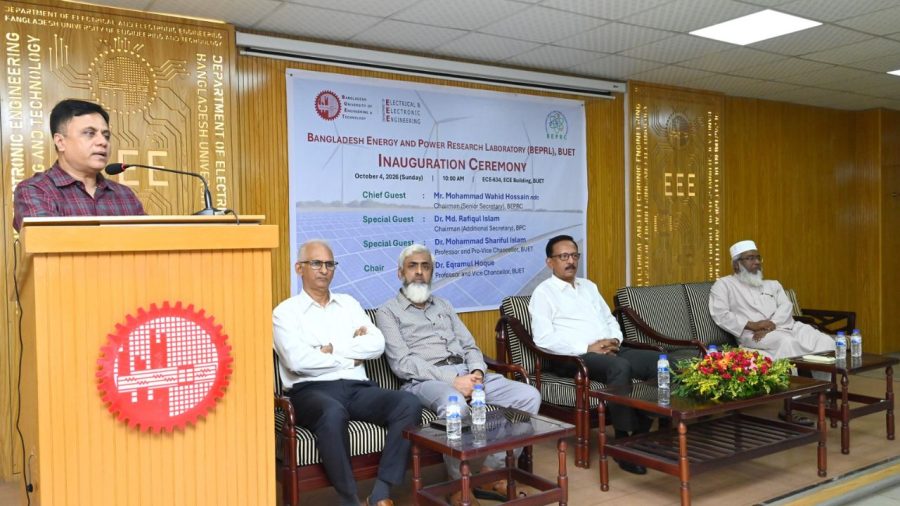
The laboratory, established at BUET with funding from the Bangladesh Energy and Power Research Council, was inaugurated on Sunday at the university’s Department of Electrical and Electronic Engineering in Dhaka. Researchers from BUET and other national and international institutions are expected to use the facility for work spanning power generation, energy storage, transmission, distribution and energy efficiency, BUET said in a press release.
Mohammad Shariful Islam, pro vice-chancellor of BUET, chaired the inauguration, while BEPRC Chairman and Senior Secretary Mohammad Wahid Hossain attended as chief guest.
Abdul Hasib Chowdhury, professor at BUET’s Department of Electrical and Electronic Engineering and former pro vice-chancellor of the university, attended as special guest.
Md Kamrul Hasan, dean of the Faculty of Electrical and Electronic Engineering, along with faculty members, researchers and officials from BUET and BEPRC, also attended.
Muhammad Anisuzzaman Talukder, who moderated the event, said efforts to establish the laboratory had been under way since 2021. BUET and BEPRC continued with the initiative despite institutional changes during the period.

He said the goal was to develop BEPRL into a globally competitive research facility where researchers from BUET and other institutions in Bangladesh and abroad could collaborate on energy and power challenges.
Kamrul Hasan said Bangladesh needed a dedicated energy and power research laboratory capable of supporting research tailored to the country’s needs in power generation, energy storage, transmission and distribution.
He also stressed greater sharing of research facilities, instruments and data.
Abdul Hasib Chowdhury said BEPRL should go beyond conventional academic research and contribute to addressing Bangladesh’s broader energy challenges.




He said the country’s relatively low per-capita energy consumption reflected the level of development across industrial, agricultural, transport and other economic sectors.
Improving energy efficiency across those sectors was necessary as global energy and fuel challenges increased, he said, expressing hope that BEPRL would contribute to the country’s advancement.
Shariful Islam described the establishment of what he called BUET’s first national-level research laboratory as a historic moment for the university.
He reaffirmed the university administration’s support for BEPRL and said the laboratory could harness Bangladesh’s skilled human resources to develop solutions to energy challenges and promote more efficient energy use.
Wahid Hossain stressed the need for BEPRC and BUET to use research to tackle practical national problems.
He said research should extend beyond publication in reputed journals and focus on solutions capable of delivering tangible benefits for the country.
Hossain also acknowledged the work of teams from BEPRC and BUET over the past five years in bringing the laboratory into operation.
He said BEPRL could help strengthen a culture of industry-funded research in Bangladesh by connecting academia, industry and government.
The laboratory is intended to serve energy and power researchers across the country and could be expanded as research needs grow, he said.
Hossain described BEPRL’s establishment as a watershed for Bangladesh’s energy and power sector and expressed optimism about continued cooperation between BEPRC and BUET.
Sharif Mohammad Mominuzzaman, professor and head of BUET’s Department of Electrical and Electronic Engineering and director of BEPRL, thanked those involved in establishing the facility.
He said the laboratory aimed to help bridge the gap between research and patents in Bangladesh by extending research towards useful technologies and intellectual property.
Mominuzzaman also stressed the need to strengthen the country’s energy infrastructure and research capacity to support continued economic growth.
BUET said the laboratory was expected to bring together researchers, academia, government and industry for collaborative and application-oriented work aimed at addressing emerging challenges and developing innovative and sustainable energy solutions for Bangladesh.