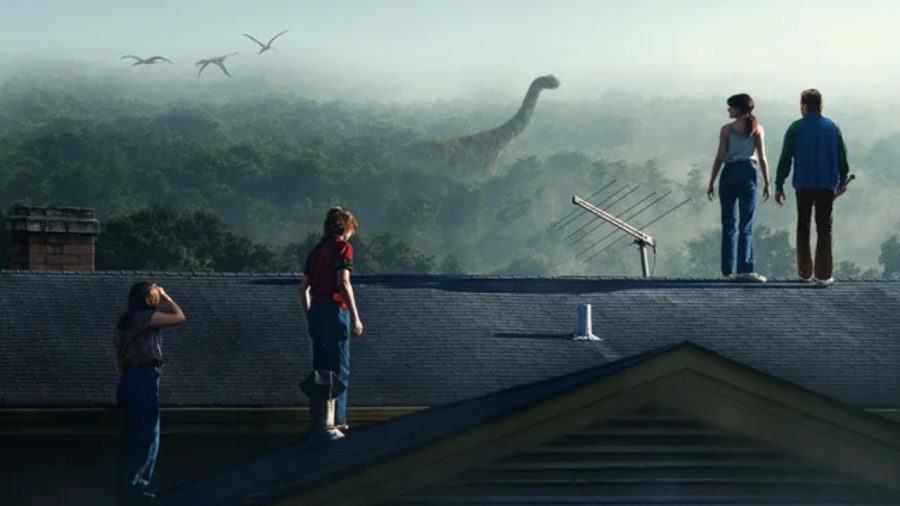

Since Jurassic Park turned dinosaurs into Hollywood’s reliable source of cinematic terror, filmmakers have tried to recapture its magic. The End of Oak Street does not imitate Spielberg’s classic outright. Instead, it asks: what happens when dinosaurs invade a suburban neighbourhood?
Set in 1982, David Robert Mitchell’s (It Follows) sci-fi thriller turns a street into a prehistoric battleground, mixing family drama, science fiction, survival horror and 1980s nostalgia.
At the centre is the Platt family. Denise (Anne Hathaway) and Greg (Ewan McGregor) are struggling with their marriage, while their children Audrey (Maisy Stella) and Brian (Christian Convery) face problems of their own. Their tensions seem ordinary until prehistoric creatures suddenly appear.
That setting is a smart idea. Instead of a remote jungle or theme-park fences, Mitchell brings dinosaurs to a suburban street, making familiar homes and routines unsettling once something enormous starts moving through them.

Once the dinosaurs arrive, the film shifts gears. The attacks are tense, the action energetic and several encounters deliver surprises. The creatures are clearly the stars.
The screenplay is less convincing in the family drama. The Platts’ problems occasionally feel thin or overly dramatic, while some character decisions seem designed mainly to put them in the path of another dinosaur. The troubled marriage also struggles to find a satisfying emotional payoff.




The explanation for the invasion is ambitious, but its unusual time-warp element does not always fit comfortably with the grounded family story. The mix of family adventure and survival horror can feel uneven, but the premise keeps the audience curious.
Hathaway is effective as Denise, bringing determination and emotional conviction to a mother protecting her children. McGregor gives Greg an appealing vulnerability despite his shortcomings. Stella and Convery add warmth despite limited material.
The 1980s setting adds personality. Songs such as Steve Winwood’s Valerie and Roxy Music’s More Than This complement the period mood, while Michael Giacchino’s original score energises the action and heightens tension during dinosaur attacks.
And then there are the dinosaurs. They range from small, feathered predators to enormous reptiles. Some feature hair and feathers for a more historically informed look. For viewers accustomed to Jurassic Park, this may take getting used to, but gives Mitchell’s creatures a distinct identity.
Some green-screen work is noticeable, and a few camera choices feel oddly placed. These shortcomings occasionally disrupt the world, but rarely overwhelm the pleasure of watching dinosaurs tear through an ordinary neighbourhood.
That contrast gives The End of Oak Street its charm: creatures associated with lost islands, laboratories or theme parks are placed among family homes and streets, making the premise frightening and entertaining.
The End of Oak Street is not another Jurassic Park, and its strength lies in not trying too hard to be one. Its family drama is uneven, but when dinosaurs take over the neighbourhood, it becomes a lively, old-fashioned creature film with enough scares, spectacle and 1980s charm to keep the ride moving.