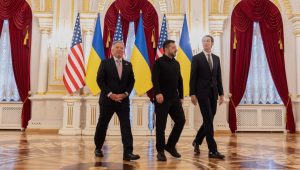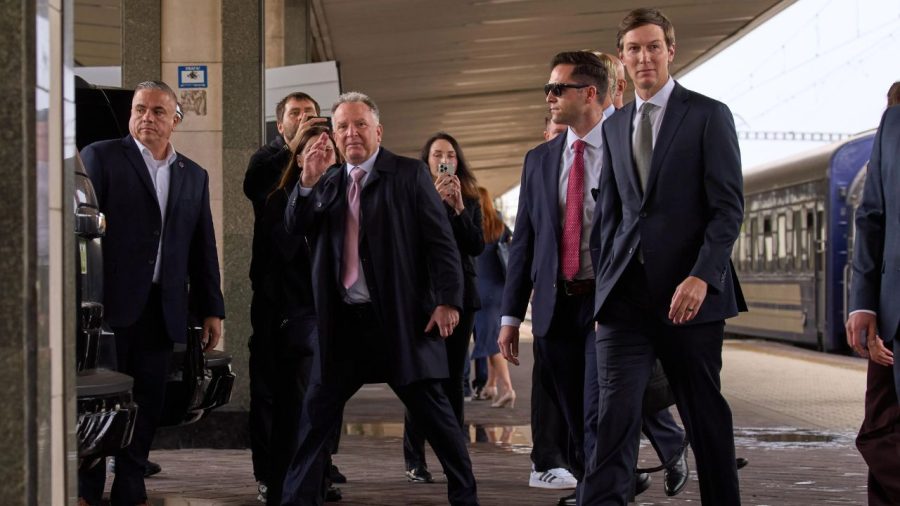

US envoys Jared Kushner and Steve Witkoff met Ukrainian President Volodymyr Zelenskiyy and senior officials in Kyiv on Sunday, as the Trump administration renewed efforts to end Russia’s four-and-a-half-year war in Ukraine.
The visit marked the envoys’ first trip to the Ukrainian capital in their roles as US negotiators, having previously travelled to Moscow several times for talks with Russian President Vladimir Putin, reports AP.
Kushner and Witkoff arrived in Kyiv directly from Moscow, where they had spent three hours in talks with Putin on Saturday without reaching an apparent breakthrough.
A White House official said further steps in the process would be outlined in the coming weeks, while Putin was reported to have found Saturday’s discussions constructive.
Previous rounds of US-mediated negotiations, encouraged by President Donald Trump, who had pledged a swift resolution to the conflict, have produced limited results.

Trump indicated on Friday that Washington had prepared a new proposal but gave no further details.
The envoys held their Kyiv meetings alongside other senior Ukrainian officials in the centre of the capital.
A source familiar with the matter said national security advisers from Britain, France and Germany were also in Kyiv on Sunday, though it was not confirmed which discussions they joined.
Zelenskiy regards Washington’s involvement as central to any lasting settlement and has warned that a limited window exists to secure peace before US political attention shifts towards its next presidential election cycle next summer.


Ahead of the envoys’ arrival, he said on social media that he had convened his negotiating team beforehand and reaffirmed Ukraine’s desire to end the war, stating that “security guarantees are needed” and that “a dignified post-war peace is needed”, adding that Kyiv’s proposals had already been prepared.
On the streets of Kyiv, a city that has endured heavy bombardment in recent weeks, reaction to the visit was cautiously hopeful.
A military veteran who took part in the fighting said he believed the war could be brought to a swift end and stressed the urgent need for peace, drawing on his own experience of combat.
A young cafe worker separately called for any agreement to be durable and lasting, appealing for Ukraine simply to be allowed to live in peace.
Despite the diplomatic push, the two sides remain divided on core issues, particularly the future of the eastern Donbas region.
Moscow has demanded that Ukrainian forces withdraw from territory they still hold there, a demand Kyiv has rejected, arguing it can continue to defend the area.
For Ukraine, binding security guarantees from the United States and European allies remain essential to deterring any future Russian aggression.
Although the front line, stretching some 1,200 kilometres, has remained largely static, both sides have escalated long-range aerial strikes in recent weeks.
Russia has bombarded Kyiv intensively over the past fortnight, including a drone strike on Friday that hit the headquarters of Ukraine’s SBU security service.
The Kremlin said it would suspend strikes on Kyiv until Monday, a pause Zelenskiy said Ukraine would reciprocate by halting attacks on Moscow. Fighting nonetheless continued elsewhere along the front, with Russia striking other Ukrainian cities on Saturday.
Ukraine, meanwhile, has spent the summer targeting Russian refineries, oil terminals and logistics hubs, including facilities used by online retailer Wildberries, in an effort to raise the economic cost of the war for Moscow.
On Sunday, Ukraine said it had struck the Ryazan oil refinery, roughly 480 kilometres inside Russian territory, sparking a fire.