
Germany’s far-right Alternative for Germany (AfD) has secured a sweeping victory in the eastern state of Saxony-Anhalt, emerging far ahead of its mainstream political rivals and claiming a clear mandate to govern.
With most interim results counted, the AfD is projected to win 44 per cent of the vote, more than twice its share in the 2021 election. The conservative Christian Democratic Union (CDU), meanwhile, suffered a major setback, falling to 17 per cent, reports BBC.
The result marks a historic moment for Germany, as no far-right party has controlled a German state since the Second World War. State governments have significant powers over policing, local education and cultural affairs. Saxony-Anhalt has a population of about 2.1 million.
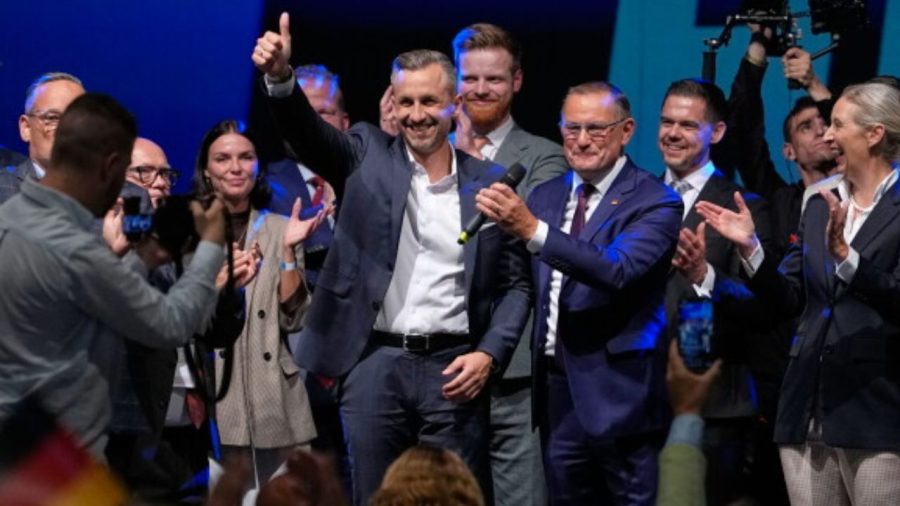
Ulrich Siegmund, the 35-year-old AfD leader in Saxony-Anhalt, described the result as “sensational” and said the party intended to begin governing as soon as possible.
National AfD co-leaders Alice Weidel and Tino Chrupalla also joined celebrations after exit polls indicated a landslide.
“This isn’t just about Saxony-Anhalt,” Siegmund told supporters at the party’s election night headquarters. “It’s a signal for the whole of Germany – a self-confident signal.”
The result prompted widespread shock across Germany, with commentators and political opponents describing it as a major political watershed.
Germany’s main television channel, Das Erste, even cancelled its long-running crime drama Tatort to focus on the election and its implications.

The AfD is projected to win 39 of the state parliament’s 83 seats, leaving it three short of the 42 needed for an outright majority. The national leaders have raised the possibility of a minority government, but Siegmund has so far rejected the idea.
“If necessary there’ll just be new elections, then we’d just get 50 or 55%,” he said, while adding that he remained willing to work with individual MPs or another party.
The newly formed BSW also secured enough votes to cross the 5 per cent threshold required to enter parliament. Had it failed to do so, the AfD’s chances of obtaining a majority would have increased.
Mainstream political parties maintain a strict Brandmauer, or firewall, against forming coalitions with the far right. The BSW, however, has indicated that it is willing to co-operate with the AfD on specific issues.
International reaction
The result also drew international attention. US President Donald Trump shared a screenshot of the German television projection on his Truth Social platform.
Russian presidential envoy Kirill Dmitriev later shared a screenshot of Trump’s post and praised what he called a “historic win for the pragmatic AfD”. Dmitriev had previously described the Russia-friendly party as “the party of hope and reason, co-operation truth and hope for Germany”.


Before Germany’s federal election last year, US Vice-President JD Vance endorsed the AfD, prompting strong criticism in Germany over what was seen as external political interference.
Poland’s centre-right Prime Minister Donald Tusk condemned the result, saying, “in Poland only idiots and traitors can rejoice at the triumph of the AfD.”
Shock for Germany’s mainstream parties
Germany’s centre-left Social Democratic Party (SPD) described the result as “truly dramatic”.
Lars Klingbeil, national leader of the SPD, which governs at the federal level in coalition with the CDU, called the result an unmistakable “signal to Berlin” and said the federal government would have to listen to it.
Sven Schulze, the CDU leader in Saxony-Anhalt, conceded defeat as his party’s share of the conservative vote fell by more than half compared with the previous election.
“This was an extremely tough and intensive election campaign,” Schulze said, adding that his party would have to face the reality of the result.
Divided electorate
Voter turnout reached an unusually high 76.7 per cent, highlighting the intense political divisions within the state.
AfD supporters in Magdeburg praised Siegmund for connecting with ordinary people. A local voter, Ollie, told reporters: “This man gives us what no-one else can give… This is a party for the working people.”
Another voter, Bert, a father of three, expressed concerns about the situation in eastern Germany, saying people could sense that things were going badly and that he feared public safety was deteriorating.
The political shift also sparked strong opposition. On the eve of the election, demonstrators gathered at a “Democracy Festival” in Magdeburg.
One demonstrator, Nikita, said, “learn from our history and not go back. We don’t want the dark times any more.”
Charlotte Knobloch, a 93-year-old Holocaust survivor and veteran head of the Jewish community in Munich and Bavaria, said she was frightened by the result.
“On days like this I find it hard to recognise my homeland any more,” she said, urging mainstream parties to act to prevent “this decline.”
AfD policies spark controversy
The AfD currently leads national opinion polls ahead of Chancellor Friedrich Merz’s ruling conservatives and the SPD, although its strongest support remains concentrated in eastern Germany.
The party previously won the 2024 state election in neighbouring Thuringia but did not secure enough seats to form a government.
Germany’s domestic intelligence services officially classify the AfD’s state branch as “right-wing extremist”, a designation Siegmund rejects.
One of the party’s most controversial national policies is its proposal for “remigration”, which is widely understood as involving the mass deportation of migrants. The AfD disputes that interpretation, saying the policy concerns only criminals and people living in Germany illegally. It also acknowledges that a state government would not have the federal authority to implement such measures.
The party’s influence at state level nevertheless remains significant. Its local branch has faced strong criticism for opposing the Bauhaus school of design in Dessau, which was closed by the Nazi regime in 1933.
The AfD has described the school as “the dead-end of modernism”, prompting accusations that it is using language associated with National Socialism.
Another controversy involves Hans-Thomas Tillschneider, one of the AfD’s leading figures in Saxony-Anhalt, who has faced criticism over his position on Russia.
Asked about a Russian army mug in his office, Tillschneider dismissed it as a souvenir and said: “it’s not our war.”