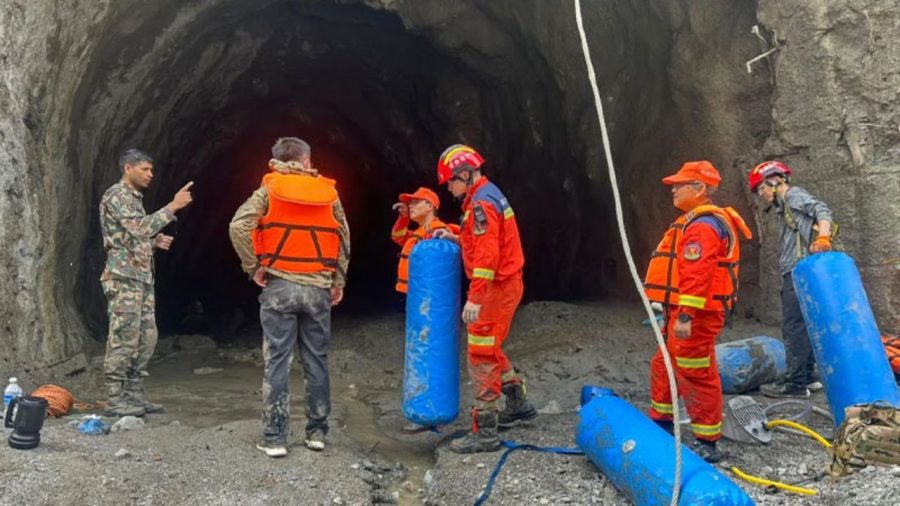



Two hydropower workers have been rescued alive after being trapped for nine days inside the flooded underground structures of Nepal’s Upper Trishuli 3A hydropower project.
The mechanical foreman and supervisor were saved on Friday following an intensive search operation that also retrieved the body of one deceased colleague, reports Kathmandu Post.
The rescue comes as Nepal reels from one of its worst disasters in years, with the total national flood death toll rising to 1,287, following initial flash floods on 26 August that killed at least 95 people and left nearly 400 missing.
The survivors have been identified as Sanjay Sah, a 30-year-old foreman for the Nepal Electricity Authority (NEA) from Saptari district, and Kabir Maharjan, supervisor for a hydropower automation project from Kirtipur, Kathmandu.
Maharjan, who has worked for the NEA for more than 15 years, had travelled to the project from the Kulekhani hydropower project for scheduled maintenance work.

Sacrifice and survival underground
On 26 August, Sah was on shift in the control room when the Bhotekoshi river flooded the facility.
Rather than escaping immediately, Sah prioritised saving his colleagues, prompting 40 to 45 people present in the area – far exceeding the usual operational shift of five or six workers – to flee. His efforts to save others cost him his own window of escape.


Trapped underground, Sah spent his days chanting prayers beside the powerhouse. His last contact with his family was a brief three-minute phone call with his sister, Sudha, shortly before the flood at approximately 7am on 26 August.
Maharjan had entered the tunnel on the morning of 26 August after having breakfast, warning his wife, Hira Shobha, that his mobile phone would lose reception underground. After nine days of silence, Maharjan was rescued in a serious condition with a leg injury.
He is currently receiving treatment in the intensive care unit at Birendra Army Hospital in Chhauni, Kathmandu, where he was flown alongside Sah, who remains in a stable condition. Shobha, who visited her husband in the hospital, expressed relief that he was given a second life.
Extreme rescue conditions, mounting economic toll
The hazardous rescue operation was carried out by the Nepali Army and the Armed Police Force (APF), alongside the Nepal Police, technical specialists, and foreign rescue teams.
Armed Police Force member Ambar Mahat detailed how a seven-member Collapsed Structure Search and Rescue (CSSR) team, led by Head Constable Pawan Bahadur Tamang, crawled through thick mud, sludge, and fallen rocks for 15 to 20 minutes to reach the survivors.
High water pressure had caused concrete slabs above the tunnel to collapse, complicating the search.
Following reports from the CSSR team and the Nepali Army that they had reached the deepest point of the tunnel and found no other survivors, Upper Trishuli Hydropower Station chief Aabhash Ojha suggested calling off the search.
Nepali Army spokesperson Rajaram Basnet confirmed that only one deceased worker was recovered on the lowest floor. Station staff are scheduled to inspect the site before a final decision on halting the search is made.
The 26 August flash flood caused widespread damage across multiple regional plants, affecting 42 workers at Upper Trishuli 3A, 557 at Upper Trishuli 1, 191 at Upper Trishuli 3B, and 93 at Rasuwagadhi.
With multiple power stations devastated, the Nepalese government is currently conducting assessments, with initial estimates suggesting that Bhotekoshi flood reconstruction could cost up to $5 billion.