


Global solidarity refers to a simple idea that people, communities, and nations owe something to one another across borders. An injustice suffered by one group is everyone’s concern, not a local footnote to sympathise with from a distance. UN Human Rights Office frames it, denoting that meaningful human rights realisation depends on genuine international cooperation, not goodwill dispensed at the margins. Realistically, the idea rejects a top-down, charity-shaped relationship among nations in favour of mutual struggle; people standing with each other, not simply for each other, across the resource gap between the Global North and the Global South.
That is the philosophy on paper. Looking honestly at how the world behaves, we are more skeptical. The world does not have a shortage of resources: food, water, energy, land, capital. What it has is an imbalance in who holds them. Some parts of the world sit on a surplus large enough to waste, while others go without the basics – not because those basics do not exist, but because they were never shared to begin with. Solidarity as currently practiced lets the powerful declare the principle while holding onto the resources, leaving the less powerful expected to believe in it anyway. This piece looks at that gap, with attention to South Asia, and what it means for the young people building a life inside it.
The clearest place to see this gap is in who gets to decide how the world’s resources move. In climate negotiations, emissions targets, adaptation finance, the loss and damage fund, it’s rarely the most vulnerable nations who get the final say. That power sits, instead, with the countries that did the most polluting to begin with. The IMF and the World Bank work on a similar logic. Your voice in the room depends on how much money you put in, not how many people you represent or how badly you need the help. The World Trade Organisation carries its own version: agenda-setting has historically happened among a small circle of powerful blocks, with the rest of the membership handing a finished deal rather than a seat in the room. None of this gets framed as hoarding; it is usually called ‘Neutral Policy’ or ‘Technical Negotiation’. But the effect is identical: one part of the world keeps more than it needs, another makes do with less, and the arrangement gets described as ‘Balanced’.

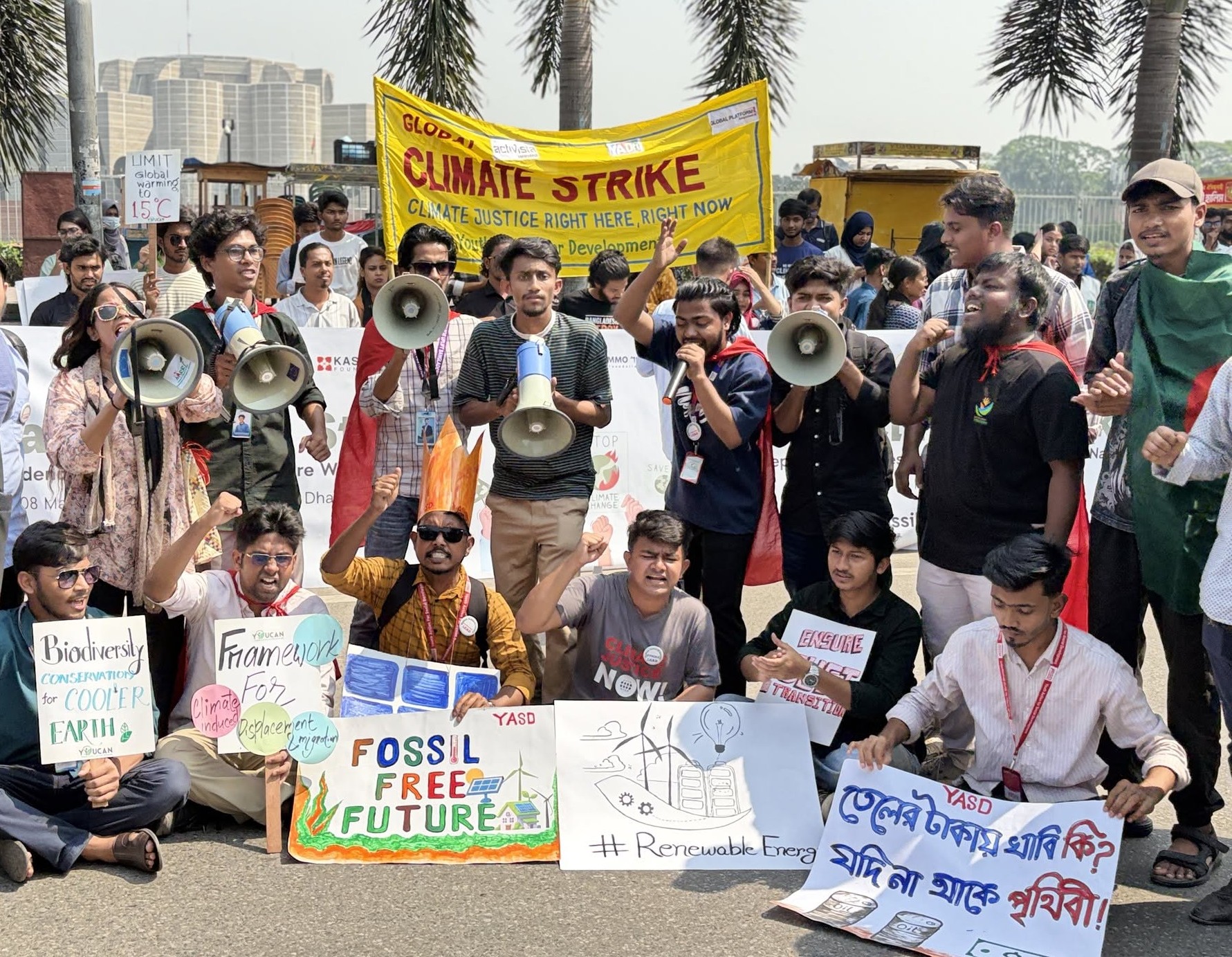
This is not only an abstract governance problem; it is a youth problem. Decisions made in these rooms, i.e., how climate debt gets structured, whose emissions get subsidised, whose quota decides whose vote counts, carry consequences that will play out over decades, made by negotiators who will not live with the outcome. Young people across today’s Global South will spend the next fifty or sixty years inside whatever arrangement gets settled now, in institutions where they hold no vote. In most of the countries carrying this imbalance, young people are the majority, not a footnote. Bangladesh’s population, like most of South Asia, skews young. Which means decisions being made right now-about debt, about climate finance, about who gets access to what-are decisions about young people’s futures, made almost entirely without them in the room.
This is where solidarity and youth meet directly, because it is young people who inherit that contradiction. A young person in a least developed country should not have to appeal to the goodwill of donor capital to access clean water, education, or a stable climate. These aren’t privileges handed out as generosity. They are basic human needs. And access to them is a basic human right, no matter where a person happens to be born. Seen this way, global solidarity stops being about one part of the world swooping in to rescue another. It becomes about every part of the world finally sharing what it already has enough of, an obligation owed equally to a young man in Dhaka, a gender-diverse youth navigating stigma, a grassroots organiser without transport to a training venue, a young pregnant woman from a remote char without a health facility, and a person with disability working around infrastructure never built with them in mind.



For refugees and stateless youth, this contradiction sharpens into erasure. Take a Rohingya youth in Cox’s Bazar, or really any young person without a recognised nationality. They’re not just facing unequal access to resources. They’re facing a system that hasn’t even decided, one way or another, whether they’re owed access in the first place. No citizenship means no clear path to education past a certain grade. It means formal work is out of reach, or barely in reach. Movement is restricted. Legal identity itself is either withheld outright or handed over in some limited, provisional form that can be taken back. Their future is left undefined by designing a life held in suspension, waiting on a status that may never resolve. If global solidarity has a floor, it should be this: no young person’s future should be treated as indefinitely postponable simply because their birth left them without a state to claim them.
Understood this way, young people do not experience solidarity as an abstract diplomatic term. They experience it as a plain, practical question: is anyone holding more than they need share it, because of what is happening to us? Sitting at the table with local authorities on their own terms, reclaiming what was taken, and documenting their own realities instead of waiting for someone else to even notice.
If global solidarity is going to mean anything beyond a slogan, it must be measured by what moves. Water. Finance. Land. Opportunity. Voice. Whether these things flow toward the people who go without, instead of piling up where there’s already surplus. None of this requires inventing some new theory of solidarity. The theory already exists. It’s sitting right there, on paper, in every strategy document and every summit declaration ever written. What’s missing isn’t the idea. It’s the will to share what’s already been claimed as principle.
Until that changes, young people, including those without a state to call their own, will keep building what the world promised but never delivered. It is worth saying plainly, one more time: this was never a request for charity. It is a claim to what was always meant to be shared, a fair portion of a world that has enough, a genuine seat at the table, and the basic conditions of a dignified life, owed to every young person simply as a global citizen.
Both writers are Development Professionals in the youth development sector