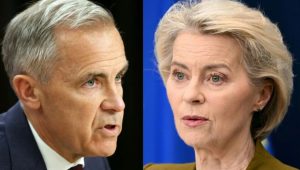
Canada will not distribute toll profits from the new $4.7 billion Gordie Howe bridge to the United States until its full construction investment has been recovered, Prime Minister Mark Carney announced on Thursday.
The bridge, which connects Windsor, Ontario, to Detroit, Michigan, is scheduled for a 27 July opening. The project’s delays have recently strained relations between the two countries, coinciding with talks for a new trade treaty and American dissatisfaction regarding Canada’s response to forest fires, reports Reuters.
Addressing the media, Carney maintained that the core 2012 pact with Michigan, whereby Canada financed the project in exchange for initial toll rights, remains in effect. “Any sharing of the toll revenue won’t happen until all of the debt is repaid,” he mentioned.

Under the terms, once the construction debt is cleared, Canada will divide net profits equally with the US for the subsequent 15 years. These payments will be calculated after subtracting maintenance costs, such as snow removal. Carney predicted “modest” net gains in the initial years and noted that any American share must be reinvested into economic development.
Though the full text of the bilateral agreement is not public, reports suggest the US will receive a 50 per cent profit share and has the authority to block toll hikes higher than 10 per cent.



The prime minister’s comments follow a claim by US President Donald Trump last week that he had brokered a “much better deal” for America. However, the agreement has drawn fire from Canadian critics. Conservative MP Shuvaloy Majumdar condemned the arrangement as a “terrible deal,” demanding that the government release a full accounting of what was “given away”.
Conversely, Fen Hampson, an international affairs professor at Carleton University, argued the deal represents a Canadian triumph. He noted that “the math” suggests very little revenue will be left to divide after the debt is repaid.
Hampson further observed that letting Trump believe he had secured a win was a strategic move to prevent “vindictive” behaviour from the US president.
The bridge dispute has also been linked to criticism from Michigan Republicans regarding Canadian wildfire management. State Representatives Jack Bergman, John James, Lisa McClain, and John Moolenaar accused the Canadian government of failing to sufficiently fund forest thinning and arson prevention as smoke reaches the US.
Carney dismissed these complaints, asserting that the United States must do more to address the underlying issue of climate change. “Climate change is the responsibility of everyone, really, everyone, including the United States,” he concluded.