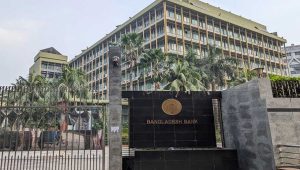
Just months after emerging as one of the few recovery stories in the country’s troubled banking sector, Islami Bank has plunged back into crisis, prompting Bangladesh Bank to inject emergency liquidity, dissolve its board and take direct control following a sharp deposit flight.
Economists say the turmoil now engulfing the country’s largest Shariah-based bank is not primarily driven by bad loans, hidden losses or a sudden deterioration in fundamentals.
Instead, they argue it has become a crisis of confidence — one that could have been avoided.
Bangladesh Bank Assistant Spokesperson Mohammad Shahriar Siddiqui told TIMES of Bangladesh that a new board would be formed within two to three days after necessary scrutiny.
Until then, the powers of the board will remain with an official appointed by the central bank.
“There was a problem with the board. It has been dissolved. Necessary liquidity support is being provided. The bank has been given Tk5,000 crore in two days,” he said.
The episode is seen by banking analysts as an early test of the government’s pledge to reform the banking sector and rebuild trust after years of governance failures, political interference and financial irregularities.
“We have witnessed a self-inflicted wound in the banking sector,” said Ashikur Rahman, principal economist at the Policy Research Institute, speaking to TIMES.
“After 2024, the bank had largely recovered from the risk of a bank run. Depositor confidence was returning, and deposit growth had risen from around 6 per cent to nearly 12 per cent. Yet at this stage, a series of self-defeating decisions were taken.”
The scale of withdrawals shows how quickly confidence unravelled.

According to bank officials, around Tk9,300 crore in net deposits left Islami Bank between 1 and 14 June, prompting it to seek Tk10,000 crore in emergency liquidity support from Bangladesh Bank.
The central bank initially responded with Tk2,500 crore in assistance, appointed an observer and held crisis talks with senior management before dissolving the entire board, including Chairman Md Khurshid Alam, on Sunday night.
Under the Bank Company Act, Bangladesh Bank Executive Director Mohammad Zahir Hussain has been vested with board-level powers.
Speaking to TIMES on Monday, Zahir Hussain said the immediate priority was to stabilise the institution, restore depositor confidence and ensure normal operations.
“We are taking all necessary measures to ensure that the bank’s activities continue normally,” he said.
The move follows a period of apparent recovery after the end of S Alam Group’s control, when deposits had begun to return and confidence gradually improved.



However, that recovery rested on fragile foundations.
The immediate trigger for the latest turmoil was a leadership dispute that quickly escalated into a broader confrontation over governance and control.
After Chairman M Zubaidur Rahman resigned on 24 May, Bangladesh Bank appointed former deputy governor Md Khurshid Alam as chairman, and the board accepted the resignation of Managing Director Omar Faruk Khan.
Following the Eid holidays, the Jamaat-e-Islami-backed Islami Bank Conscious Customers Forum launched protests demanding Alam’s removal and Khan’s reinstatement, coinciding with accelerating withdrawals.
Economist Ashikur Rahman argued that the crisis reflected deeper uncertainty over ownership and governance rather than street protests alone.
“An opportunity was created for previous owners to return through the Bank Resolution Act. At the same time, attempts were made to capture Islami Bank again. What we saw was a self-inflicted wound that damaged depositor confidence,” he said.
“Ultimately, ordinary people will bear the cost.”
He warned that the implications extend far beyond a single institution.
“If confidence in the banking sector is not there, how will investment be mobilised?” he asked, noting that Bangladesh’s ambition of becoming a one-trillion-dollar economy depends on a trusted financial system.
Zahid Hussain, former lead economist at the World Bank’s Dhaka office, said Bangladesh Bank must also accept responsibility.
“The instability around Islami Bank and the deterioration in its financial position due to panic withdrawals ultimately falls under the responsibility of Bangladesh Bank as the regulator,” he said.
While the central bank maintains that Islami Bank remains stable, he warned that dissolving the board is not a permanent solution.
“The real challenge is restoring depositor confidence. Administrative changes alone will not resolve the problem.”
The Islami Bank Conscious Customers Forum, however, criticised the central bank’s intervention.
At a press conference on Monday, convener Nurnabi Manik said the group’s demand had been the removal of Khurshid Alam and reinstatement of former Managing Director Omar Faruk Khan, but argued that power had instead been concentrated in a single individual after the board’s dissolution.
“That is not safe for a financial institution in any way,” he said, while welcoming the liquidity support and removal of Alam.
Signs of stabilisation, however, are beginning to emerge.
Acting Managing Director Altaf Hossain told TIMES that withdrawal pressure had fallen by about half on Monday, as many customers refrained from withdrawing funds after the board was dissolved.
“Most of them felt reassured and left without withdrawing their money,” he said.
He added that the bank had not needed to fully utilise the liquidity support provided by Bangladesh Bank.
The stakes extend well beyond a single institution.
Islami Bank holds about 8.7 per cent of Bangladesh’s banking assets, while Association of Bankers Bangladesh Chairman Mashrur Arefin has warned that the crisis is already affecting the wider financial sector and requires swift resolution.
The broader banking system remains fragile, with non-performing loans standing at Tk 588,704 crore, or 32.26 per cent of total outstanding loans, and private-sector credit growth at historic lows.
For economists, the episode is ultimately a warning about the cost of mixing politics and banking.
“The banking sector must never become a political battleground,” Ashikur Rahman said.
“The previous government made that mistake, and the public is still paying the price. The new government should not repeat it.”